Business Automation Consultant: What to Fix Before Automating More Work
Repetitive work can quietly take over a business.
Employees copy information between systems, send the same follow-up messages, update spreadsheets, handle client onboarding, check task statuses, and remind coworkers about overdue work. Each task may take only a few minutes, but together they create manual effort, manual coordination, and repetitive tasks that leave many businesses losing time every week.
The usual response is to buy another tool or automate the first task that appears slow. That often creates more complexity when the process behind the task is unclear, handoffs break, or data quality is inconsistent. A faster broken process is still a broken process, and poor automation can spread confusion, reduce customer experience, and make reducing errors harder instead of easier.
A business automation consultant—or, for a growing company, a small business automation consultant—helps business owners and operations leaders identify bottlenecks and fix the workflow before adding more automation tools. Masterly Tech starts with a process audit to build a clear picture of how work moves across the organization, where delays happen, and which steps need human judgment, technical expertise, system integration, or change management before automated workflows are put in place.
This page explains why automation efforts fail, how the right tools and connected workflows improve reliability with fewer errors, where crm automation and other practical opportunities can save time for small teams and small business operations, and how ongoing optimization, employee adoption, and measuring results help most small businesses automate in ways that match real market demands and help them stay ahead.
The goal is not to automate everything. It is to build a practical business system that helps people complete work accurately, consistently, and on time.
When Manual Work Starts Limiting Growth
Many businesses start with quick manual fixes and end up losing time as those workarounds pile up. A spreadsheet tracks requests. An employee sends reminders. A manager checks each project. Someone copies customer information from one platform into another.
These temporary solutions may work when the business is small. As the company grows, the same process becomes harder to manage.
Common warning signs include:
- Employees entering the same information more than once
- Customer requests waiting for manual review
- Important tasks depending on one person’s memory
- Follow-up messages being sent late or not at all
- Teams using separate spreadsheets for the same process
- Managers asking for status updates that should already be visible
- Customer information being stored in disconnected systems
- Work being delayed during vacations or staff changes
- Reports requiring hours of manual preparation
- Employees creating their own workarounds
These issues limit a small business by increasing manual coordination and repetitive tasks. They also make it harder to serve customers and manage the business, while increasing the chance of mistakes, missed deadlines, and uneven service.
Why Automation Projects Fail
Automation projects often fail because automation efforts start with software before the process is clear enough to support it.
A platform may offer forms, notifications, approvals, integrations, and artificial intelligence features. Those features can be useful, but they cannot decide how the business should operate.
Before automation can work well, the company needs clear answers to important questions:
- What starts the process?
- What information is needed?
- Who owns each stage?
- What decisions require approval?
- Where should information be stored?
- When should a customer receive an update?
- What happens when a task is late?
- Which exceptions require human review?
- How should completion be measured?
If these questions are not answered, automation can create confusion at a faster speed. Tasks may be assigned to the wrong person. Customers may receive incorrect messages. Reports may show activity without showing whether the process succeeded.
Effective business automation consulting looks at the full operating process before configuring the technology, because the business needs the ability to trust how the workflow operates before adding automation tools. It also reduces complexity before implementation.
A Business Automation Consultant Connects the Big Picture
A business automation consultant should do more than recommend software.
The consultant must understand how people, processes, data, and systems work together. A change in one area can affect several other parts of the business.
For example, automating a customer request may involve:
- A form that collects the correct information.
- A central system that stores the customer record.
- Rules that assign the request to the correct team.
- Notifications that explain what action is needed.
- A deadline for responding.
- An alert when the deadline is missed.
- A customer message confirming the next step.
- Reporting that includes monitoring response time and completion.
If one part of this chain is missing, the automation may not solve the original problem.
Masterly Tech examines the entire workflow. We look for manual tasks, manual effort, places where handoffs break, unclear ownership, missing information, disconnected platforms, and steps that no longer support the business.
This broader view helps the organization identify bottlenecks and build automated workflows across departments instead of solving one small task while creating problems somewhere else.
What Should Be Fixed Before More Work Is Automated?
Automation works best when the process has a clear picture of its purpose and structure, and the business has the ability to define both clearly.
Some businesses try to automate processes that contain outdated steps. Others automate work that should be removed completely. In some cases, two teams complete similar tasks because no one has decided which team should own the process.
Masterly Tech helps clarify:
- The business goal behind the process
- The event that should start the workflow
- The information needed to complete the work
- The person responsible for each stage
- The systems that should send or receive data
- The decisions that can follow set rules
- The decisions that need human judgment
- The points where delays or mistakes occur, where handoffs break, and where teams can identify bottlenecks
- The result that marks the process as complete
This review can reveal opportunities to simplify the process before automation begins. A ten-step process may only need six steps. Two approval stages may serve the same purpose. A report may contain information no one uses.
Fixing these issues first lowers complexity and makes the final automation easier to understand, test, and maintain.
Where Business Automation Can Improve Operations
Business automation can support a broad range of operating needs. The right opportunities depend on the company’s services, team structure, customer journey, and existing technology.
A process automation consultant may help improve workflows involving:
Lead Capture and Assignment
Automation can collect inquiries, create contact records, assign leads, notify sales representatives, and reduce manual tasks that keep sales reps from selling. This reduces the risk of leads sitting unnoticed in an inbox or spreadsheet, while CRM automation supports faster follow-up and fewer errors in lead handling.
Customer Onboarding
Client onboarding is one of the first workflows most small businesses automate because it includes repeated forms, approvals, and setup tasks. A connected onboarding workflow can organize forms, agreements, payments, internal tasks, customer messages, and service setup, and automated workflows reduce manual coordination so small teams can save time. Each team can see what has been completed and what still needs attention.
Internal Requests and Approvals
Businesses can organize requests for purchases, time off, content, technology support, or management approval. Clear routing rules help requests reach the right person without long email chains.
Project Handoffs
Automation can create tasks, assign owners, send notifications, and update project stages when work moves between teams. This helps reduce delays caused by unclear responsibility, shows where handoffs break, and helps teams identify bottlenecks between stages.
Customer Follow-Up
Scheduled and event-based messages can confirm requests, provide updates, request documents, or remind customers about the next step. These messages should support personal service, not replace it. AI tools such as AI-driven chatbots can handle routine customer queries 24/7 while your team handles exceptions.
Reporting and Leadership Visibility
Connected systems can reduce the time employees spend collecting information for weekly or monthly reports. Leaders gain a clearer view of workload, delays, completion rates, and exceptions, with monitoring of workflow performance after implementation so ongoing optimization is based on what the process is actually doing, not just what reports show.
Workflow Automation Should Support Employees
A workflow automation consultant should consider how employees will use the new process during a normal workday, including their confidence in the workflow and their ability to trust what the automation is doing.
A technically correct automation can still fail if it is difficult to understand. Employees may avoid the system, create side spreadsheets, or return to manual work when they do not trust the results.
Useful automation should make responsibility clear. Employees should know:
- What task has been assigned
- Why the task was created
- What information is available
- When the task is due
- What action completes the task
- Where to report a problem
- What happens after completion
Masterly Tech designs workflows with the people using them in mind. We also consider how managers will handle monitoring and change management support as the process becomes part of daily operations and the business handles exceptions.
This helps the automation become part of daily operations instead of another system employees must work around.
Connecting Disconnected Business Systems
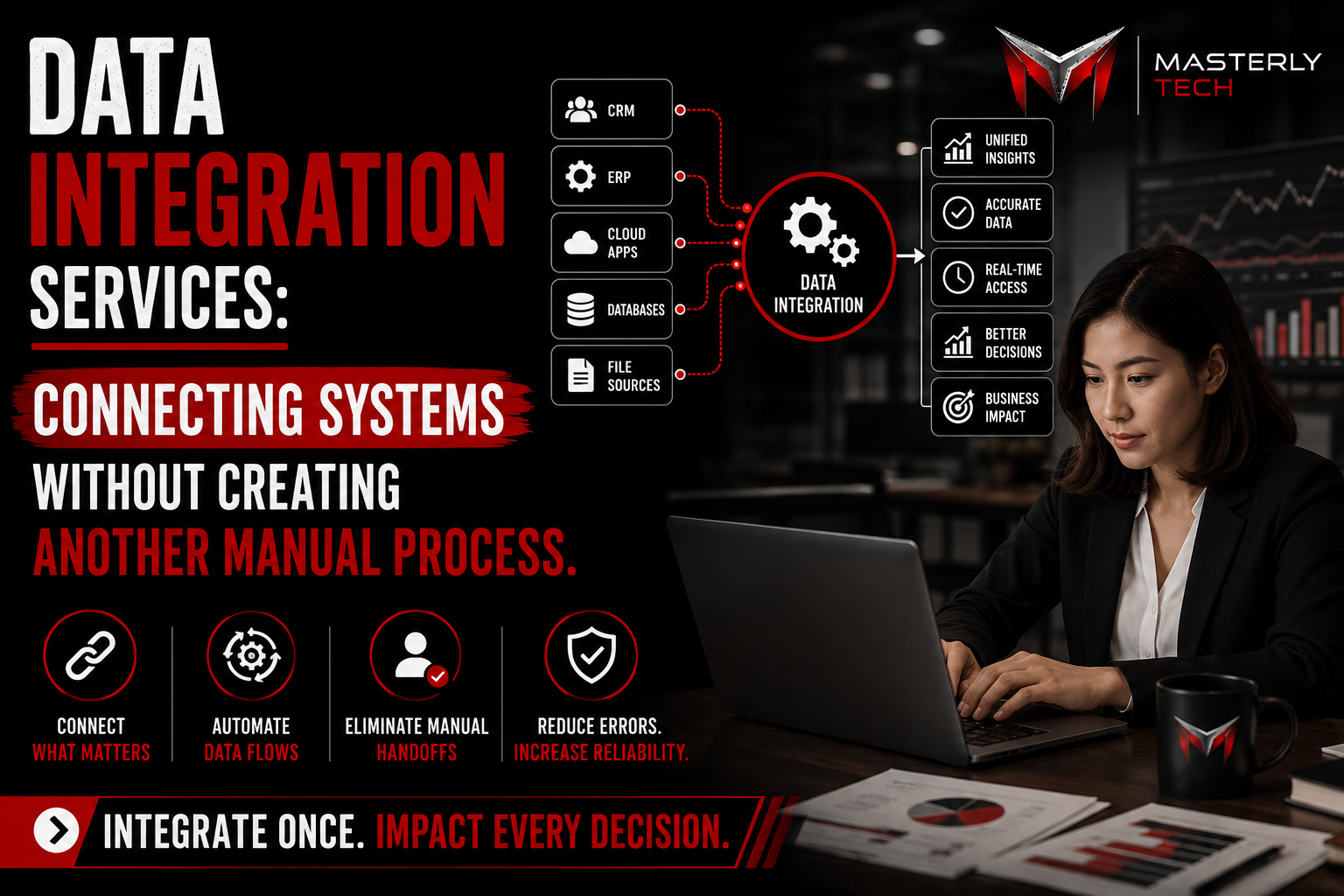
Many companies already have capable software. The problem is that the platforms do not share information in a useful way.
Customer information may exist in the CRM, accounting platform, project management system, email platform, and shared files. Employees must search several places to understand the status of one customer or project.
Disconnected systems can lead to:
- Duplicate records
- Conflicting information
- Delayed updates
- Manual data entry
- Incomplete customer histories
- Incorrect reports
- Missed handoffs
- Security and access concerns
Poor data quality across disconnected systems can also lead to inaccurate predictions and unreliable automation results.
Masterly Tech evaluates how information should move between platforms. We identify which system should serve as the main source of truth for each type of data and which integrations may reduce manual work while using the right tools to protect data quality.
Not every platform needs to connect with every other platform. The purpose of integration is to support the process, not to create a complicated network that becomes difficult to manage.
Protecting the Customer Experience and Brand Reputation
Customers may never see the automation behind a business, but they experience its results.
They notice when the company responds quickly. They notice when employees have the correct information. They notice when updates arrive at the right time and when the next step is easy to understand.
They also notice when the process fails.
A customer may receive the same request from two employees. A promised follow-up may never arrive. Information submitted online may be missing when the customer calls. An automated message may continue after the issue has already been resolved.
These experiences can make a capable company appear disorganized.
Practical automation supports a consistent customer experience. It gives employees better information, creates clearer handoffs, and helps the business meet its commitments. That consistency protects trust and strengthens the company’s reputation.
Measuring the Real Value of Automation
The value of automation is not based only on the number of tasks completed automatically.
A useful automation project should improve a business result. Depending on the workflow, that result may include:
- Faster response times
- Fewer data-entry mistakes
- Shorter project delays
- More consistent follow-up
- Better customer communication
- Clearer task ownership
- Less time spent preparing reports
- Improved visibility for managers
- Fewer missed requests
- More employee capacity for important work
Masterly Tech helps define the expected result before the workflow is built. This gives the business a practical way to decide whether the automation is helping.
It also prevents the company from adding automation that looks impressive but does not improve operations.
Done-for-You Business Automation Consulting From Masterly Tech
Masterly Tech provides done-for-you business automation consulting for owners and operations leaders who need to reduce repetitive work and manual effort that can consume a large share of employees’ time, with AI able to automate 60–70% of some routine work, repair handoff delays, improve follow-up, and connect business systems.
Our services may include:
- Reviewing current processes and platforms
- Mapping workflows across teams
- Finding delays, duplicate work, and unclear ownership
- Identifying useful automation opportunities
- Simplifying processes before automation
- Designing workflow rules and approval paths
- Connecting forms, databases, and business platforms
- Configuring task assignments and notifications
- Improving customer and internal follow-up
- Creating management reporting requirements
- Testing workflows and handling exceptions
- Documenting the completed automation
- Supporting employee adoption
- Performing a process audit before selecting automation technologies and the right tools
We build around the way the business needs to operate. That may mean improving the current software, connecting existing systems, or recommending a better structure where the present tools cannot support the process.
Our focus is a practical result: less avoidable manual work, fewer delays, clearer ownership, and more dependable service.
Frequently Asked Questions About Business Automation Consultants
What does a business automation consultant do?
A business automation consultant reviews manual processes, often starts with a process audit, identifies delays and repeated work, helps identify bottlenecks, and recommends the right tools based on the workflow’s complexity to design connected workflows that help the business operate more efficiently.
What is business automation consulting?
Business automation consulting helps a company decide which processes should be simplified, automated, integrated, or kept under human control as part of digital transformation across the organization, with ongoing optimization after implementation.
What is the difference between a process automation consultant and a workflow automation consultant?
A process automation consultant may review the full business process, while a workflow automation consultant often focuses on how tasks, data, and notifications move between steps. The work frequently overlaps.
Does business automation require new software?
Not always. Existing platforms may already have useful features that are not properly connected or configured. Masterly Tech reviews the current environment, including current tools, automation tools, and any ai tools already in place, before recommending new software.
Which business processes can be automated?
Common areas include lead routing, customer onboarding, internal approvals, task assignments, project handoffs, follow-up messages, data updates, and reporting. More advanced examples include AI predicting inventory shortages in supply chain management and machine learning supporting predictive maintenance to help prevent costly equipment failures.
Can automation replace employees?
The goal is not to remove necessary people. Good automation helps the operations team save time on manual tasks, reduces repetitive work, and gives employees more time for judgment, problem-solving, communication, and customer service, with fewer errors in routine work.
How long does a business automation project take?
The timeline depends on the number of workflows, systems, integrations, approval steps, data issues, and testing needs. Masterly Tech defines the project scope before implementation.
Can Masterly Tech improve an existing automation?
Yes. We can review current workflows, identify why they are failing, and refine the process, rules, data, or platform connections. That can include monitoring performance, fixing data quality issues, and making changes as part of ongoing optimization after implementation.
Request an Automation Assessment With Masterly Tech Group
If repetitive work, manual follow-up, handoff delays, and disconnected systems are slowing your business, adding another tool may not solve the problem.
Masterly Tech can perform a process audit, identify bottlenecks, and recommend the right tools for a small business or growing organization. Our business automation consultant services help companies create clearer workflows, stronger accountability, and more consistent service, so small teams can save time and stay ahead without adding more manual coordination.
Request an automation assessment with Masterly Tech Group.
Visit Masterly Tech or call (888) 209-4055 to discuss your business automation needs.