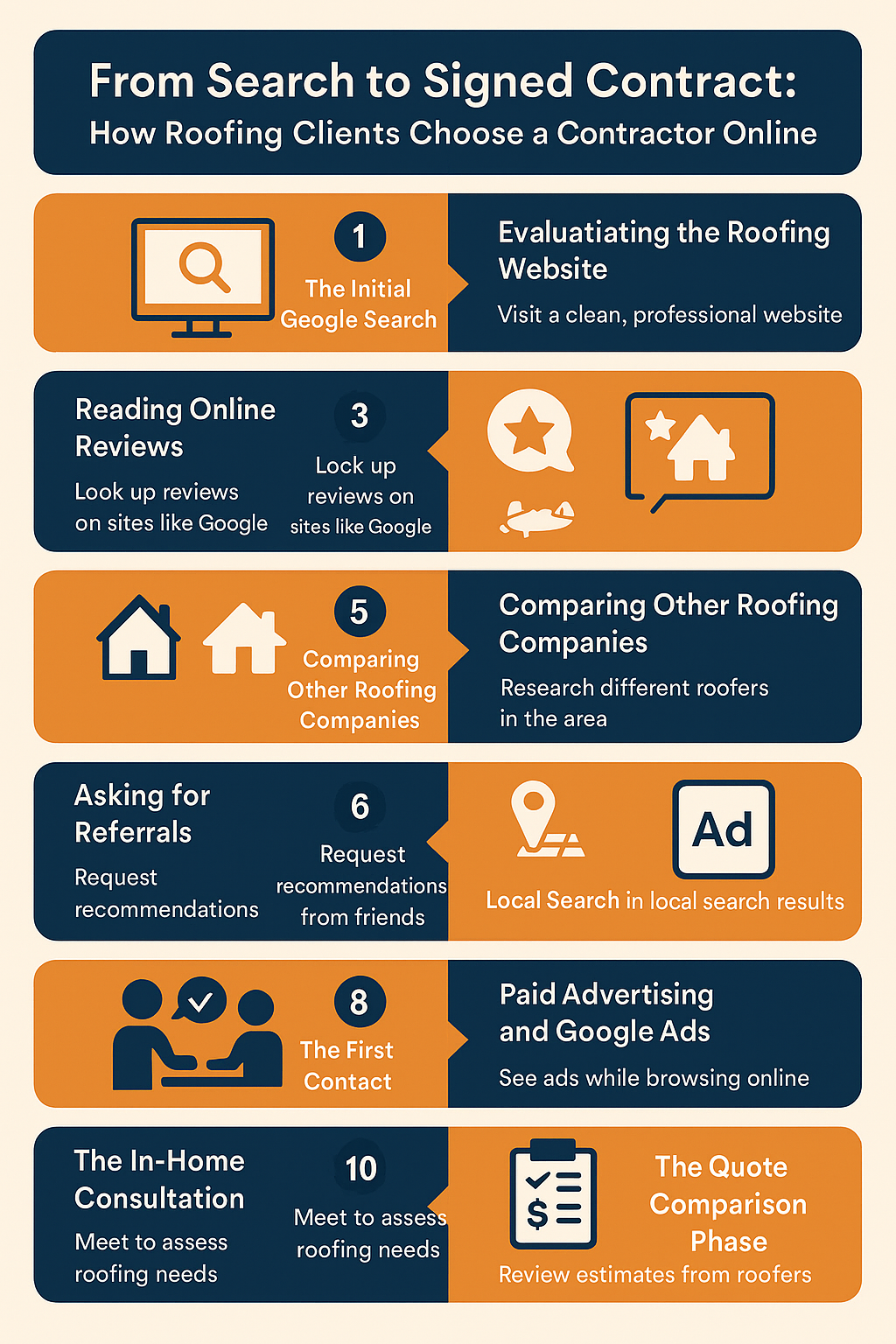
From Search to Signed Contract How Roofing Clients Choose a Contractor Online

August 25, 2025


Understanding the Roofing Customer Journey

In today’s digital-first world, potential customers rarely pick up the phone without doing their homework. For roofing companies, this means every online interaction matters—from the first Google search to the final click to sign a contract. Mapping the entire customer journey helps you understand how roofing clients make decisions, so you can appear at every touchpoint.


Why the Journey Matters More Than Ever

The modern roofing business must meet clients where they are: online. Whether someone needs an emergency roof repair or is planning for a future installation, their path to choosing a contractor often starts digitally. Understanding that journey gives your roofing marketing a clear direction.


Step 1: The Initial Google Search

When a homeowner notices a leak or storm damage, the first step is often a Google search like “roof repair near me.” If your business isn’t listed on the first page of search results, you’re invisible to most.


To appear at this stage:

  • Optimize your Google Business Profile with accurate info and photos.
  • Focus on roofing SEO and using relevant keywords.
  • Invest in google ads for high-priority local keywords.


Step 2: Evaluating the Roofing Website

Once you show up in google search results, users want to verify your legitimacy. A clean, mobile-friendly roofing website with clear service offerings and visible contact info builds trust.


Include on your roofing website:

  • Easy-to-navigate layout and professional web design
  • Customer testimonials and before/after images
  • Clear calls to action to book a free estimate


Step 3: Reading Online Reviews

Consumers today rely heavily on online reviews to validate decisions. They check review websites like Yelp, Google, and even Facebook to read real experiences from other homeowners.


Encourage your clients to leave reviews, and always respond to both praise and criticism. This shows your commitment to exceptional customer service and builds credibility.


Step 4: Exploring Social Media Presence

Many potential customers research contractors on social media sites like Facebook, Instagram, and TikTok. Your social media marketing efforts give them a behind-the-scenes look at your work and customer engagement.

Post regularly on popular social media platforms, sharing:

  • Project progress and roofing tips
  • Client testimonials and job site walkthroughs
  • Promotions such as free gutter cleaning or discounts


Step 5: Comparing Other Roofing Companies

Before making a decision, users often compare multiple roofing contractors. If you aren’t visible across platforms or don’t stand out, they’ll go with a competitor.

To stay competitive:

  • Benchmark against other roofing companies in your area
  • Showcase unique selling points like warranty length, turnaround time, or certifications
  • Use your marketing materials to highlight your value


Step 6: Asking for Referrals

Even in a digital world, customer referrals still carry massive weight. Encourage satisfied clients to share their experiences and join a referral program that rewards word-of-mouth.

Make it easy for clients to:

  • Leave a review
  • Share your contact info on social
  • Refer neighbors for bonus services or gift cards


Step 7: Local Search Optimization

Local SEO is critical in making sure you show up in local search results when someone in your service area looks for a roofer.

Your roofing marketing strategies should include:

  • Consistent NAP (name, address, phone) on business listings and online directories
  • Optimized meta descriptions for every page
  • A localized content plan that uses your city or region as target keywords


Step 8: Paid Advertising and Google Ads

Even the best roofing SEO takes time. Supplement with targeted paid advertising like google ads to stay visible for competitive keywords. This helps generate qualified leads in real-time.


Set a clear marketing budget, and monitor campaigns using Google Analytics to track what converts. When used strategically, paid ads can dramatically increase qualified leads and new customers.


Step 9: The First Contact

Once you've built trust through search, reviews, and content, potential customers will reach out. Make sure your response is immediate and informative.

First impressions matter, and your sales team should:

  • Be responsive and friendly
  • Explain your roofing services clearly
  • Offer appointment scheduling that respects the client’s time


Step 10: The In-Home Consultation

This is where many roofing professionals shine. During the consultation, you have the opportunity to establish expertise, build rapport, and explain your service offerings.


Bring marketing collateral, proof of insurance, and testimonials to reinforce your reputation. This is also a chance to highlight financing options and warranty programs.


Step 11: The Quote Comparison Phase

Most clients will gather 2–3 estimates before making a decision. Your estimate should be clear, transparent, and visually polished.

Set yourself apart by including:

  • Line-item pricing
  • Visual aids or images of similar projects
  • A summary of why your company is the best fit


Step 12: The Final Decision and Signed Contract

After comparing estimates and doing research, the customer is ready to sign. Make it as easy and seamless as possible to close the deal.

Provide:

  • Digital contracts with e-sign options
  • Transparent timelines
  • A single point of contact for post-signing communication

Keeping the Customer Engaged After the Job

The journey doesn’t end when the roof is installed. Stay connected through follow-up emails, referral incentives, and social media engagement.

This boosts referral leads, repeat business, and a steady stream of quality leads over time. Happy clients become brand advocates.


Roofing SEO Services that Keep You Visible

Your visibility in search engine rankings will determine your lead flow. Masterly Tech Group specializes in roofing SEO services designed to keep your brand in front of the right target audience.

We focus on:

  • Technical and on-page SEO services
  • Keyword strategy for roofing contractors
  • High-quality backlinks and content creation


Content Marketing for Long-Term Growth

To maintain relevance and drive sustainable growth, roofing companies must invest in content marketing. This builds authority while educating potential clients.


Our team helps you create quality content that includes blog posts, FAQ pages, and videos—all designed to improve search visibility and user trust.


A Marketing Plan That Works

No two roofing businesses are alike. That’s why you need a custom marketing plan that aligns with your goals, geography, and capacity.

As a top-tier roofing marketing agency, Masterly Tech Group tailors your plan using proven digital marketing strategies, including:

  • Local SEO optimization
  • Website conversion audits
  • Lead capture and email follow-up automation


The Role of Online Directories and Listings

Many local homeowners still use online directories like Angi, HomeAdvisor, or Thumbtack to find roofers. Make sure your business website and Google Business Profile are synced and optimized for these listings.


Accuracy across platforms ensures that your roofing company ranks higher in search results and avoids missed leads.


Why Marketing Agencies Matter for Roofers

Partnering with a specialized marketing agency like Masterly Tech Group gives your business a competitive edge. We understand the roofing industry and what it takes to stand out in a crowded market.

We help roofing contractors:

  • Generate more leads from digital channels
  • Position themselves as industry professionals
  • Scale operations with data-backed decisions


Reaching the Right People at the Right Time

With a combination of roofing SEO, local search, and engaging social media marketing, you can meet your target audience exactly when they need your help. Every interaction should lead them closer to choosing your business.


It’s not about selling—it’s about solving problems, building trust, and offering high-quality roofing solutions.


Blending Traditional and Digital Strategies to Attract Local Roofing Leads

While many local roofing companies focus on online marketing, the most successful ones understand that it takes a mix of both online and offline tactics to truly stand out. When potential customers search for contractors online, they expect to find clear, trustworthy information—and if you're not visible, you're missing out on high-value roofing jobs. To boost exposure and generate leads, smart roofers pair digital campaigns with traditional efforts like direct mail that target specific neighborhoods. By balancing both strategies, your business stays top-of-mind across multiple touchpoints and reaches homeowners in the way they prefer to engage.


Maximizing Online Visibility to Win Customers in Your Service Area

For any roofing business aiming to grow, it’s essential to invest in effective roofing marketing that captures attention across every step of the buyer journey. A specialized roofing marketing agency can help implement local SEO tactics that ensure your company appears when potential customers search for services in your service area. Beyond search engines, consistent and engaging social media marketing builds familiarity and trust with homeowners long before they request a quote. When your digital presence aligns with what homeowners are already searching for, you're far more likely to turn online interest into signed contracts.


Boosting Visibility with Targeted Roofing Contractor SEO

In a competitive market, standing out means more than just having a website—it requires a strong roofing contractor SEO strategy. This approach focuses on optimizing your digital presence so that homeowners find your business first when searching for roofing solutions online. By targeting location-specific keywords, enhancing your Google Business Profile, and building local backlinks, SEO helps attract the right traffic to your site. Effective SEO turns casual searches into real leads, making it a crucial investment for any contractor looking to dominate their service area.


Why Roofer SEO Services Are Essential for Long-Term Success

If you're not ranking on the first page of search results, you're missing out on valuable opportunities. Professional roofer SEO services help position your business where homeowners are actively looking for solutions. From keyword optimization to site speed improvements and content creation, SEO ensures your brand shows up consistently throughout the online journey. By investing in ongoing SEO, you increase visibility, attract qualified traffic, and stay ahead of competitors in your local market. It’s one of the smartest long-term strategies to grow your roofing business sustainably.


The Power of Digital Marketing for Roofing Companies

In today’s connected world, referrals alone aren’t enough—digital marketing for roofing companies is what drives consistent growth and visibility. From SEO and Google Ads to social media campaigns and email follow-ups, a well-rounded digital strategy ensures your business is visible wherever homeowners are searching. This approach helps build trust, generate qualified leads, and showcase your services to the right audience. Roofing companies that embrace digital tools not only stay competitive—they become the first choice in their local markets.


Fresh Roofing Marketing Ideas That Attract Quality Leads

Standing out in a crowded market requires more than just a website—it takes creative and consistent roofing marketing ideas to keep your brand top-of-mind. From running seasonal promotions like free inspections or limited-time discounts to launching referral contests or neighborhood mailers, innovation drives engagement. Pair these with strong digital tactics like video testimonials, blog content, and localized SEO pages to multiply your reach. When your marketing ideas are tailored to your audience and service area, you not only generate leads—you build long-term trust with homeowners.


Let Us Help You Capture More Roofing Leads

Masterly Tech Group knows what makes roofing marketing effective. From increasing your visibility in search results to building trust through professional design and digital strategy, we help your roofing company get chosen by the right clients.


Call us today at (888) 209-4055 to book a free consultation. Our team will review your current strategy and show you how to appear at every step of your customer's online journey—from search to signed contract.

(888) 209-4055

Customer lifecycle stages from awareness to retention and referral.
August 28, 2026
Improve the customer lifecycle by aligning customer lifecycle stages, the client lifecycle, and the customer retention journey to support loyalty and growth.
Website strategy showing planning, goals, and user experience.
August 28, 2026
Build a website strategy that aligns website planning, web strategy, and clear website goals to improve user experience, conversions, and long-term growth.
Data strategy showing governance, management, and business reporting.
August 28, 2026
Build a business data strategy that strengthens data governance, improves reporting, and creates a clear data management strategy for better decisions and growth.
Customer experience management across key client touchpoints.
August 28, 2026
Strengthen customer experience management with a clear customer experience strategy, consistent CX management, and better overall client experience management.
August 28, 2026
When your marketing campaigns aren't delivering measurable results and you're struggling to justify marketing spend to stakeholders, comprehensive marketing analytics provides the insights you need to optimize performance and prove ROI. Our marketing analytics services help businesses across all industries transform raw data into actionable strategies that drive growth and revenue generated from every dollar invested. Get a free marketing analytics audit and discover how to maximize your marketing ROI. Why Businesses Trust Our Marketing Analytics Expertise Certified Google Analytics and marketing automation specialists with 8+ years of experience in digital marketing analytics Average client sees 40% improvement in marketing ROI within 90 days through data driven decision making Over 500 successful marketing analytics implementations across Fortune 500 and SMB clients Why Companies Choose Our Marketing Analytics for Business Growth Marketing professionals today face a critical challenge: too much marketing data spread across multiple platforms with no unified way to extract valuable insights. Our data-driven approach transforms marketing guesswork into strategic decision-making, helping you allocate budgets more effectively and achieve sustainable growth. Companies using marketing analytics can increase ROI by 15-20%, and effective marketing analytics can reduce operational costs by 70%. Multi-touch attribution modeling reveals true customer journey impact across all channels - multi-touch attribution captures the influence of multiple touchpoints, giving marketing teams a better understanding of what actually drives conversions rather than relying on last-click assumptions Real-time dashboards provide instant visibility into campaign performance and key performance indicators, allowing for immediate adjustments to marketing strategies based on performance metrics - so your marketing departments never operate on stale performance data Predictive analytics forecasting helps optimize future marketing activities and budgets - predictive analytics forecasts future consumer behaviors and trends using historical data, turning your marketing strategy from reactive to proactive Our Marketing Analytics Services Comprehensive analytics capabilities designed to measure, optimize, and scale your marketing efforts across all marketing channels and multiple touchpoints. Campaign Performance Analytics Campaign analytics measures performance signals like reach and conversions across every platform where you run ads. We track and analyze paid advertising campaigns across Google Ads, Facebook, LinkedIn, and other platforms. PPC analytics tracks ad performance across platforms like Google and Facebook, measuring ROAS, conversion rate, click through rates, and customer acquisition cost to optimize ad campaigns. Campaign analytics helps identify gaps by comparing results to benchmarks, ensuring every dollar of ad spend works harder. Effective campaign analytics requires clean and trustworthy data - which is why data management is central to everything we do. Customer Journey Analytics Map complete customer journeys from awareness to conversion using multi-touch attribution. Multi-touch attribution analyzes multiple interactions leading to conversions, helping you identify high-value touchpoints and optimize the path to purchase. Marketing analytics helps identify the most effective customer touchpoints, improving customer experience and revealing where potential customers drop off. Multitouch attribution allows analysis across multiple devices and channels, giving your marketing executives full visibility into how different campaigns contribute to sales outcomes. Marketing Mix Modeling Advanced statistical analysis to determine optimal budget allocation across marketing channels. Marketing mix modeling evaluates the impact of various marketing channels - including offline efforts like events and print alongside digital - on total revenue. Incrementality testing isolates the true impact of marketing efforts, ensuring you understand true campaign impact rather than just correlation. Budget optimization reallocates funds to high-performing marketing channels based on data, so your marketing budget delivers maximum return on investment. Web and SEO Analytics Comprehensive website performance tracking including organic traffic, user behavior, conversion paths, and SEO performance. SEO analytics focuses on data to grow organic traffic and conversions from search engines. Google Analytics 4 tracks user behavior across different sessions, providing granular data points on how visitors interact with your content. We identify content creation and technical optimization opportunities that improve visibility for your target audience. How Our Marketing Analytics Process Works Our systematic approach ensures accurate data collection, meaningful data insights, and actionable recommendations for marketing optimization. Step 1: Marketing Data Audit and Strategy Planning Comprehensive review of existing marketing data sources, business goals, and key metrics. An analytics framework connects marketing activities to business outcomes to guide strategies. We catalog every data source - from CRM and customer data to web analytics and social media analytics - to identify gaps and establish a single source of truth. Data collection and integration unify information from marketing channels into a single source of truth. Step 2: Implementation and Integration Set up tracking systems, connect data sources, and configure dashboards across multiple channels. Tableau visualizes marketing data in real-time dashboards. HubSpot combines analytics and CRM solutions in one package. Databox centralizes marketing data from multiple platforms, while Supermetrics automates data transfer into reporting tools. Marketing data warehouses centralize data from different channels, ensuring your marketing analytics software infrastructure is built for scale and accuracy. Step 3: Analysis and Optimization Ongoing performance monitoring, insight generation, and strategic recommendations. We apply A/B testing - which compares two versions to determine better performance - alongside incrementality testing and customer segmentation that enhances targeting by grouping customers based on behavior and demographics. Monthly reports with actionable insights and specific steps to improve marketing ROI and efficiency. Data storytelling provides context to marketing data for better insights, ensuring marketing decisions are understood by every stakeholder. Marketing Analytics Success Stories Real results from clients who transformed their marketing performance through data driven marketing and optimization strategies. E-commerce client increased ROAS by 65% through improved attribution modeling and budget reallocation - proving that marketing attribution is one of the most powerful tool available for measuring campaign ROI and optimizing specific campaigns SaaS company reduced customer acquisition cost by 45% using funnel analytics and conversion optimization - common metrics include customer acquisition cost (CAC), return on ad spend (ROAS), and revenue, and this client saw dramatic improvements across all three Manufacturing business improved lead quality by 80% through enhanced lead scoring and analytics insights - customer lifetime value (CLV), which represents the total net profit from a customer over the relationship duration, increased substantially as a direct result These outcomes reflect what data-driven marketing strategies can achieve: enhanced customer engagement significantly and measurable business cost reductions. What Our Clients Say Testimonials from marketing directors and business owners who have experienced measurable improvements through our analytics expertise. Include actual client testimonials with specific results and attribution Feature quotes about improved decision-making and campaign effectiveness Highlight testimonials from relevant industries and company sizes  Industries We Serve Specialized marketing analytics expertise across diverse industries and business models. Marketing analytics improves decision-making with data-driven insights regardless of your sector - and today, marketing analytics is standard practice in most businesses for good reason. E-commerce and retail businesses seeking to optimize online sales, social media channels performance, and customer lifetime value through performance marketing B2B technology companies focused on lead generation, sales pipeline analytics, and measuring how paid ads and content creation contribute to revenue across different channels Healthcare and professional services tracking patient acquisition , referral patterns, and measuring how social media analytics and email analytics contribute to growth - email analytics measures open rates, spam rates, and conversion rates for ongoing campaigns Financial services measuring compliance-friendly marketing performance, customer acquisition, and key factors driving long-term retention
Connected martech stack with integrated marketing tools and systems.
August 28, 2026
Build a connected martech stack that aligns martech tools, data, automation, and marketing systems to improve visibility, efficiency, and customer growth today.
Website architecture with clear site hierarchy and navigation.
August 28, 2026
Build better website architecture with a clear site hierarchy, intuitive navigation, and information architecture that helps visitors find key pages and convert.
Landing page design with clear CTAs, forms, and mobile UX.
August 28, 2026
Improve landing page design with a clear layout, strong UX, credible proof, streamlined forms, CTA hierarchy, and mobile design that supports more conversions.
By Angelie Te August 27, 2026
Most growing businesses hit the same wall. Leads pour in from paid ads, organic traffic, events, referrals, and social media engagement, and lead scoring—whether you’re prioritizing U.S. demand from SEMrush-driven acquisition or other channels—is the method for ranking those leads by fit and intent so sales knows who to contact first. For sales leaders, marketing teams, and business decision-makers managing high-volume U.S. pipelines, that means faster response times, better sales-and-marketing alignment, and more conversions without adding headcount. The pipeline looks healthy on paper, but the sales team can only make so many calls per day, and not every lead deserves the same level of urgency. This guide explains the fundamentals of lead scoring, how to build and test a scoring model, which data inputs to use, how to separate fit from intent, when to automate, which pitfalls to avoid, and what that looks like in practical U.S. demand examples. Why Lead Scoring Matters When Your Pipeline Starts To Overflow When leads arrive faster than reps can follow up, three things break down. First, response times stretch. A prospect who requested a demo on Monday might not hear back until Thursday, by which point they have already booked a call with a competitor. Second, reps start cherry-picking. Without a clear system, salespeople default to gut instinct, pursuing leads that "feel" right while ignoring others that may convert at a higher rate. Third, marketing loses visibility into what happens after handoff, making it nearly impossible to measure which campaigns produced revenue and which just produced noise. Sales reps spend roughly 8% of their time prioritizing leads and opportunities. That number climbs when there is no scoring system and reps have to manually sort through CRM records, a time-consuming process, to decide who deserves a call. Lead scoring improves the likelihood of closing deals by timely follow-ups, because the highest-intent prospects get reached while their interest is still fresh. Lead scoring is a systematic way to rank prospects so the sales team knows who to call, when, and with what urgency. Prospects receive points based on explicit and implicit data. The result is a prioritized list that replaces guesswork with a repeatable scoring model tied to actual revenue outcomes. The business value is straightforward: faster response times for the right people, more deals without adding headcount, and a clearer handoff between marketing and sales. The process follows a simple sequence: a lead enters the system, gets scored on fit and buyer intent, is routed based on the score, and the outcome (won, lost, or still nurturing) feeds back into the model to better coordinate marketing efforts. What Lead Scoring Should Help a Team Decide  Before building any model, define what decisions it must support. Lead scoring helps sales teams focus on high-value leads, but only if the team agrees on what those decisions look like. Core decisions a lead scoring model should answer: Who gets outreach first? Which leads receive a same-day phone call versus a three-day email sequence? What counts as a Marketing Qualified Lead (MQL)? At what score does marketing hand a lead to sales? Which leads stay in nurture? Low scores should not be deleted; they should enter an automated email track until behavior changes. Which leads get disqualified? Competitors, student emails, and companies outside the serviceable market should lose points, not gain them. Lead scoring helps categorize leads as hot, warm, or cold. A concrete SDR workflow might look like this: leads scoring above 70 become same-day call priorities; leads between 40 and 69 enter an email cadence; leads under 40 stay in nurture until new activity pushes them up. Consider a U.S. B2B SaaS company generating 2,000+ new leads per month from SEO campaigns, paid search, and webinars. Without scoring, reps treat every inbound form fill the same. With scoring, the team can segment by sales priority and focus on the leads most likely to convert.
Marketing dashboard with KPIs and lead metrics.
August 27, 2026
Build a marketing dashboard that connects marketing KPIs, campaign reporting, lead metrics, conversion data, and pipeline insights for clearer, smarter decisions.