Accounting Firm SEO Company: What to Know and How to Plan
Introduction: What "Accounting Firm SEO Company" Really Means
An accounting firm SEO company is a specialized service provider focused on improving search visibility for CPA firms, bookkeeping practices, and accounting organizations. The goal is not generic website traffic. It is qualified inquiries for specific services like tax planning, client accounting services, audits, and bookkeeping, matched to firm size, location, and target client type.
Search engine optimization is vital for growth in the accounting industry, and the landscape has shifted. In 2025 and 2026, prospective clients search using Google, Bing, AI assistants like ChatGPT, Perplexity, and Google AI Overviews. Most high-value clients turn to search engines for immediate accounting assistance, and the way those engines deliver results now includes AI-generated summaries alongside traditional links. A modern accounting firm SEO company must understand both traditional SEO and AI search engines, and how they coexist in how prospects research accountants.
This page walks through the practical decisions involved in planning SEO for accountants: defining your firm's needs, understanding what services to expect, measuring what actually matters, and knowing when qualified professional assistance may be useful. No hype, no guaranteed rankings, just a clear framework for making informed choices.

Define Niche Accounting SEO Buyer Needs (By Firm Type and Stage)
Accounting SEO looks different depending on firm type. A solo CPA in one city has completely different priorities than a multi partner CPA firm with offices across a region, and SEO for bookkeeping firms serving national ecommerce clients requires yet another approach. Niche knowledge in the accounting industry helps tailor effective SEO strategies to each situation.
Here is how common firm profiles compare:
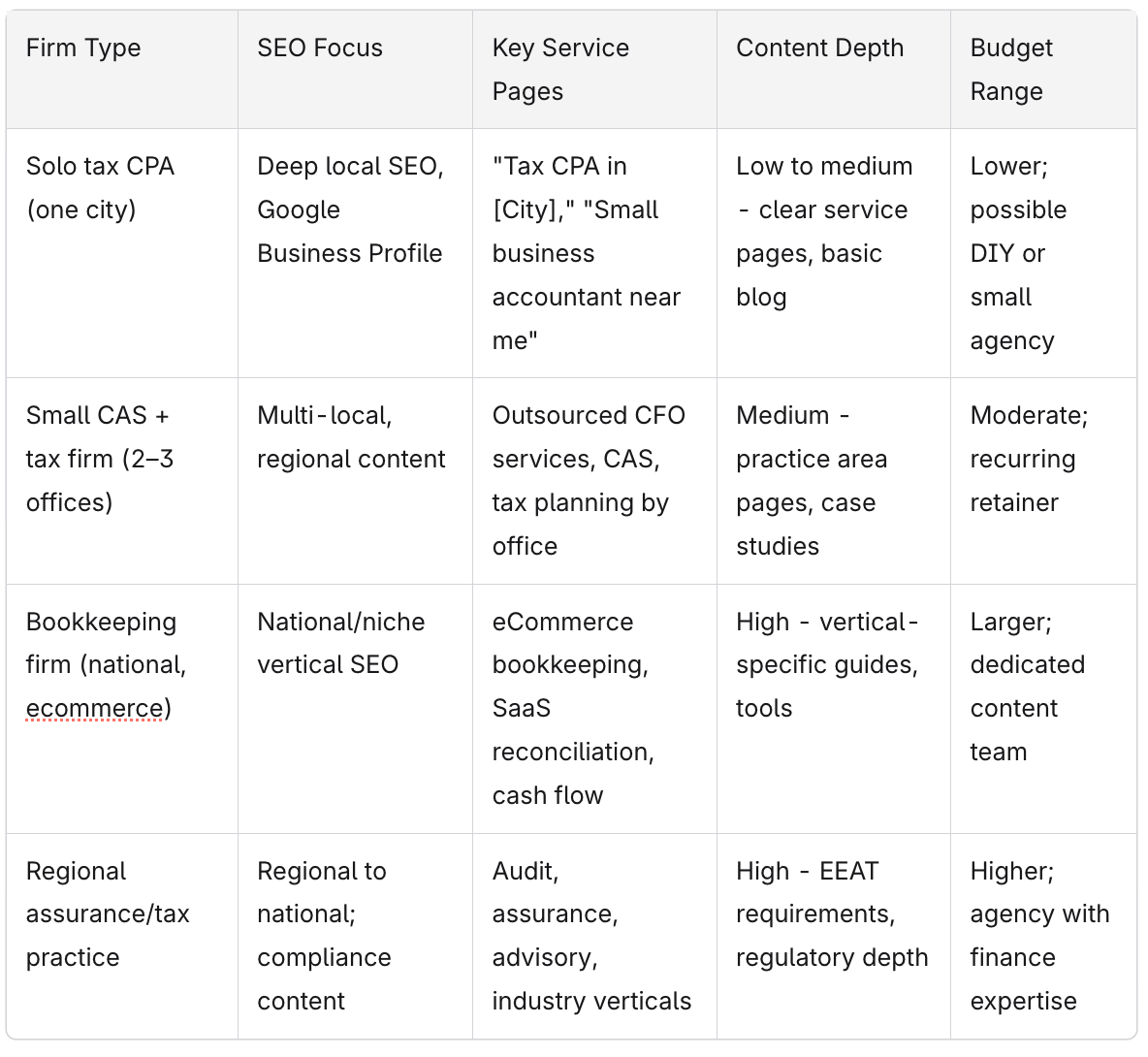
Each profile's needs differ across local search optimization, practice-area page depth, content marketing strategy, and budget range. Buyers typically care about lead quality over volume, seasonal demand (January through April for tax-focused firms versus year-round for CAS), and avoiding wasted spend on irrelevant target keywords.
Common pain points across most accounting firms include heavy dependence on referrals, inconsistent lead flow, outdated accounting websites, and no tracking of where inquiries actually come from. A recent study found that
53.1% of U.S. accounting firm websites failed at least one basic SEO check such as missing title tags, meta descriptions, H1 headings, or HTTPS. That is a significant gap and an opportunity.
Traditional SEO vs. AI Search Engines for Accounting Firms
Traditional search engines like Google and Bing still drive the majority of prospective clients to accounting websites. But AI search engines and assistants - ChatGPT, Perplexity, Google AI Overviews, Microsoft Copilot - now mix search with summarization and answer-first interactions. These AI powered search tools often extract content directly from websites, cite them, or paraphrase them.
A modern accounting firm SEO company must cover both: on page optimization and technical SEO work for Google, plus structured, authoritative content that AI tools can safely reference. The industry calls this evolution answer engine optimization (AEO) or generative engine optimization (GEO). Despite the new terminology, AEO and GEO still rely on strong traditional SEO foundations - schema markup, quality content, and domain authority.
Realistic expectations matter here. Appearing in AI-generated answers is not guaranteed. But accounting practices with clear service descriptions, verified CPA bios, Google reviews, and trustworthy content are more likely to be recommended by both Google search results and AI surfaces. When a Google AI Overview appears, click-through rates for the top organic link drop approximately 58%, which means firms that are cited in those overviews gain a meaningful advantage.
Traditional SEO signals:
- Title tags and meta descriptions
- Internal links and backlinks
- Site speed and mobile optimization
- HTTPS security
AI-friendly signals:
- Clear FAQs and structured answer blocks
- In-depth practice area guides
- Verified CPA bios with credentials
- Transparent service and pricing pages
SEO strategies should address both columns to maximize search visibility across all surfaces where prospective clients search.
Local SEO Basics for Accountants: Google Business Profile and Service Pages
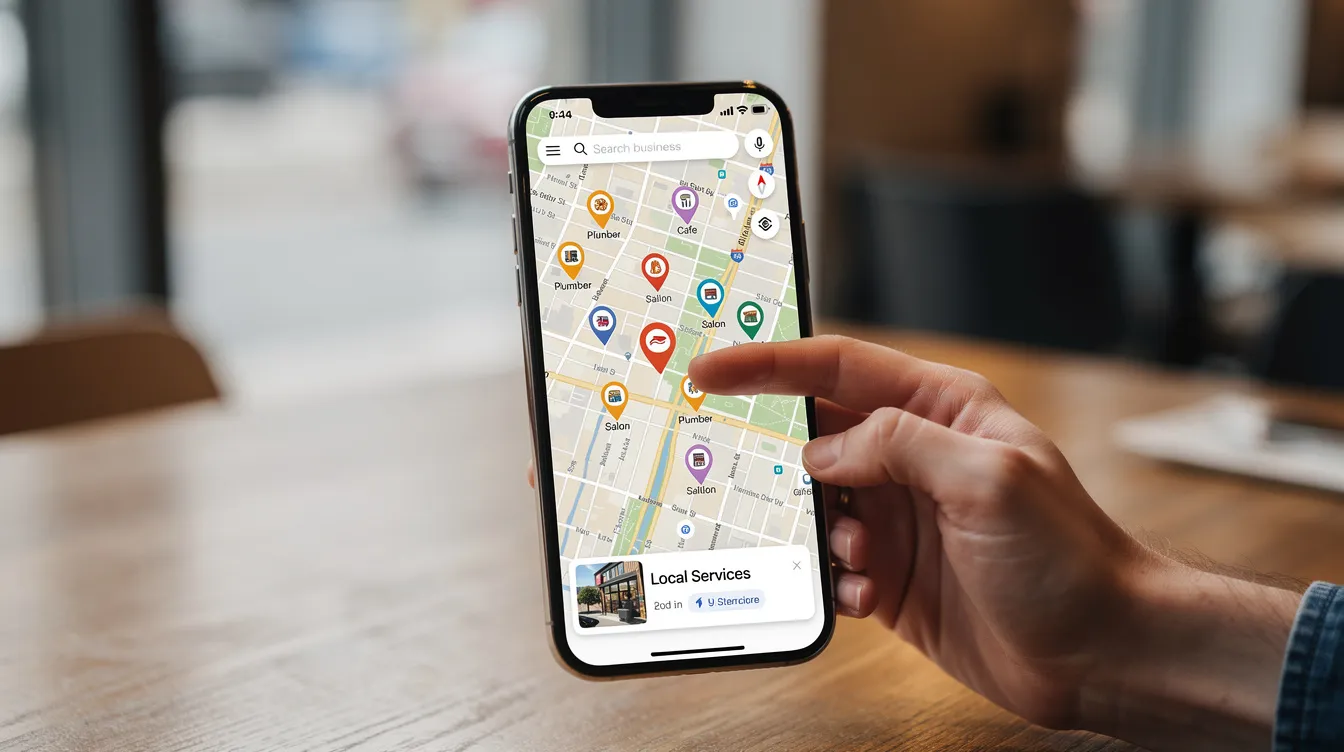
Accountant local SEO is typically the first lever most firms should pull. Forty-six percent of all Google searches seek local information, and many potential accounting clients prefer local service providers. High-intent local searches for accounting services often occur within 15 miles of a client's location - phrases like "CPA near me" or "tax accountant in [City]" drive this behavior. Local SEO helps businesses appear in geographic searches, particularly Google's Local Pack results.
Google Business Profile Fundamentals
Optimizing Google Business Profile boosts local search visibility. The essentials include:
- Consistent Name, Address, Phone (NAP) across all listings
- Primary and secondary categories (e.g., "Certified Public Accountant," "Tax Consultant")
- Complete hours, service descriptions, and service area
- Regular photos of staff and offices
- A deliberate review strategy: soliciting client reviews and responding to them
Google reviews are a major ranking factor in local SEO. Firms with higher review counts and ratings tend to rank better in map-pack results. Google Business Profile management should be an ongoing task, not a one-time setup.
Effective Service-Area Pages
An effective local page for accounting services includes city-specific content for tax, bookkeeping, CAS, and payroll services. Each page should feature real staff photos, clear calls-to-action, and FAQs addressing local regulations or common questions.
Consistent local citations - same name, address, and phone number across directories, CPA society listings, and mapping services - support local search results and map-pack visibility. Only about 3% of accounting firms currently use AccountingService schema markup, so implementing structured data remains a significant competitive advantage.
Local SEO improvements often show movement within 60 to 90 days, with stronger gains accumulating over 6 to 9 months.
Core SEO Services an Accounting Firm Should Expect
Good SEO companies for CPAs are transparent about deliverables. You should know exactly what you are paying for, not just that someone is "doing SEO in the background." SEO agencies should offer a mix of technical SEO and content creation tailored to the accounting industry.
Main service categories include:
- Technical SEO audit: Crawlability, site speed improvements, structured data setup, XML sitemap, HTTPS verification, mobile responsiveness. Technical SEO includes site speed improvements and structured data setup as baseline requirements.
- On page SEO: Title tags, meta descriptions, header structure, keyword research with location and service combinations, and internal links between service pages.
- Content marketing plans: Practice-area pages, blog posts, evergreen guides, FAQs, and seasonal content aligned to filing deadlines and business cycles.
- Link building: Credible backlinks from CPA societies, business associations, and relevant industry sources.
- Local search optimization: Google Business Profile optimization, local citations, and geo-targeted service pages.
CPA-specific examples matter. Service pages should target terms like "outsourced CFO services," "sales tax compliance," "estate tax planning in [State]," and "QuickBooks cleanup" - not only generic accounting services. SEO for bookkeeping firms may emphasize different topics such as cash flow management, ecommerce reconciliation, or SaaS bookkeeping, but follows the same principles.
You should see these on your SEO statement of work:
- Number of technical fixes and timeline
- Number of service pages to be created or optimized
- Blog posts or content pieces per month
- Link building targets and sources
- Google Business Profile management steps
- Reporting cadence and KPI definitions
- Payment structure tied to deliverables
On-Page SEO for Accounting Firms: Getting the Fundamentals Right
Most accounting firms underperform on basic on page SEO before needing complex tactics. High-ranking SEO signals credibility to prospective clients, and the fundamentals are where that starts. Google's algorithms emphasize E-A-T: Experience, Authoritativeness, and Trustworthiness - all of which directly apply to professional services firms in accounting.
Key elements of page optimization:
- Title tags: Include city + service ("Dallas CPA Firm | Tax Planning & Bookkeeping"). Stay within 50-60 characters.
- Meta description: Clear benefit statement with services and location. Limit to approximately 155 characters.
- Heading structure: One H1 per page, descriptive H2s for subtopics. Use headings to organize content logically, not just for style.
- Internal links: Connect service pages to relevant blog posts, case studies, and staff bios.
Structure practice-area pages with these sections:
- Who this is for - Target client types (startups, high-net-worth individuals, ecommerce sellers)
- What's included - Services breakdown
- Pricing guidance - Ranges or transparency to reduce friction
- FAQs - Address common questions and local regulatory issues
For EEAT, show licensed CPAs, designations (CPA, EA, CMA), memberships, and real partner bios with headshots. Client testimonials add trust. Accounting professionals should be visible and credible on the site.
Quick on page SEO checklist:
- [ ] Homepage has unique title tag, meta description, H1, and HTTPS
- [ ] Service pages target city + service combinations
- [ ] FAQ or answer blocks exist per major service
- [ ] Staff bios include credentials and photos
- [ ] Schema markup implemented (LocalBusiness, AccountingService)
- [ ] Pages load quickly on mobile
Content Marketing That Drives Accounting Firm Lead Generation
Content marketing for CPAs is about answering specific client questions across the calendar - not recycling generic tax tips every April. High-quality content is essential for effective SEO strategies, and educational content positions CPAs and accountants as industry experts in their local market.
Concrete content types that drive accounting firm lead generation:
- Evergreen guides: "S Corp vs. LLC Tax Implications," "Cash Flow Forecasting for Small Business," entity formation. These build long-term website traffic.
- Seasonal content: Tax filing deadline reminders, year-end accounting checklists, audit prep guides. Publish 60 to 90 days before the relevant period.
- Industry-specific explainers: Construction accounting, medical practice financials, SaaS revenue recognition, ecommerce bookkeeping services.
Regularly updating content helps maintain search engine relevance. Accurate content creation is critical due to the regulatory nature of accounting - firms should review all published material for compliance.
FAQs, calculators, and checklists (e.g., "year-end bookkeeping checklist for small businesses") serve double duty: they perform well in traditional search results and are easily referenced by AI search engines.
A good accounting firm SEO company will build an editorial calendar aligned with filing deadlines and business cycles, turning your site into a go to resource rather than a neglected brochure. For context, one Orlando CPA firm generated 766 tracked leads over 13 months through a combination of six service pages, monthly backlinks, GBP management, and regular blog content.
Link Building and Authority Signals for Accounting Practices
Accounting practices do not need aggressive or spammy link building. What they need are credible mentions from relevant sources. High-quality backlinks improve search visibility for accounting firms, and backlinks signal website credibility to search engines.
Appropriate link sources:
- State and local CPA societies
- Local chambers of commerce
- Industry-specific associations (construction, healthcare, nonprofit)
- Guest articles on reputable finance or business blogs
- Speaking engagement bios and event pages
- Podcast appearances
Quality matters more than quantity. Five to ten strong, relevant links can help more than dozens of low-quality directory submissions. Authority signals also include Google reviews, professional certifications, peer-reviewed content, and press mentions - all of which can be highlighted on the site with schema markup to help search engines understand your credibility.

This is paragraph text. Click it or hit the Manage Text button to change the font, color, size, format, and more. To set up site-wide paragraph and title styles, go to Site Theme.