API Integration Services: Connecting Business Systems Without Creating Data Silos
Your sales team uses a CRM. Marketing relies on forms, email tools, and campaign platforms. Finance manages payments in another system. Operations tracks work through spreadsheets or separate software. Each tool may perform its own job well, but the business still depends on people copying information from one place to another.
Disconnected systems create more than an inconvenience. They cause missing records, duplicate contacts, delayed follow-up, incorrect reports, and inconsistent customer experiences. Leaders may see different numbers depending on which platform they open.
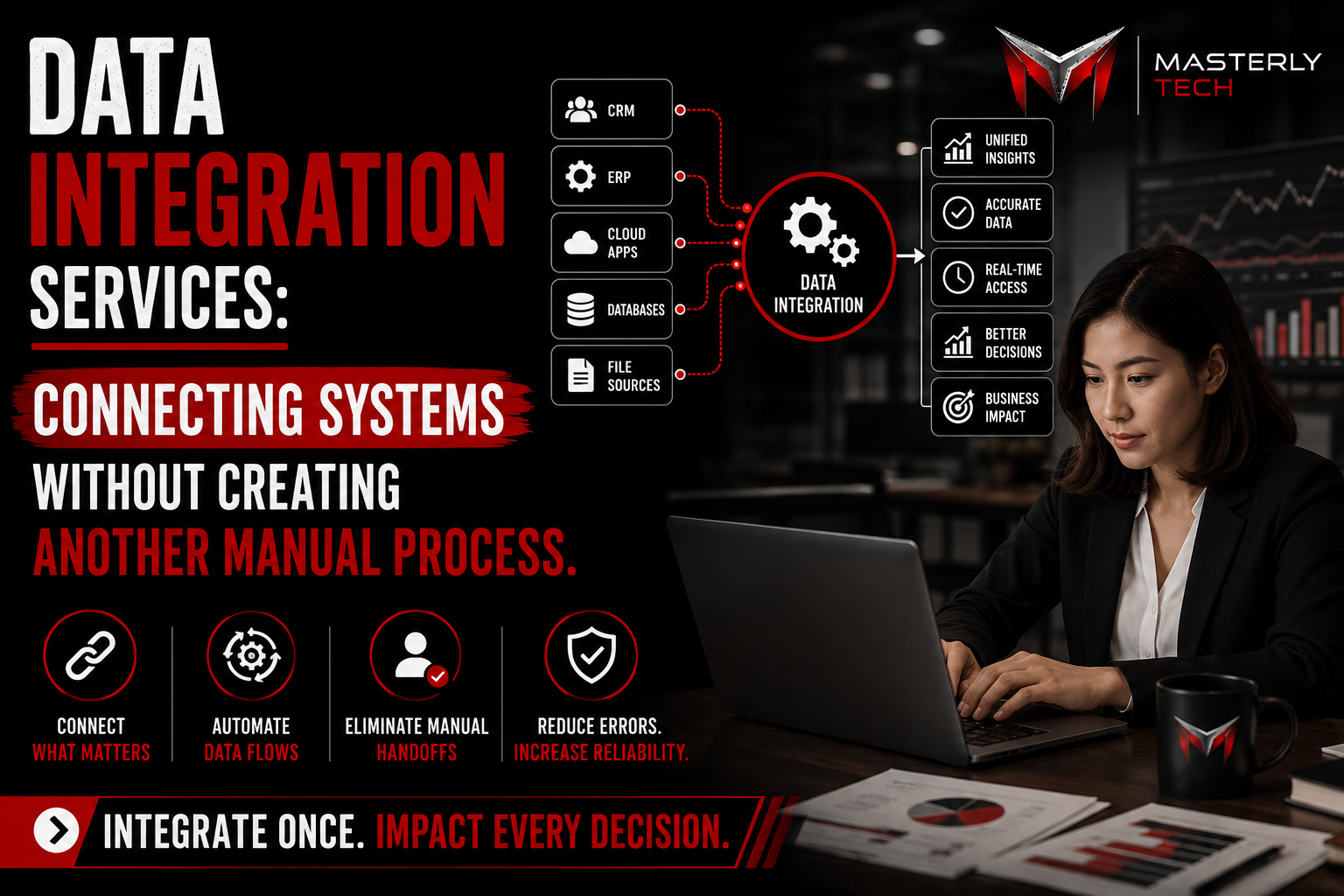
API integration services connect the systems your business already uses so information can move between them in a controlled and useful way. Masterly Tech helps growing companies plan, build, test, and support integrations without creating more data silos or unnecessary technical complexity.
Disconnected Systems Create Hidden Business Costs
Manual data entry often begins as a temporary solution. A team exports a spreadsheet, cleans the information, and uploads it into another platform. An employee copies a payment status into the CRM. Sales checks one system while operations checks another.
As the company grows, these workarounds become part of daily operations. The business begins paying for the same work again and again.
Disconnected systems can lead to:
- Leads entering the business without being assigned
- Customer records containing different contact details
- Payment information failing to reach the service team
- Sales representatives working from outdated data
- Duplicate emails or conflicting customer messages
- Reports that do not match across platforms
- Staff spending hours on data entry
- Important tasks depending on one person’s memory
- Leadership making decisions from incomplete information
These problems affect more than internal efficiency. A customer may submit a form and receive no response. A client who has already paid may be asked to pay again. A sales representative may contact someone without knowing that the service team is handling an active complaint.
Each failure can weaken trust in the company. Business system integration helps reduce these gaps by creating a clearer flow of information between the tools responsible for each part of the customer journey.
What API Integration Services Do for a Growing Company
An application programming interface, commonly called an API, allows approved software systems to exchange information and request actions. The API provides the technical connection, but a useful integration requires more than linking two endpoints.
Professional API integration services determine what data should move, when it should move, where it belongs, and what should happen if the transfer fails.
For example, a completed website form might create or update a CRM contact. The integration could also record the inquiry source, assign the lead, trigger a follow-up task, and send the correct information to an operations platform. If the contact already exists, the system may need to update the record instead of creating a duplicate.
The integration should reflect the actual business process. A technical connection that ignores field rules, record ownership, user permissions, and exception handling can create a new set of problems.
Masterly Tech approaches software integrations as part of the company’s operating system, not as isolated technical tasks.
Connecting Customer Relationship Management (CRM), Marketing, Forms, and Sales Systems
A CRM is often expected to serve as the main customer record, but it cannot do that when important information remains trapped across different systems.
Forms may collect leads without recording campaign details. Email software may contain engagement data that sales cannot see. Scheduling tools may confirm appointments without updating the contact’s status. Sales may keep notes outside the CRM because the system does not reflect how the team works.
Application integration services can connect these touchpoints so the CRM receives useful, structured information. The goal is to align customer relationship management, marketing, and sales workflows so users see the same current information. Depending on the systems and business requirements, the integration may support:
- Lead and customer record creation
- Contact and company updates
- Lead-source and campaign tracking
- Appointment information
- Email subscription status
- Sales-stage changes
- Task creation and assignment
- Customer-service updates
- Marketing consent records
- Reporting fields
The purpose is not to send every available field into every system. Too much data can make the CRM harder to manage. The goal is to move the information that supports a more holistic view for follow-up, service, reporting, and decisions across multiple departments.
Payment and Operations Integrations
A customer’s experience does not end when a sale closes. Payment, onboarding, fulfillment, and service systems also need accurate information to support ongoing business operations after the sale.
A payment integration might update a CRM record after a successful transaction, notify the correct internal team, or begin an onboarding process. An operations integration may send approved order details into a project-management or service platform, such as passing an e-commerce order into fulfillment after payment is confirmed.
Connected systems across payments and operations can reduce delays between different departments. These workflows can reduce delays between departments. They can also give sales and customer-service teams better visibility into what has happened after the purchase.
However, financial and operational information requires careful handling. The integration should limit unnecessary exposure, respect user permissions, and avoid storing sensitive data in systems that do not need it.
Masterly Tech reviews the role of each platform before defining the connection. This supports an integration design based on business responsibility rather than convenience alone.
Good Integrations Need a Clear Data Owner
Data silos are not solved simply by copying the same information into more systems. When several platforms can change the same field, the business may no longer know which value is correct.
A well-designed integration starts with analysis of current workflows and data sources before it identifies a source of truth for important data. The CRM may own contact details. A payment platform may control transaction status. An operations system may own fulfillment information. A marketing platform may control subscription preferences.
The exact ownership model depends on the company’s workflow. Clear ownership is crucial when different systems use different data formats.
Clear ownership helps prevent:
- Systems overwriting newer information
- Duplicate or conflicting customer records
- Status fields changing without explanation
- Reports using different definitions
- Staff correcting the same error repeatedly
- One integration reversing the work of another
Business system integration should create order across the technology environment. Good data integration helps maintain that order instead of spreading unclear data across more platforms.
Integration Security Cannot Be Added Later
APIs may handle customer information, access credentials, financial events, internal records, and business actions. Security and compliance must be part of the integration design from the beginning.
Common concerns include authentication, authorization, token storage, access permissions, data validation, endpoint management, limits on automated requests, and infrastructure or provider risk when third-party APIs are involved. OWASP identifies broken authorization, broken authentication, security misconfiguration, poor API inventory management, and unsafe use of third-party APIs among the leading API security risks. OWASP API Security Top 10 Strong governance around authentication, access, and third-party API use is crucial for secure implementation.
Secure software integrations should also account for the way connected platforms send event notifications. Webhook guidance commonly includes using secrets, HTTPS, event validation, unique delivery identifiers, and a process for missed deliveries. GitHub webhook security and delivery practices
The appropriate safeguards depend on the platforms, data, and risk involved. Masterly Tech evaluates security requirements as part of the integration plan rather than treating them as a final technical check.
Reliable Integrations Plan for Failures
Software systems experience temporary outages, rate limits, expired credentials, format changes, and delayed responses. An integration that works only when every platform is available can quietly lose information when something goes wrong.
A reliable connection should use a centralized monitoring tool to track all integration flows and surface failures faster. Depending on the use case, that may require retries, error records, alerts, duplicate prevention, and a clear process for correcting failed transfers.
Without this planning, a team may believe that information moved successfully when it did not. The failure may remain hidden until a customer complains or a report does not match.
Organizations with defined integration principles have reported a 25% reduction in errors, which reinforces the value of stronger monitoring and reliability standards.
Monitoring is especially important for integrations tied to revenue, lead routing, customer onboarding, or payment status. These workflows should not depend on someone noticing that a record is missing.
Masterly Tech designs integrations with the full data journey in mind, including what should happen when the expected transfer cannot be completed, along with support and troubleshooting when transfers fail or platforms change.
Why Quick Connections Often Become Long-Term Problems
Many software platforms offer prebuilt connectors. Companies can also integrate pre-built third-party solutions instead of building from scratch, but these tools still need to be checked against the company’s field structure, duplicate rules, conditional logic, error handling, reporting needs, and other required capabilities.
A basic connector may create a contact each time a form is submitted, even when that person already exists. It may send all records without checking consent, region, service type, or customer status. It may also fail when a platform changes a field or permission.
The company then adds more automation to correct the first automation. Over time, no one knows which workflow controls the record. Many organizations have moved away from older ESB-heavy setups toward alternative integration tools, and 65% of organizations have made that shift because one-size-fits-all architectures rarely fit every workflow.
Professional application integration services begin with the business requirements. This allows the company to decide whether a point-to-point connection is enough or whether a more flexible event-driven model, middleware platform, custom API connection, or combined approach is appropriate.
The simplest suitable option is often the most maintainable. The right choice depends on volume, complexity, security, platform limits, and the importance of the workflow.
API Integration Services From Masterly Tech
Masterly Tech provides done-for-you API integration services for growing companies with disconnected CRM, marketing, forms, payment, and operations systems.
Our work can include:
- Reviewing the current software environment and gathering stakeholder input during discovery
- Mapping the movement of customer and business data
- Identifying systems of record and field ownership
- Defining integration requirements, including a clear strategy for how teams govern integrations over time
- Evaluating native connectors and custom API options
- Building and configuring approved integrations across cloud and on-premise platforms
- Mapping and transforming fields
- Adding validation and duplicate controls
- Testing common workflows and exception cases
- Documenting the completed integration
- Supporting monitoring and future changes
These connections scale naturally as transaction volumes and growth increase.
We start with the business problem. This prevents the project from becoming a technical connection that does not improve the way the company operates.
The result is a more connected system where teams can access the information they need, leaders can trust reporting more confidently, and customers experience fewer delays or conflicting messages. The work is tailored to how different organizations need systems to integrate, because there is no one-size-fits-all integration strategy.

Frequently Asked Questions About API Integration Services
What are API integration services?
API integration services connect software platforms so they can exchange approved data and trigger business actions. The connection is designed around the company’s workflow, security needs, and reporting requirements, and implementation covers planning, technical setup, and support for how those systems work together in practice.
What systems can Masterly Tech connect?
Masterly Tech evaluates integrations involving CRM, marketing, website forms, payment, scheduling, reporting, and operations platforms. Masterly Tech can connect different systems and data sources when the API or approved access method allows it. Feasibility depends on each system’s API and access options.
Are API integrations the same as automation?
Not exactly. An API integration creates communication between systems. Automation uses that connection to perform actions based on defined events or conditions.
Can business system integration reduce duplicate records?
Yes. An integration can include matching rules, validation, and update logic to reduce unnecessary duplicates. The correct approach depends on the quality and structure of the existing data. Stronger integration and cleaner record handling can also reduce operational costs, with some organizations reporting reductions of up to 40%.
Do all software integrations require custom development?
No. Some projects can use a platform’s native connector or a trusted middleware tool. Tool choice depends on the provider, workflow complexity, and required capabilities, while custom development may be appropriate when the workflow, security, or data requirements are more complex.
How long does an API integration project take?
The timeline depends on the number of systems, API quality, data mapping, authentication, testing requirements, available documentation, input from multiple departments, and the need to identify field rules before buildout. Masterly Tech defines the scope after reviewing the business need. Projects can also expand during planning when different departments request additions.
Can an integration work in both directions?
Yes, if the connected platforms support the required actions. Simple point-to-point syncing can work for basic use cases, but two-way integrations should be planned carefully to prevent loops, conflicts, and accidental overwriting.
How are integration failures handled?
A well-designed integration may use error logging, alerts, retries, duplicate controls, and recovery procedures as part of ongoing governance. The right controls depend on the importance and frequency of the data transfer, and help teams maintain reliability after launch. Strong governance frameworks can reduce integration maintenance costs and operational costs by 40% over time.
Can application integration services connect an older system?
Possibly. The system may support an API, database connection, file exchange, or another approved method, and some older infrastructure can still connect safely this way. A technical review is needed to determine what is safe and practical, especially for critical systems in legacy environments where integration may rely on APIs, files, or approved database access.
Request a Systems-Integration Consultation With Masterly Tech Group
Disconnected systems should not force your team to repeat work or leave customers waiting. Masterly Tech provides API integration services that connect CRM, marketing, forms, payment, and operations platforms around a clear business process.
Call Masterly Tech at (888) 209-4055 or visit MasterlyTechGroup.com to request a systems-integration consultation with Masterly Tech Group.