Customer Journey Mapping Finding the Friction Between First Visit and Long-Term Client
Turn U.S. Customer Data into Revenue-Driving Journey Maps
Most U.S. businesses collect search data, traffic reports, and conversion metrics but never connect them into a single view of how customers actually move from first search to purchase. That disconnect costs revenue because it hides audience intent across touchpoints — whether people are trying to learn, compare options, visit a site, or buy — and makes it harder to see where prospects drop off, stall, or convert. Customer journey mapping with Semrush for U.S. businesses solves that by turning Semrush search and traffic data into a visual journey map you can use to diagnose the real path to conversion.
Built for U.S. businesses, marketers, and agencies that need clearer acquisition decisions, this work covers keyword intent analysis, competitor journey benchmarking, multi-channel attribution mapping, and the steps from data collection through implementation, along with U.S. case-study examples. Our service combines Semrush's data infrastructure with hands-on mapping methodology to build journey maps that help companies fix acquisition funnels, reduce wasted ad spend, close more customers, and better interpret what search engines surface and why.
Why U.S. Companies Trust Our Semrush-Powered Journey Mapping
- Certified Semrush agency partner with 5+ years building customer journey analytics for American businesses
- Average 40% improvement in conversion rates within 6 months across U.S. client engagements
- Over 250 journey mapping projects completed for U.S. companies spanning e-commerce, SaaS, healthcare, and local services
- Specialized in U.S. consumer search behavior, search intent classification, and multi-channel attribution
Why U.S. Businesses Choose Our Digital Marketing Customer Journey Mapping Approach
We pair Semrush's dataset with a structured mapping process that turns raw numbers into decisions your marketing team can act on within weeks.
- 26.7 billion keywords indexed globally by Semrush, with U.S.-specific keyword search volume updated monthly and monthly search volume used to judge demand; we use this database to map your audience's search intent across every stage of the customer journey
- Competitor path analysis through Semrush Traffic Analytics, which processes approximately 22 billion monthly click events to reveal where your competitors gain and lose customers, including how branded keywords contribute to growth visibility
- GA4 and CRM integration so journey maps reflect first-party conversion data alongside Semrush's third-party clickstream insights; this eliminates the gap between estimated traffic and actual revenue
- Recommendations rooted in how Americans search, including AI overviews, featured snippets, zero-click queries, and prompt intent that now reshape the customer experience before a visitor ever reaches your website
Our Customer Journey Mapping and Keyword Research Services
We build journey maps for U.S. companies at three levels: keyword intent analysis, competitor benchmarking, and multi-channel attribution. Each deliverable stands alone or combines into a full mapping engagement.
Semrush Search Intent and Keyword Intent Analysis for Journey Stages
There are four main keyword types: informational, navigational, commercial, and transactional. Informational keywords are used by searchers with information intent who want to learn something; navigational keywords help users find a specific website or page; commercial keywords indicate users are researching products or services; transactional keywords show the strongest intent to buy or act. Understanding search intent at each stage is critical for SEO success.
We map every relevant keyword in your market to the correct journey stage. Awareness-stage content targets informational queries (how to articles, blog posts, FAQs). Consideration-stage content targets queries tied to commercial investigation, which often include words like "compare" or "reviews." Decision-stage content targets transactional keywords where users are ready to take action. The deliverable is a complete keyword-to-journey-stage map with search volume, keyword difficulty, and competition data for each particular keyword, including classification by transactional intent.
80% of all searches are informational intent queries. 10% of all searches are for commercial intent queries. 10% are for navigational intent queries. Most businesses over-invest in transactional keywords and under-invest in informational searches, which is where high-funnel consumers begin researching options. We fix that imbalance.
Competitor Customer Journey Benchmarking
Semrush's Traffic Journey widget shows traffic sources flowing into a competitor's domain and the exit destinations where visitors go after leaving. We use this to identify where competitors capture potential customers you're missing and where they lose visitors you could intercept.
The deliverable includes a competitor journey analysis covering organic, paid search, referral, social, direct, and AI traffic channels. You see which touchpoints, pages built for transactional searches, and paths feed competitor first-site visits and where people go afterward. This analysis can also provide valuable insight from competitor paths into missing content, underperforming landing pages, and referral partnership opportunities.
Multi-Channel Attribution Mapping
For U.S. companies running ads across Google Ads, social platforms, email, content marketing, paid, and organic channels, we integrate Semrush data with Google Analytics to track customer touchpoints across every channel. The result is a visual journey map with attribution modeling and ROI analysis per touchpoint.
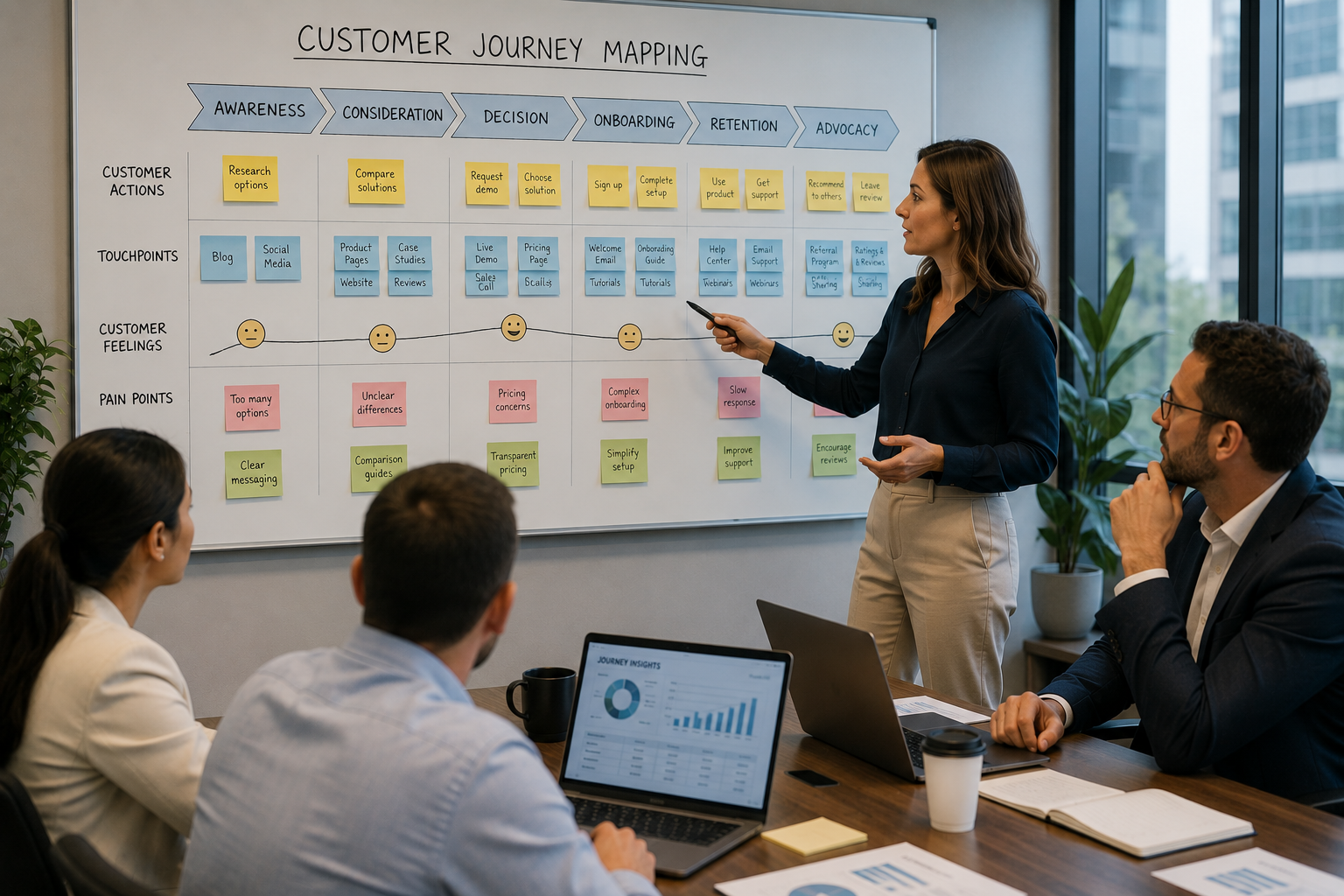
Typical stages of the customer journey include awareness, consideration, purchase, retention, and advocacy. Core components of customer journey mapping include stages, touchpoints, actions, emotions, and pain points. Our maps document all five, so your team sees where customers stall, which touchpoints provide valuable insight into what content format works at each stage, and which channels deliver more conversions per dollar spent.
How Our Journey Mapping Process Works
Every engagement follows three phases, from data collection through implementation, typically spanning 6 to 8 weeks.
Step 1: Semrush Data Collection and Audience Analysis
We start with keyword research using Semrush's Keyword Magic Tool, pulling U.S.-specific data for your industry. We check search volume trends over the past 12 months to detect seasonality and demand shifts, and we add detailed information on demand patterns to strengthen the research inputs. Customer persona development uses Semrush One2Target demographics alongside your existing CRM data, including how prospects phrase natural-language searches and use an ai prompt during modern search journeys.
The process of creating a customer journey map begins with defining clear objectives. Before we build anything, we confirm what business goals the map needs to serve: reducing acquisition cost, improving lead quality, shortening sales cycles, or increasing retention.
Timeline: 1 to 2 weeks depending on market scope.
Step 2: Journey Mapping and Touchpoint Identification
We create visual journey maps that highlight exact places of contact and documented customer emotions at each stage. Gap analysis compares your current touchpoints against competitor paths and against the user intent signals in Semrush data. Search intent can be determined by analyzing SERP features, so we examine google search results for every target keyword to confirm which content types Google prioritizes and whether results skew informational, navigational, commercial, or conversion-oriented based on user behavior.
Customer journey maps highlight the pain points where prospects abandon the funnel. Mapping helps uncover unmet customer needs from an outside-in perspective. We surface these gaps as specific recommendations: create content for an underserved informational keyword cluster, optimize content on existing service pages, build comparison article content for the consideration stage, or improve product pages that rank but don't convert, as with a running shoes query that may need stronger conversion content.
Timeline: 2 to 3 weeks for mapping and strategy development.
Step 3: Content Strategy, Implementation, and Performance Tracking
You receive an implementation roadmap with prioritized touchpoint optimizations. We set up ongoing monitoring using Semrush Position Tracking, market overview trend lines, and custom dashboards that compare year-over-year organic impressions, share of voice, and non-branded keyword growth.
Data collection for journey mapping includes customer interviews, surveys, and analytics. Effective customer journey maps should be treated as living documents that are regularly updated. We conduct a 90-day performance review, revise the map based on new data, and adjust the content strategy to reflect shifts in the market.
Proven Results for U.S. Businesses
Universal Health Services shifted SEO operations in-house using Semrush and recorded +49% conversion growth in 5 months. They scaled from 5 pilot campaigns to 50, achieving 60% cost savings in SEO delivery across hundreds of facilities.
electrIQ Marketing partnered with Wine Insiders, a wine e-commerce brand, and used Semrush Organic Research, Traffic Analytics, and Backlink Analytics to align content with journey stages. Over 15 months, the brand saw +172.75% year-over-year organic traffic, a 6x increase in non-branded visits, and 329.47% growth in revenue from organic traffic. Non-branded search traffic feeds the awareness and consideration stages; this case demonstrates what happens when you map informational keywords and commercial keywords to the right content.
Morningside Acupuncture, a New York City local service business, used Semrush Local tools including Listing Management, Map Rank Tracker, and Review Management. From late 2020 to 2021 they saw a 2,900% increase in organic web traffic, 4x revenue growth, and 50 to 75% of their customer base arriving via organic search.
Square used Semrush for Enterprise with market segmentation across U.S. regions and achieved a 30% increase in organic search traffic. The platform helped them respond to algorithm shifts and performance gaps within days rather than weeks.
Skyodin, a local SEO agency, doubled a Michigan cannabis store's weekly revenue using Semrush Local suite tools. 80% of the agency's new client acquisition came through local SEO. They saved approximately 14 hours per month by automating review management across directories.
What Our U.S. Clients Say
Customer journey mapping identifies gaps and pain points in the customer experience. Customer journey mapping aligns cross-functional teams around a single view of the customer experience. Our clients report these outcomes consistently.
Space for authentic client testimonials. Include company type, U.S. region, and measurable outcomes such as conversion rate improvements, customer acquisition cost reductions, or revenue increases. Each testimonial should reference specific journey mapping results.
U.S. Markets We Serve
- Northeast: New York, Boston, Philadelphia, Washington DC metropolitan areas
- Southeast: Atlanta, Miami, Charlotte, Nashville, Tampa regions
- Midwest: Chicago, Detroit, Minneapolis, St. Louis, Cleveland markets
- West Coast: Los Angeles, San Francisco, Seattle, Portland, San Diego areas
- Southwest: Dallas, Houston, Austin, Phoenix, Denver markets
- All 50 states: Remote journey mapping service available for businesses in any U.S. location
Customer journey mapping helps businesses visualize customer actions, thoughts, and emotions across different stages and channels. Whether your target audience is local to a single metro or distributed across regions, we build maps that reflect how people searching in your market actually behave.
Customer Journey Mapping Helps Companies Make Informed Decisions
Customer journey mapping helps a company name understand how prospects and clients move from initial awareness to a final decision. A clear table of contents can organize the journey by major stages, making it easier for teams to identify where customers need information, compare relevant products, explore a product category, or move toward a service decision. This visibility can help leaders make more informed decisions about the systems, content, and customer touchpoints that deserve attention.
Frequently Asked Questions
How much does customer journey mapping cost for U.S. businesses?
Projects range from $5,000 to $25,000 depending on business size, number of competitors analyzed, and market complexity. A single-location service business with one primary digital marketing funnel falls at the lower end. Multi-location enterprises with complex acquisition channels, mixed intent keyword clusters, and GA4 integration requirements fall at the higher end. Every engagement includes Semrush data analysis, visual journey maps, and an implementation roadmap.
How long does it take to see results from journey mapping optimization?
Initial improvements in more traffic and more conversions typically appear within 60 to 90 days of implementing recommendations. Optimizing for informational intent includes creating blogs and FAQs, which build potential traffic over 3 to 6 months. High-quality content builds trust and authority for informational searches, compounding over time. Based on U.S. case studies, conversion rate improvements of 30 to 49% are achievable within 5 to 6 months when implementation is consistent.
Do you work with Semrush data exclusively or integrate other tools?
Semrush is our primary platform for keyword research, competitor analysis, and traffic journey visualization. We integrate with Google Analytics, HubSpot, Salesforce, and other U.S. business tools to combine third-party data with your first-party conversion and CRM records. Google Keyword Planner data supplements volume estimates where needed. Your business retains ownership of all data and deliverables. Semrush's clickstream data provides the competitive intelligence layer that Google Analytics alone cannot offer; combining both eliminates blind spots in your journey map.
How does AI search affect customer journey mapping?
Semrush Journeys now tracks influence from AI search, LLM assistants, and zero-click queries. These non-traditional touchpoints reshape how U.S. consumers move through the awareness stage. People searching via AI assistants often receive summary answers without clicking through to a specific site, which means mapping influence rather than just traffic. We account for AI overviews, featured snippets, and navigational queries that bypass traditional search results when building your journey map.
Request a Customer-Journey and Systems Review Before Adding More Tools
Adding more technology will not solve a disconnected customer journey. Masterly Tech can help you review how your website, CRM, automation, data, and customer touchpoints work together so you can identify gaps before investing in additional tools.
Call Masterly Tech at (888) 209-4055 or visit https://www.masterlytechgroup.com/ to request a customer-journey and systems review.