Getting More Consultations with Google: What Every Plastic Surgeon Should Know

August 25, 2025


Why Google Is the Cornerstone of Plastic Surgery Marketing

In today's digital-first world, plastic surgeons can't afford to ignore the power of Google. From search engine result pages to Google Ads, your visibility on this platform directly impacts your ability to attract new patients. Many cosmetic surgery practices struggle not because of skill, but because of lackluster marketing strategies. Effective plastic surgery marketing is no longer optional—it's essential.


At Masterly Tech Group, we help you dominate search rankings, create high-converting landing pages, and drive more phone calls and virtual consultations. When your plastic surgery website ranks high and your ads appear in front of the right audience, you're not just seen—you're booked.


The Direct Connection Between Search Visibility and Bookings

Patients begin their journey with a search. Whether it's "breast augmentation near me" or "non-surgical facelift Dallas," your practice website must be at the top. The first page of Google is premium real estate; most patients never click beyond it.


Search engine optimization (SEO) ensures you're visible when prospective patients are searching. High rankings lead to more website content views, more patient engagement, and ultimately, more consultations.


Why SEO Matters for Plastic Surgeons

Effective SEO doesn't happen by chance. It requires:

  • Targeted keyword research
  • Fast, mobile-optimized web design
  • Unique and informative educational content
  • Strategic use of video content and patient testimonials
  • Ongoing updates to match Google's evolving algorithm


For plastic surgery practice marketing, your content must match user intent, answer questions, and establish trust with potential patients.


Google Ads: Paid Advertising that Pays Off

Google Ads and Google Adwords are game-changers for plastic surgery practices that want immediate visibility. Unlike SEO, which takes time, ads give you instant access to prospective clients searching for your services.


An optimized digital marketing campaign with proper targeting, ad extensions, and clear call-to-actions increases lead generation and consultation bookings. Pair it with strong landing pages and you're on your way to measurable results.


Crafting the Perfect Plastic Surgery Website

Your plastic surgery website design should be more than beautiful—it should convert. A clean, professional layout combined with:

  • Clear navigation
  • Trust-building patient reviews
  • Interactive before-and-after galleries
  • Detailed information about cosmetic procedures and reconstructive surgery


These elements drive patient trust and keep users engaged.


How Social Media Marketing Complements Google Strategies

Your social media presence builds community and keeps your plastic surgery brand top of mind. Platforms like Instagram and Facebook are ideal for showcasing results, promoting non-surgical procedures, and running social media ads.


But for maximum impact, your social media marketing must align with your SEO and ad strategies. When done right, it helps convert followers into loyal patients.


The Power of Integrated Marketing Campaigns

A one-off ad won’t get you sustained results. What works is a cohesive strategy where all channels talk to each other: SEO, online marketing, email marketing, and social media platforms.

For example:

  • A social media engagement post links to a blog post
  • The blog post is optimized for SEO
  • The blog captures emails for a nurturing leads sequence
  • Emails drive readers to book a virtual consultation or call


This multi-touch approach is what sets top-performing cosmetic surgery businesses apart.


Using Email Marketing to Nurture Leads

Don’t ignore your email list. An email marketing campaign can nurture hesitant leads and turn them into plastic surgery patients. Share educational blog posts, special offers, video content, or success stories.


Consistent email contact keeps your practice website and services front of mind, reinforcing your authority and encouraging bookings.


Attracting the Right Target Audience with Google

Many plastic surgeons waste money advertising to the wrong people. Google allows detailed targeting by:

  • Location
  • Search intent
  • Device type
  • Time of day


Targeting helps you attract potential clients who are ready to book now, not just browsers. This is where working with a specialized marketing agency makes a huge difference.


Reviews, Testimonials, and Social Proof

Never underestimate the power of word of mouth online. Patient testimonials, Google reviews, and star ratings are often the tipping point for prospective patients deciding between your plastic surgery clinic and a competitor.


Showcasing real feedback builds credibility. Incorporating these into your web pages, landing pages, and ads boosts conversions.


Why Video Content Matters in Marketing for Plastic Surgeons

Video is a powerful trust-builder. It shows your personality, educates, and reassures viewers. Whether it's a surgeon answering FAQs or a patient sharing their journey, video content dramatically increases social media engagement and time spent on site.


Your digital marketing strategy must include professional, authentic media created for both your plastic surgery website and social media platforms.


Going Beyond Basic Marketing Plans

An effective marketing plan should be tailored to your goals. Whether you're launching a private practice, expanding services like breast augmentation, or promoting non-surgical procedures, your plan must include:

  • SEO audits and updates
  • Google ad strategy
  • Retargeting ads for returning visitors
  • Monthly content calendar
  • Conversion-focused web design enhancements


Having an in-house team often isn’t enough. Partnering with experts in marketing for plastic surgeons brings specialized knowledge and proven systems.


Converting More Leads Through Better Web Design

Design isn’t just aesthetics—it’s about function. Your practice website must load quickly, be mobile-friendly, and clearly explain services like cosmetic surgery, reconstructive surgery, and more.

Incorporate:

  • Lead forms above the fold
  • Trust badges and certifications
  • Chat widgets for instant communication


These features increase more leads and help plastic surgery practices connect with potential patients at critical decision moments.


What Most Patients Are Looking for Online

Your target patients are searching for:

  • Proof of results (photos, reviews)
  • Doctor credentials
  • Safety and comfort
  • Cost and financing


Ensure your web pages and marketing campaigns address these areas clearly. When you meet their needs upfront, booking a consultation becomes the next logical step.


Marketing Strategies That Work Without Guesswork

Guesswork is costly. Real success comes from analytics-backed strategy. We help plastic surgeons test ad performance, measure click-through rates, monitor keyword trends, and refine digital marketing tactics in real time.


This data-driven approach drives better search rankings, smarter ad spend, and more patient bookings.


Generating More Leads with Better Content

Quality content builds trust and improves your Google ranking. Mix up your website content with:

  • How-to articles
  • Procedure overviews
  • Doctor Q&As
  • Before-and-after videos


This drives traffic from search engine results and engages prospective patients more effectively than salesy content.
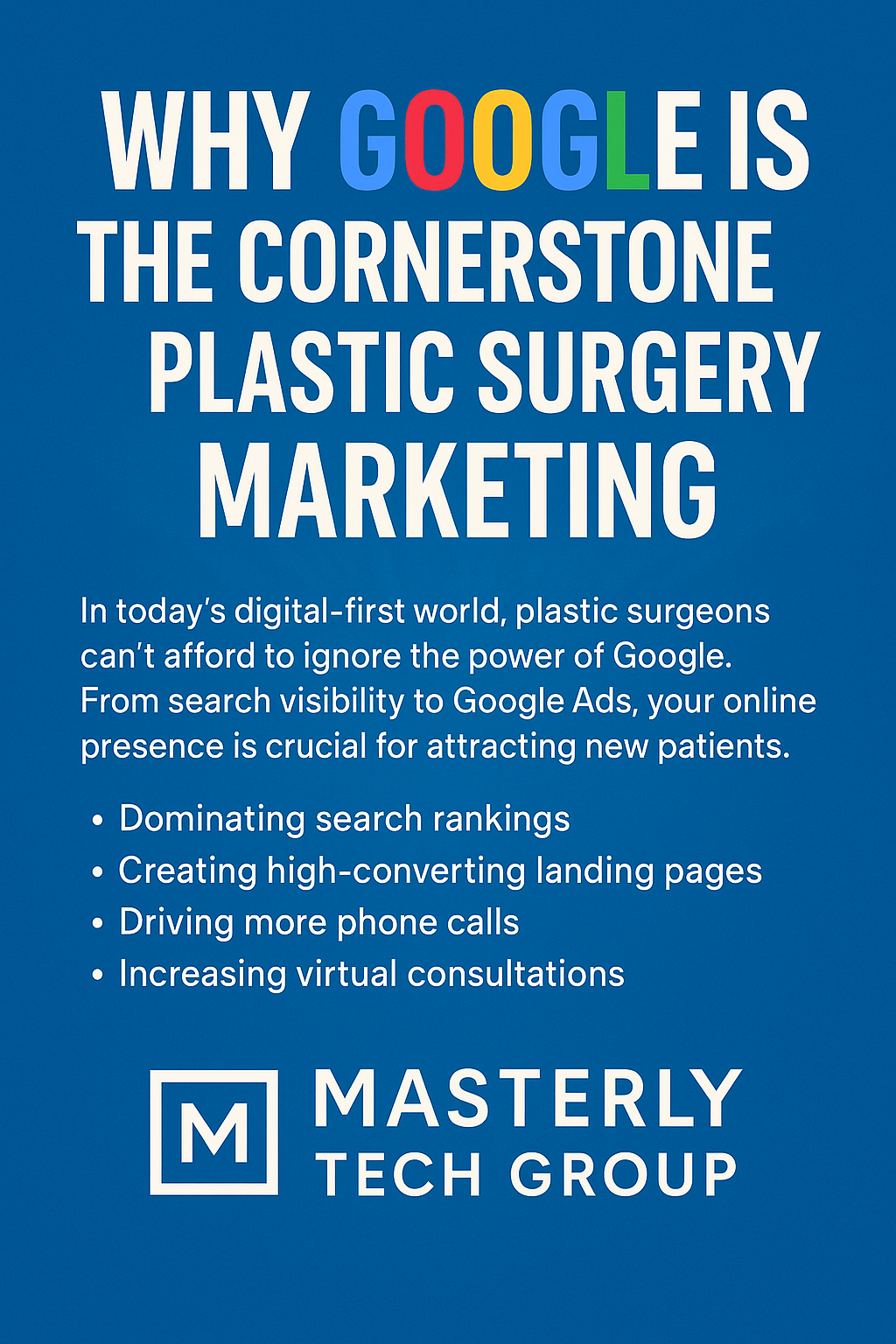
Digital graphic titled “WHY GOOGLE IS THE CORNERSTONE PLASTIC SURGERY MARKETING” with “GOOGLE” stylized in its iconic blue, red, yellow, and green colors. The background is a clean blue, and the text emphasizes the importance of Google for plastic surgeons' marketing success. Below the heading, a paragraph explains the need for search visibility and online presence, followed by bullet points listing strategies like dominating search rankings, creating high-converting landing pages, driving more phone calls, and increasing virtual consultations. At the bottom, the logo and name “MASTERLY TECH GROUP” appear in white with a boxed “M” icon.


Using Direct Mail to Support Digital Campaigns

While digital dominates, direct mail still has a place. Send postcards linking to custom landing pages, or mail invites to virtual consultations. When paired with online marketing, direct mail offers another personalized touchpoint.


Done correctly, it's another tool to increase visibility and appointments.


Building a Plastic Surgery Brand Patients Trust

Your plastic surgery brand is more than a logo—it's the feeling your patients get when they see your content. Consistency in tone, imagery, and messaging across social media, paid advertising, and your plastic surgery website is key.


People buy from those they trust. Make trust the core of your marketing strategies.


How a Marketing Agency Can Maximize Your Growth

An experienced marketing agency understands what drives patients in your field. At Masterly Tech Group, we specialize in plastic surgery practice marketing that drives measurable results. We handle everything from media production to ad targeting and SEO.


Outsourcing to experts lets your team focus on what you do best—surgery. We handle the lead generation engine behind the scenes.


Smart Campaigns for Cosmetic Surgery Success

Whether you're offering cosmetic procedures, reconstructive surgery, or non-surgical treatments, your marketing must evolve. Targeting, messaging, and design must be continuously refined.


With the right tools, data, and strategy, your cosmetic surgery business can rise above competitors and attract higher-quality prospective patients.


Amplifying Reach and Bookings Through Plastic Surgeons’ Social Media and Online Visibility

In today’s competitive market, promoting your plastic surgery services through well-planned digital efforts is no longer optional—it’s essential. A growing number of plastic surgeons reported increased consultation rates when they aligned their Google Ads and SEO strategies with high-impact social content. Strong plastic surgeons social media profiles not only showcase results but also humanize your brand, making it easier for potential clients to connect and trust your expertise. By integrating paid search with authentic, educational, and visual storytelling online, your practice can effectively reach new audiences and turn casual browsers into committed patients.


Building Trust That Converts: What Your Online Presence Says to Patients

Today’s successful plastic surgery practice isn’t just defined by the results in the operating room—it’s shaped by how well it connects with plastic surgery patients online. Boosting patient engagement through responsive design, transparent communication, and meaningful content helps create trust before a patient ever walks through your door. When new patients see consistent branding, educational posts, and authentic patient reviews, they’re more likely to choose your practice over a competitor. Establishing that connection online is one of the most effective ways to drive real-world bookings and long-term loyalty.


Turning Website Traffic into Booked Consultations with Smart Landing Pages

A well-optimized plastic surgery practice website is only as effective as the experience it offers to visitors. To convert new patients, you need high-performing landing pages that speak directly to the concerns and goals of plastic surgery patients. These pages should highlight key procedures, include real patient reviews, and encourage interaction through clear calls-to-action and contact options. Boosting patient engagement online not only builds trust but also increases the chances that a visitor becomes a booked consultation. When executed correctly, these strategies consistently bring more qualified traffic and leads into your consultation calendar.


Turning Clicks into Consultations: Engaging Patients at Every Digital Touchpoint

A thriving plastic surgery practice isn't built on visibility alone—it’s built on meaningful connections. Today’s plastic surgery patients want more than flashy ads; they want trust, education, and a personalized experience. That’s why boosting patient engagement through responsive websites, interactive content, and real-time communication tools is essential. From showcasing patient reviews to simplifying online booking, every digital element should be focused on attracting and converting new patients. The more value you provide upfront, the more confident prospective clients will feel about choosing you for their care.


Why Digital Marketing for Plastic Surgeons Is the Key to Practice Growth

In a highly visual and competitive field, digital marketing plastic surgeons rely on isn’t just about visibility—it’s about strategy that delivers results. From search engine optimization to Google Ads and social media campaigns, digital tools help you attract, educate, and convert high-value patients. With the right approach, your online presence becomes more than a brochure—it becomes a powerful patient acquisition system. At Masterly Tech Group, we specialize in crafting campaigns tailored to the unique needs of cosmetic and reconstructive practices, ensuring your brand stands out and your calendar fills up.


Designing a Digital Marketing Campaign That Fills Your Consultation Calendar

A successful digital marketing campaign for plastic surgeons is more than just running ads—it’s a coordinated strategy designed to attract, educate, and convert. From search engine visibility to compelling landing pages and targeted social media promotions, each element should drive prospective patients toward booking a consultation. Consistency across platforms builds trust, while data-driven adjustments ensure your campaign remains effective and efficient. When every touchpoint is aligned with your practice goals, your campaign becomes a patient-generating machine—not just a marketing expense.


Contact Us for a Free Marketing Consultation

At Masterly Tech Group, we help plastic surgery clinics and private practices get booked through smarter digital strategies. Whether you need to increase Google ranking, build high-converting landing pages, or run smarter social media ads, our team is here to help.


Contact us at (888) 209-4055 to book a free consultation. Let us answer your questions and show you how better marketing can bring more consultations to your practice.

(888) 209-4055

Customer lifecycle stages from awareness to retention and referral.
August 28, 2026
Improve the customer lifecycle by aligning customer lifecycle stages, the client lifecycle, and the customer retention journey to support loyalty and growth.
Website strategy showing planning, goals, and user experience.
August 28, 2026
Build a website strategy that aligns website planning, web strategy, and clear website goals to improve user experience, conversions, and long-term growth.
Data strategy showing governance, management, and business reporting.
August 28, 2026
Build a business data strategy that strengthens data governance, improves reporting, and creates a clear data management strategy for better decisions and growth.
Customer experience management across key client touchpoints.
August 28, 2026
Strengthen customer experience management with a clear customer experience strategy, consistent CX management, and better overall client experience management.
August 28, 2026
When your marketing campaigns aren't delivering measurable results and you're struggling to justify marketing spend to stakeholders, comprehensive marketing analytics provides the insights you need to optimize performance and prove ROI. Our marketing analytics services help businesses across all industries transform raw data into actionable strategies that drive growth and revenue generated from every dollar invested. Get a free marketing analytics audit and discover how to maximize your marketing ROI. Why Businesses Trust Our Marketing Analytics Expertise Certified Google Analytics and marketing automation specialists with 8+ years of experience in digital marketing analytics Average client sees 40% improvement in marketing ROI within 90 days through data driven decision making Over 500 successful marketing analytics implementations across Fortune 500 and SMB clients Why Companies Choose Our Marketing Analytics for Business Growth Marketing professionals today face a critical challenge: too much marketing data spread across multiple platforms with no unified way to extract valuable insights. Our data-driven approach transforms marketing guesswork into strategic decision-making, helping you allocate budgets more effectively and achieve sustainable growth. Companies using marketing analytics can increase ROI by 15-20%, and effective marketing analytics can reduce operational costs by 70%. Multi-touch attribution modeling reveals true customer journey impact across all channels - multi-touch attribution captures the influence of multiple touchpoints, giving marketing teams a better understanding of what actually drives conversions rather than relying on last-click assumptions Real-time dashboards provide instant visibility into campaign performance and key performance indicators, allowing for immediate adjustments to marketing strategies based on performance metrics - so your marketing departments never operate on stale performance data Predictive analytics forecasting helps optimize future marketing activities and budgets - predictive analytics forecasts future consumer behaviors and trends using historical data, turning your marketing strategy from reactive to proactive Our Marketing Analytics Services Comprehensive analytics capabilities designed to measure, optimize, and scale your marketing efforts across all marketing channels and multiple touchpoints. Campaign Performance Analytics Campaign analytics measures performance signals like reach and conversions across every platform where you run ads. We track and analyze paid advertising campaigns across Google Ads, Facebook, LinkedIn, and other platforms. PPC analytics tracks ad performance across platforms like Google and Facebook, measuring ROAS, conversion rate, click through rates, and customer acquisition cost to optimize ad campaigns. Campaign analytics helps identify gaps by comparing results to benchmarks, ensuring every dollar of ad spend works harder. Effective campaign analytics requires clean and trustworthy data - which is why data management is central to everything we do. Customer Journey Analytics Map complete customer journeys from awareness to conversion using multi-touch attribution. Multi-touch attribution analyzes multiple interactions leading to conversions, helping you identify high-value touchpoints and optimize the path to purchase. Marketing analytics helps identify the most effective customer touchpoints, improving customer experience and revealing where potential customers drop off. Multitouch attribution allows analysis across multiple devices and channels, giving your marketing executives full visibility into how different campaigns contribute to sales outcomes. Marketing Mix Modeling Advanced statistical analysis to determine optimal budget allocation across marketing channels. Marketing mix modeling evaluates the impact of various marketing channels - including offline efforts like events and print alongside digital - on total revenue. Incrementality testing isolates the true impact of marketing efforts, ensuring you understand true campaign impact rather than just correlation. Budget optimization reallocates funds to high-performing marketing channels based on data, so your marketing budget delivers maximum return on investment. Web and SEO Analytics Comprehensive website performance tracking including organic traffic, user behavior, conversion paths, and SEO performance. SEO analytics focuses on data to grow organic traffic and conversions from search engines. Google Analytics 4 tracks user behavior across different sessions, providing granular data points on how visitors interact with your content. We identify content creation and technical optimization opportunities that improve visibility for your target audience. How Our Marketing Analytics Process Works Our systematic approach ensures accurate data collection, meaningful data insights, and actionable recommendations for marketing optimization. Step 1: Marketing Data Audit and Strategy Planning Comprehensive review of existing marketing data sources, business goals, and key metrics. An analytics framework connects marketing activities to business outcomes to guide strategies. We catalog every data source - from CRM and customer data to web analytics and social media analytics - to identify gaps and establish a single source of truth. Data collection and integration unify information from marketing channels into a single source of truth. Step 2: Implementation and Integration Set up tracking systems, connect data sources, and configure dashboards across multiple channels. Tableau visualizes marketing data in real-time dashboards. HubSpot combines analytics and CRM solutions in one package. Databox centralizes marketing data from multiple platforms, while Supermetrics automates data transfer into reporting tools. Marketing data warehouses centralize data from different channels, ensuring your marketing analytics software infrastructure is built for scale and accuracy. Step 3: Analysis and Optimization Ongoing performance monitoring, insight generation, and strategic recommendations. We apply A/B testing - which compares two versions to determine better performance - alongside incrementality testing and customer segmentation that enhances targeting by grouping customers based on behavior and demographics. Monthly reports with actionable insights and specific steps to improve marketing ROI and efficiency. Data storytelling provides context to marketing data for better insights, ensuring marketing decisions are understood by every stakeholder. Marketing Analytics Success Stories Real results from clients who transformed their marketing performance through data driven marketing and optimization strategies. E-commerce client increased ROAS by 65% through improved attribution modeling and budget reallocation - proving that marketing attribution is one of the most powerful tool available for measuring campaign ROI and optimizing specific campaigns SaaS company reduced customer acquisition cost by 45% using funnel analytics and conversion optimization - common metrics include customer acquisition cost (CAC), return on ad spend (ROAS), and revenue, and this client saw dramatic improvements across all three Manufacturing business improved lead quality by 80% through enhanced lead scoring and analytics insights - customer lifetime value (CLV), which represents the total net profit from a customer over the relationship duration, increased substantially as a direct result These outcomes reflect what data-driven marketing strategies can achieve: enhanced customer engagement significantly and measurable business cost reductions. What Our Clients Say Testimonials from marketing directors and business owners who have experienced measurable improvements through our analytics expertise. Include actual client testimonials with specific results and attribution Feature quotes about improved decision-making and campaign effectiveness Highlight testimonials from relevant industries and company sizes  Industries We Serve Specialized marketing analytics expertise across diverse industries and business models. Marketing analytics improves decision-making with data-driven insights regardless of your sector - and today, marketing analytics is standard practice in most businesses for good reason. E-commerce and retail businesses seeking to optimize online sales, social media channels performance, and customer lifetime value through performance marketing B2B technology companies focused on lead generation, sales pipeline analytics, and measuring how paid ads and content creation contribute to revenue across different channels Healthcare and professional services tracking patient acquisition , referral patterns, and measuring how social media analytics and email analytics contribute to growth - email analytics measures open rates, spam rates, and conversion rates for ongoing campaigns Financial services measuring compliance-friendly marketing performance, customer acquisition, and key factors driving long-term retention
Connected martech stack with integrated marketing tools and systems.
August 28, 2026
Build a connected martech stack that aligns martech tools, data, automation, and marketing systems to improve visibility, efficiency, and customer growth today.
Website architecture with clear site hierarchy and navigation.
August 28, 2026
Build better website architecture with a clear site hierarchy, intuitive navigation, and information architecture that helps visitors find key pages and convert.
Landing page design with clear CTAs, forms, and mobile UX.
August 28, 2026
Improve landing page design with a clear layout, strong UX, credible proof, streamlined forms, CTA hierarchy, and mobile design that supports more conversions.
By Angelie Te August 27, 2026
Most growing businesses hit the same wall. Leads pour in from paid ads, organic traffic, events, referrals, and social media engagement, and lead scoring—whether you’re prioritizing U.S. demand from SEMrush-driven acquisition or other channels—is the method for ranking those leads by fit and intent so sales knows who to contact first. For sales leaders, marketing teams, and business decision-makers managing high-volume U.S. pipelines, that means faster response times, better sales-and-marketing alignment, and more conversions without adding headcount. The pipeline looks healthy on paper, but the sales team can only make so many calls per day, and not every lead deserves the same level of urgency. This guide explains the fundamentals of lead scoring, how to build and test a scoring model, which data inputs to use, how to separate fit from intent, when to automate, which pitfalls to avoid, and what that looks like in practical U.S. demand examples. Why Lead Scoring Matters When Your Pipeline Starts To Overflow When leads arrive faster than reps can follow up, three things break down. First, response times stretch. A prospect who requested a demo on Monday might not hear back until Thursday, by which point they have already booked a call with a competitor. Second, reps start cherry-picking. Without a clear system, salespeople default to gut instinct, pursuing leads that "feel" right while ignoring others that may convert at a higher rate. Third, marketing loses visibility into what happens after handoff, making it nearly impossible to measure which campaigns produced revenue and which just produced noise. Sales reps spend roughly 8% of their time prioritizing leads and opportunities. That number climbs when there is no scoring system and reps have to manually sort through CRM records, a time-consuming process, to decide who deserves a call. Lead scoring improves the likelihood of closing deals by timely follow-ups, because the highest-intent prospects get reached while their interest is still fresh. Lead scoring is a systematic way to rank prospects so the sales team knows who to call, when, and with what urgency. Prospects receive points based on explicit and implicit data. The result is a prioritized list that replaces guesswork with a repeatable scoring model tied to actual revenue outcomes. The business value is straightforward: faster response times for the right people, more deals without adding headcount, and a clearer handoff between marketing and sales. The process follows a simple sequence: a lead enters the system, gets scored on fit and buyer intent, is routed based on the score, and the outcome (won, lost, or still nurturing) feeds back into the model to better coordinate marketing efforts. What Lead Scoring Should Help a Team Decide  Before building any model, define what decisions it must support. Lead scoring helps sales teams focus on high-value leads, but only if the team agrees on what those decisions look like. Core decisions a lead scoring model should answer: Who gets outreach first? Which leads receive a same-day phone call versus a three-day email sequence? What counts as a Marketing Qualified Lead (MQL)? At what score does marketing hand a lead to sales? Which leads stay in nurture? Low scores should not be deleted; they should enter an automated email track until behavior changes. Which leads get disqualified? Competitors, student emails, and companies outside the serviceable market should lose points, not gain them. Lead scoring helps categorize leads as hot, warm, or cold. A concrete SDR workflow might look like this: leads scoring above 70 become same-day call priorities; leads between 40 and 69 enter an email cadence; leads under 40 stay in nurture until new activity pushes them up. Consider a U.S. B2B SaaS company generating 2,000+ new leads per month from SEO campaigns, paid search, and webinars. Without scoring, reps treat every inbound form fill the same. With scoring, the team can segment by sales priority and focus on the leads most likely to convert.
Marketing dashboard with KPIs and lead metrics.
August 27, 2026
Build a marketing dashboard that connects marketing KPIs, campaign reporting, lead metrics, conversion data, and pipeline insights for clearer, smarter decisions.