
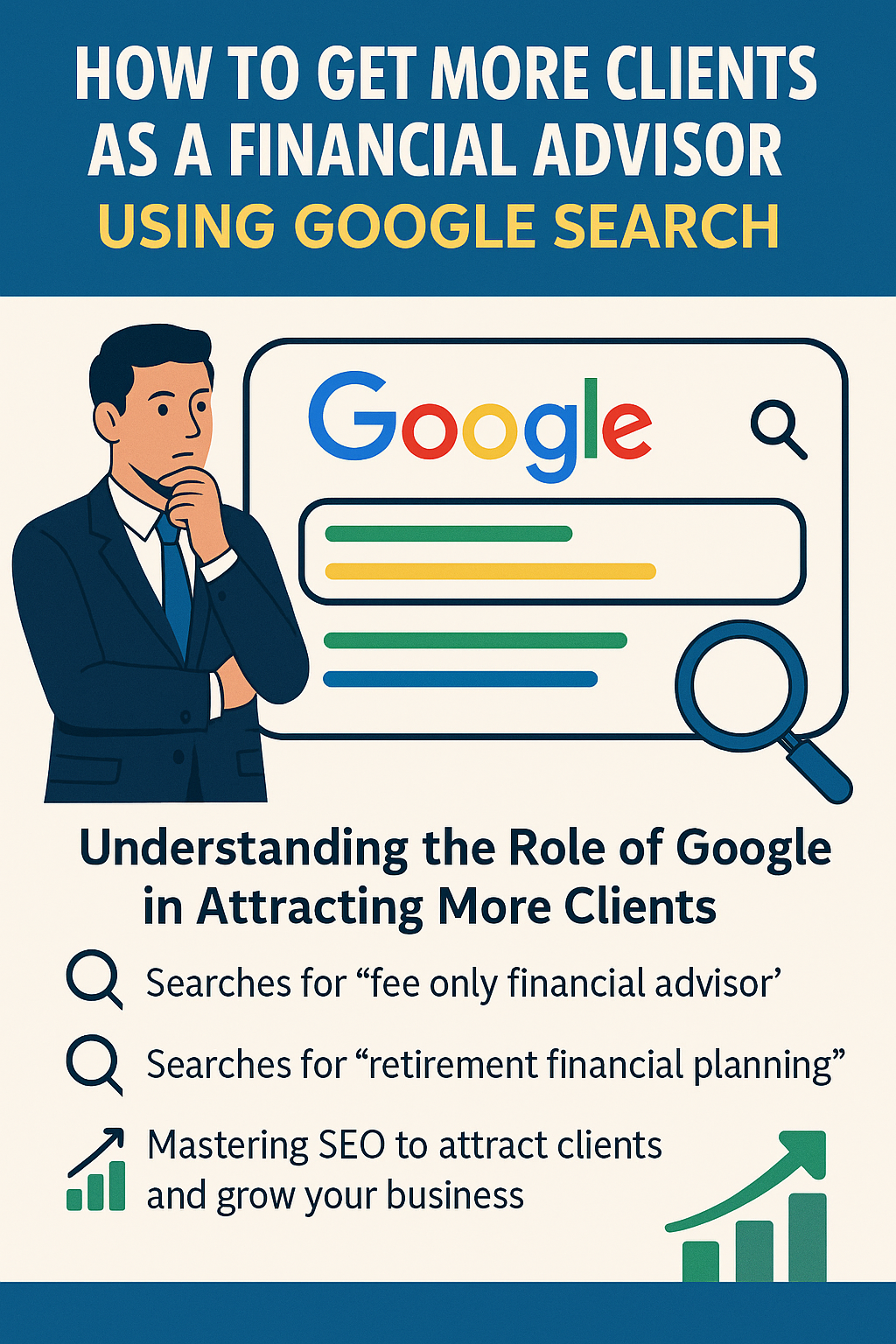
How to Get More Clients as a Financial Advisor Using Google Search

August 25, 2025


Understanding the Role of Google in Attracting More Clients

Google has become the go-to platform for prospective clients looking for financial guidance. Whether they are searching for "fee only financial advisor" or "retirement financial planning," potential clients are using search engines to find professionals they can trust. For financial advisors, mastering search engine optimization (SEO) is no longer optional—it's essential for business growth.


Using Google effectively means understanding how search engine algorithms work, knowing which keywords people use, and optimizing your web page to appear at the top of the search engine results pages. With the right strategies, you can build authority, increase visibility, and ultimately bring in more clients.


The Importance of SEO for Financial Advisors

SEO for financial advisors is a targeted approach that allows professionals to appear prominently in Google search results. Since most people never scroll past the first page of search engine results, failing to rank high can mean missing out on countless prospective clients.

Proper SEO efforts position your financial advisor business in front of people actively searching for your services. With consistent and strategic implementation, SEO becomes one of the most cost-effective marketing efforts for long-term client acquisition.


How Search Engines Influence Financial Planning Decisions

Search engines are the first step for many people when they begin their financial planning journey. Whether it’s budgeting, retirement, or investing, users type queries into the search bar to find answers. If your website isn’t optimized with relevant keywords and high quality content, you’re losing valuable exposure.


Appearing in the top search engine rankings helps you build credibility and trust. The higher your position in the search engine results pages, the more likely it is that a prospective client will contact you for a consultation.


Conducting Effective Keyword Research

Keyword research is the foundation of any strong SEO program. It involves identifying the terms your potential clients are using when they search for financial advice. Tools like Google Analytics, Google Search Console, and other online tools can help you determine which keyword phrases have the right balance of search volume and keyword difficulty.


Look for long tail keywords like "retirement planning for small business owners" or "best financial advisor in Dallas." These terms may have lower search volume but attract high-intent users who are closer to making a decision.


Utilizing Keyword Research Tools

Keyword research tools provide insights that can shape your entire content strategy. These platforms show:

  • Search volume trends
  • Keyword rankings across devices
  • Related search terms and long tail keywords


By targeting both basic keywords and more specific keywords, you increase your reach while staying relevant. Focus on keyword strategies that reflect the questions your ideal client is asking.


Optimizing Your Web Page with On Page SEO

On page SEO includes everything on your website that helps search engines understand your content. This includes your:

  • Page title
  • Meta description
  • Headings
  • Keyword placement
  • URL structure


Make sure each web page focuses on a particular keyword relevant to the topic. Use variations of that keyword to signal relevance to search engines while maintaining a natural flow for readers.


Creating High Quality Content That Ranks

Creating content that ranks higher in Google requires more than stuffing in keywords. Your content must be valuable, clear, and easy to read. Blog posts should answer real questions your prospective clients have and provide solutions to their problems.

Financial advisors should focus on:

  • Educational articles on retirement, savings, and investment
  • Case studies or testimonials from satisfied clients
  • Simple explainers on complex financial topics


Leveraging Local SEO to Attract Nearby Clients

Local SEO focuses on helping you appear in search results for users in your geographic area. When a potential client types "financial advisor near me" or "Dallas retirement planner," your listing should appear in the local search pack.

To improve local SEO:

  • Create or claim your Google Business Profile
  • Include local keywords throughout your site
  • Add location tags to page titles and meta descriptions
  • Use consistent NAP (Name, Address, Phone) information across the web


Understanding Google Business Profile Optimization

Google Business Profile is essential for local visibility. A fully optimized profile includes:

  • Accurate contact details
  • Business hours
  • Customer reviews
  • Photos of your office or team


Encourage satisfied clients to leave reviews. Positive feedback improves your credibility and increases chances of appearing in local search results.


Using Google Search Console to Monitor Performance

Google Search Console provides insights into how your web pages perform in Google Search. It shows:

  • Which keywords bring users to your site
  • Your position in search engine rankings
  • Click-through rates for each page


Use this data to adjust your SEO strategies. If a blog post ranks for a relevant keyword but gets few clicks, update the meta description or page title to make it more compelling.


Implementing Technical SEO Best Practices

Technical SEO ensures your website is structured for search engines to crawl and index properly. Common elements include:

  • Fast loading speed
  • Mobile responsiveness
  • Secure HTTPS connection
  • Clean and organized site architecture


Even the best content won’t rank if technical issues prevent search engines from reading your site effectively.


Building Quality Backlinks Through Off Page SEO

Off page SEO involves activities outside your website that affect your ranking. The most important factor here is link building. Earning backlinks from authoritative websites boosts your site’s credibility.

Financial advisors can build links by:

  • Writing guest blog posts
  • Collaborating with financial publications
  • Getting listed in online business directories


Each quality backlink signals to Google that your content is trustworthy and valuable.


Enhancing Your SEO Work with Ongoing Adjustments

SEO is not a one-time task. Regular updates to your site and content ensure you stay competitive. Monitor keyword rankings, test new strategies, and continue creating content that addresses evolving client needs.

Stay up to date with search engine optimization SEO changes to maintain strong search engine results.


The Role of Blog Posts in Attracting Website Traffic

Blog posts give financial advisors the opportunity to rank for a variety of different keywords. Regular content creation increases your visibility and helps prospective clients find you through organic search.

Post topics may include:

  • "Top 5 Financial Planning Mistakes"
  • "How to Save for Retirement in Your 30s"
  • "Fee Only Financial Advisor vs. Commission-Based"


Each article should be optimized with on page SEO techniques and include internal links to your main service pages.


Tracking SEO Progress with Google Analytics

Google Analytics provides detailed insights into user behavior on your site. You can see:

  • Where your traffic is coming from
  • Which pages are most popular
  • How long users stay on each page


This information helps you refine your marketing strategy and identify which SEO efforts are producing results.


Improving Keyword Rankings Through Strategic Content

To improve keyword rankings, align your content with the user’s search intent. If someone searches "how to retire early," they expect a step-by-step guide—not a sales pitch.

Answer their questions directly, provide real examples, and end with a call to action that invites them to book a consultation. This increases engagement and supports higher rankings in search engine results pages.


Common SEO Mistakes Financial Advisors Should Avoid

Avoiding SEO mistakes is just as important as doing things right. Common issues include:

  • Keyword stuffing
  • Duplicate content
  • Broken links
  • Ignoring mobile optimization


Review your website regularly to ensure it aligns with current SEO best practices.
How to Get More Clients as a Financial Advisor Using Google Search.


Aligning SEO Strategies with Your Marketing Goals

SEO should not operate in isolation. It must align with your larger marketing efforts to be truly effective. Combine search engine optimization with email campaigns, social media, and content marketing to build a cohesive presence.


The more channels your brand appears on, the more trustworthy and familiar you become to prospective clients.


Final Thoughts on Growing Your Financial Advisor Business with SEO

Google is a powerful tool for financial advisors who want to grow their client base. With the right SEO strategies, your firm can dominate local search results, rank higher on national terms, and build lasting credibility online.


It all starts with optimizing your site, targeting the right keywords, and maintaining consistent effort across your web presence. Every day you delay your SEO efforts is a day potential clients are choosing your competitors instead.


How Financial Planners Can Leverage Long Tail Keywords for Better Visibility

For any financial planner aiming to attract more clients online, focusing on long tail keywords is a smart move. These specific, intent-driven phrases—like “financial planner for self-employed professionals” or “estate planning advisor for retirees”—are less competitive and more targeted. Incorporating them into your keyword strategies allows you to reach prospective clients who are searching for exactly what you offer. Unlike broad terms, long tail keywords often bring in higher-quality leads because they reflect deeper search intent. By aligning your services with these refined keyword strategies, you increase your chances of being found by clients ready to take action.


Strengthen Your Online Presence with Smart Keyword Strategies

For financial advisors looking to appear at the top of search engine results, effective keyword strategies are essential. Instead of relying solely on broad terms, successful SEO campaigns use a mix of competitive phrases and niche-specific long tail keywords that match exactly what prospective clients are searching for. By aligning your website content with the real questions and needs of your audience, you increase your chances of ranking higher and attracting more qualified leads. Strategic keyword use isn’t just about traffic—it’s about visibility to the right people at the right time. With the right keyword strategies in place, your digital footprint becomes a magnet for growth.


Using SEO Services and Tools to Drive Consistent Website Traffic

To grow your financial advisory business online, you need more than just a basic understanding of SEO keywords—you need a full digital marketing approach that integrates powerful seo tools and proven seo services. High-performing websites drive traffic by optimizing for key ranking factors like content quality, page speed, and backlinks from other websites. These signals show search engines that your site is trustworthy and relevant, which directly improves your seo rankings. Earning mentions and links from other sites further boosts your visibility and authority. By investing in the right tools and strategies, financial advisors can create a digital presence that consistently brings in qualified leads and long-term clients.


Boosting SEO Rankings with the Right Tools and Strategies

Financial advisors who want to stand out online must treat SEO as a core part of their digital marketing strategy—not an afterthought. Using the right SEO tools can help you identify powerful seo keywords, monitor performance, and improve your site’s ranking factor across search engines. It’s also important to earn backlinks from other websites and other sites relevant to your industry, which signals authority to Google. Professional seo services can streamline this process and ensure your web pages are fully optimized to drive traffic from qualified leads. When done correctly, these techniques can significantly enhance your seo rankings and help your business become more discoverable by clients actively searching for financial expertise.


Targeted Content Creation and Local Search: The Key to Standing Out

To truly compete in your area, financial advisors must combine local search optimization with smart content creation. A financial planner serving a specific city or region should focus on developing blog posts and service pages that include geographic terms and long tail keywords such as “retirement financial planner in Austin” or “college savings plan for Houston families.” These keyword strategies help narrow your audience and attract more high-intent users in your community. Local search tactics paired with valuable content make it easier for your website to appear when potential clients search for nearby financial planning help. The more relevant and location-specific your content is, the higher your chances of converting searchers into loyal clients.


Contact Us to Start Growing Your Client Base Through Google

If you're ready to attract more clients and grow your business using proven SEO for financial advisors, we’re here to help. At Masterly Tech Group, we specialize in crafting SEO strategies that put your services in front of the people who need them most.


Contact us at (888) 209-4055 to book a free consultation. We’ll walk you through the essential steps for boosting your visibility on Google, improving your keyword rankings, and generating more qualified leads. Let us help you turn your website into your most powerful lead generator.

(888) 209-4055

Customer lifecycle stages from awareness to retention and referral.
August 28, 2026
Improve the customer lifecycle by aligning customer lifecycle stages, the client lifecycle, and the customer retention journey to support loyalty and growth.
Website strategy showing planning, goals, and user experience.
August 28, 2026
Build a website strategy that aligns website planning, web strategy, and clear website goals to improve user experience, conversions, and long-term growth.
Data strategy showing governance, management, and business reporting.
August 28, 2026
Build a business data strategy that strengthens data governance, improves reporting, and creates a clear data management strategy for better decisions and growth.
Customer experience management across key client touchpoints.
August 28, 2026
Strengthen customer experience management with a clear customer experience strategy, consistent CX management, and better overall client experience management.
August 28, 2026
When your marketing campaigns aren't delivering measurable results and you're struggling to justify marketing spend to stakeholders, comprehensive marketing analytics provides the insights you need to optimize performance and prove ROI. Our marketing analytics services help businesses across all industries transform raw data into actionable strategies that drive growth and revenue generated from every dollar invested. Get a free marketing analytics audit and discover how to maximize your marketing ROI. Why Businesses Trust Our Marketing Analytics Expertise Certified Google Analytics and marketing automation specialists with 8+ years of experience in digital marketing analytics Average client sees 40% improvement in marketing ROI within 90 days through data driven decision making Over 500 successful marketing analytics implementations across Fortune 500 and SMB clients Why Companies Choose Our Marketing Analytics for Business Growth Marketing professionals today face a critical challenge: too much marketing data spread across multiple platforms with no unified way to extract valuable insights. Our data-driven approach transforms marketing guesswork into strategic decision-making, helping you allocate budgets more effectively and achieve sustainable growth. Companies using marketing analytics can increase ROI by 15-20%, and effective marketing analytics can reduce operational costs by 70%. Multi-touch attribution modeling reveals true customer journey impact across all channels - multi-touch attribution captures the influence of multiple touchpoints, giving marketing teams a better understanding of what actually drives conversions rather than relying on last-click assumptions Real-time dashboards provide instant visibility into campaign performance and key performance indicators, allowing for immediate adjustments to marketing strategies based on performance metrics - so your marketing departments never operate on stale performance data Predictive analytics forecasting helps optimize future marketing activities and budgets - predictive analytics forecasts future consumer behaviors and trends using historical data, turning your marketing strategy from reactive to proactive Our Marketing Analytics Services Comprehensive analytics capabilities designed to measure, optimize, and scale your marketing efforts across all marketing channels and multiple touchpoints. Campaign Performance Analytics Campaign analytics measures performance signals like reach and conversions across every platform where you run ads. We track and analyze paid advertising campaigns across Google Ads, Facebook, LinkedIn, and other platforms. PPC analytics tracks ad performance across platforms like Google and Facebook, measuring ROAS, conversion rate, click through rates, and customer acquisition cost to optimize ad campaigns. Campaign analytics helps identify gaps by comparing results to benchmarks, ensuring every dollar of ad spend works harder. Effective campaign analytics requires clean and trustworthy data - which is why data management is central to everything we do. Customer Journey Analytics Map complete customer journeys from awareness to conversion using multi-touch attribution. Multi-touch attribution analyzes multiple interactions leading to conversions, helping you identify high-value touchpoints and optimize the path to purchase. Marketing analytics helps identify the most effective customer touchpoints, improving customer experience and revealing where potential customers drop off. Multitouch attribution allows analysis across multiple devices and channels, giving your marketing executives full visibility into how different campaigns contribute to sales outcomes. Marketing Mix Modeling Advanced statistical analysis to determine optimal budget allocation across marketing channels. Marketing mix modeling evaluates the impact of various marketing channels - including offline efforts like events and print alongside digital - on total revenue. Incrementality testing isolates the true impact of marketing efforts, ensuring you understand true campaign impact rather than just correlation. Budget optimization reallocates funds to high-performing marketing channels based on data, so your marketing budget delivers maximum return on investment. Web and SEO Analytics Comprehensive website performance tracking including organic traffic, user behavior, conversion paths, and SEO performance. SEO analytics focuses on data to grow organic traffic and conversions from search engines. Google Analytics 4 tracks user behavior across different sessions, providing granular data points on how visitors interact with your content. We identify content creation and technical optimization opportunities that improve visibility for your target audience. How Our Marketing Analytics Process Works Our systematic approach ensures accurate data collection, meaningful data insights, and actionable recommendations for marketing optimization. Step 1: Marketing Data Audit and Strategy Planning Comprehensive review of existing marketing data sources, business goals, and key metrics. An analytics framework connects marketing activities to business outcomes to guide strategies. We catalog every data source - from CRM and customer data to web analytics and social media analytics - to identify gaps and establish a single source of truth. Data collection and integration unify information from marketing channels into a single source of truth. Step 2: Implementation and Integration Set up tracking systems, connect data sources, and configure dashboards across multiple channels. Tableau visualizes marketing data in real-time dashboards. HubSpot combines analytics and CRM solutions in one package. Databox centralizes marketing data from multiple platforms, while Supermetrics automates data transfer into reporting tools. Marketing data warehouses centralize data from different channels, ensuring your marketing analytics software infrastructure is built for scale and accuracy. Step 3: Analysis and Optimization Ongoing performance monitoring, insight generation, and strategic recommendations. We apply A/B testing - which compares two versions to determine better performance - alongside incrementality testing and customer segmentation that enhances targeting by grouping customers based on behavior and demographics. Monthly reports with actionable insights and specific steps to improve marketing ROI and efficiency. Data storytelling provides context to marketing data for better insights, ensuring marketing decisions are understood by every stakeholder. Marketing Analytics Success Stories Real results from clients who transformed their marketing performance through data driven marketing and optimization strategies. E-commerce client increased ROAS by 65% through improved attribution modeling and budget reallocation - proving that marketing attribution is one of the most powerful tool available for measuring campaign ROI and optimizing specific campaigns SaaS company reduced customer acquisition cost by 45% using funnel analytics and conversion optimization - common metrics include customer acquisition cost (CAC), return on ad spend (ROAS), and revenue, and this client saw dramatic improvements across all three Manufacturing business improved lead quality by 80% through enhanced lead scoring and analytics insights - customer lifetime value (CLV), which represents the total net profit from a customer over the relationship duration, increased substantially as a direct result These outcomes reflect what data-driven marketing strategies can achieve: enhanced customer engagement significantly and measurable business cost reductions. What Our Clients Say Testimonials from marketing directors and business owners who have experienced measurable improvements through our analytics expertise. Include actual client testimonials with specific results and attribution Feature quotes about improved decision-making and campaign effectiveness Highlight testimonials from relevant industries and company sizes  Industries We Serve Specialized marketing analytics expertise across diverse industries and business models. Marketing analytics improves decision-making with data-driven insights regardless of your sector - and today, marketing analytics is standard practice in most businesses for good reason. E-commerce and retail businesses seeking to optimize online sales, social media channels performance, and customer lifetime value through performance marketing B2B technology companies focused on lead generation, sales pipeline analytics, and measuring how paid ads and content creation contribute to revenue across different channels Healthcare and professional services tracking patient acquisition , referral patterns, and measuring how social media analytics and email analytics contribute to growth - email analytics measures open rates, spam rates, and conversion rates for ongoing campaigns Financial services measuring compliance-friendly marketing performance, customer acquisition, and key factors driving long-term retention
Connected martech stack with integrated marketing tools and systems.
August 28, 2026
Build a connected martech stack that aligns martech tools, data, automation, and marketing systems to improve visibility, efficiency, and customer growth today.
Website architecture with clear site hierarchy and navigation.
August 28, 2026
Build better website architecture with a clear site hierarchy, intuitive navigation, and information architecture that helps visitors find key pages and convert.
Landing page design with clear CTAs, forms, and mobile UX.
August 28, 2026
Improve landing page design with a clear layout, strong UX, credible proof, streamlined forms, CTA hierarchy, and mobile design that supports more conversions.
By Angelie Te August 27, 2026
Most growing businesses hit the same wall. Leads pour in from paid ads, organic traffic, events, referrals, and social media engagement, and lead scoring—whether you’re prioritizing U.S. demand from SEMrush-driven acquisition or other channels—is the method for ranking those leads by fit and intent so sales knows who to contact first. For sales leaders, marketing teams, and business decision-makers managing high-volume U.S. pipelines, that means faster response times, better sales-and-marketing alignment, and more conversions without adding headcount. The pipeline looks healthy on paper, but the sales team can only make so many calls per day, and not every lead deserves the same level of urgency. This guide explains the fundamentals of lead scoring, how to build and test a scoring model, which data inputs to use, how to separate fit from intent, when to automate, which pitfalls to avoid, and what that looks like in practical U.S. demand examples. Why Lead Scoring Matters When Your Pipeline Starts To Overflow When leads arrive faster than reps can follow up, three things break down. First, response times stretch. A prospect who requested a demo on Monday might not hear back until Thursday, by which point they have already booked a call with a competitor. Second, reps start cherry-picking. Without a clear system, salespeople default to gut instinct, pursuing leads that "feel" right while ignoring others that may convert at a higher rate. Third, marketing loses visibility into what happens after handoff, making it nearly impossible to measure which campaigns produced revenue and which just produced noise. Sales reps spend roughly 8% of their time prioritizing leads and opportunities. That number climbs when there is no scoring system and reps have to manually sort through CRM records, a time-consuming process, to decide who deserves a call. Lead scoring improves the likelihood of closing deals by timely follow-ups, because the highest-intent prospects get reached while their interest is still fresh. Lead scoring is a systematic way to rank prospects so the sales team knows who to call, when, and with what urgency. Prospects receive points based on explicit and implicit data. The result is a prioritized list that replaces guesswork with a repeatable scoring model tied to actual revenue outcomes. The business value is straightforward: faster response times for the right people, more deals without adding headcount, and a clearer handoff between marketing and sales. The process follows a simple sequence: a lead enters the system, gets scored on fit and buyer intent, is routed based on the score, and the outcome (won, lost, or still nurturing) feeds back into the model to better coordinate marketing efforts. What Lead Scoring Should Help a Team Decide  Before building any model, define what decisions it must support. Lead scoring helps sales teams focus on high-value leads, but only if the team agrees on what those decisions look like. Core decisions a lead scoring model should answer: Who gets outreach first? Which leads receive a same-day phone call versus a three-day email sequence? What counts as a Marketing Qualified Lead (MQL)? At what score does marketing hand a lead to sales? Which leads stay in nurture? Low scores should not be deleted; they should enter an automated email track until behavior changes. Which leads get disqualified? Competitors, student emails, and companies outside the serviceable market should lose points, not gain them. Lead scoring helps categorize leads as hot, warm, or cold. A concrete SDR workflow might look like this: leads scoring above 70 become same-day call priorities; leads between 40 and 69 enter an email cadence; leads under 40 stay in nurture until new activity pushes them up. Consider a U.S. B2B SaaS company generating 2,000+ new leads per month from SEO campaigns, paid search, and webinars. Without scoring, reps treat every inbound form fill the same. With scoring, the team can segment by sales priority and focus on the leads most likely to convert.
Marketing dashboard with KPIs and lead metrics.
August 27, 2026
Build a marketing dashboard that connects marketing KPIs, campaign reporting, lead metrics, conversion data, and pipeline insights for clearer, smarter decisions.