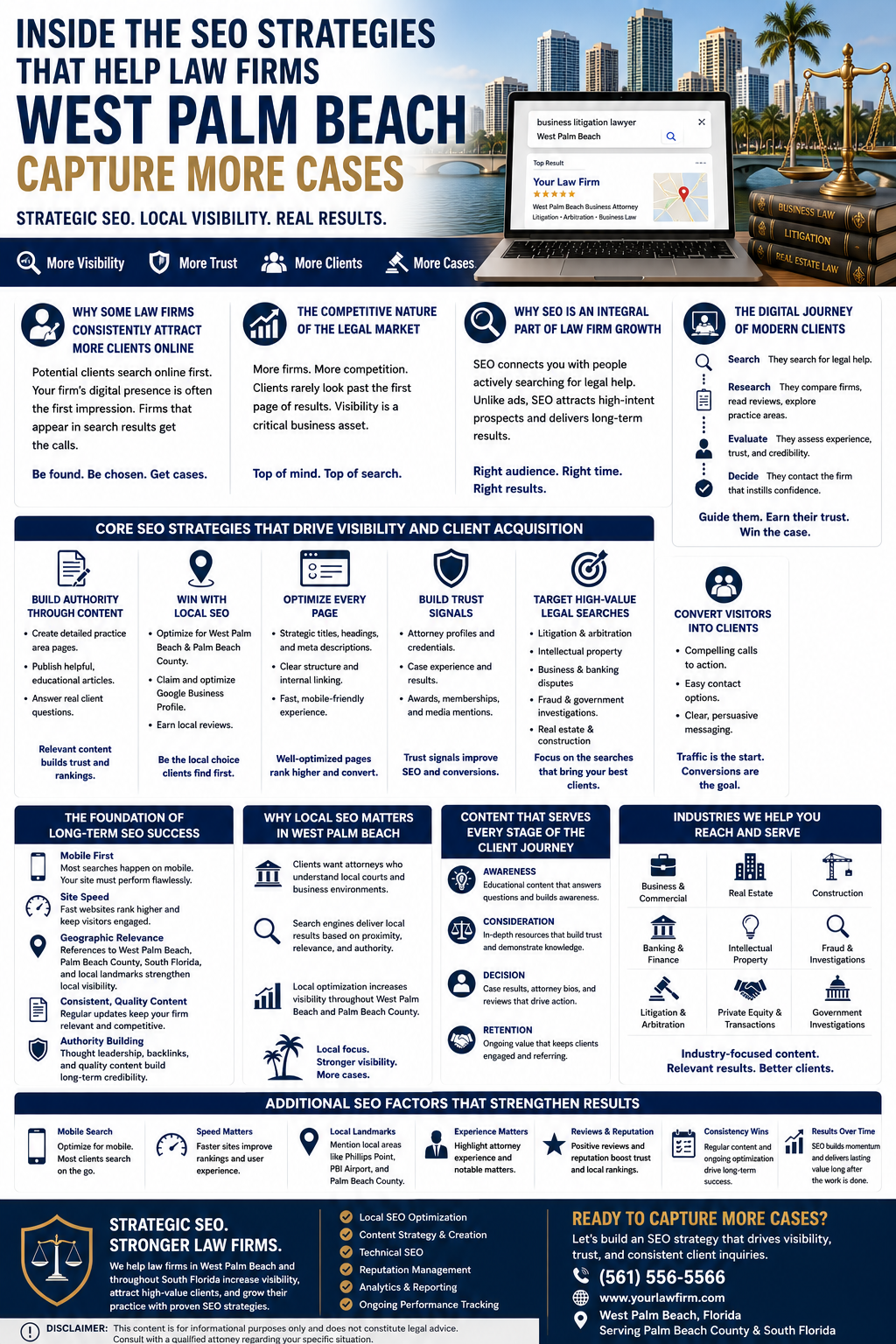
Inside the SEO Strategies That Help Law Firms West Palm Beach Capture More Cases
Why Some Law Firms Consistently Attract More Clients Online
A potential client is sitting at home late at night searching for legal help. They may have questions about a business dispute, a real estate transaction, a personal injury claim, or a complex litigation matter. Instead of asking friends for referrals, they open a search engine and type a few words into a search bar.
Within seconds, dozens of law firms appear. Some firms receive the call. Others never hear from that prospective client.
This reality has transformed the legal industry. Today, a firm's digital presence often serves as the first introduction between attorneys and potential clients. For many firms, search engine optimization has become one of the most important marketing investments they can make.
The Competitive Nature of the Legal Market
The legal market in West Palm Beach continues to grow.
As businesses expand, population increases, and industries evolve throughout Palm Beach County, more law firms compete for visibility online. Firms handling litigation, arbitration, intellectual property matters, government investigations, banking disputes, fraud claims, and real estate transactions are all competing for attention.
Potential clients rarely review every available option.
Instead, they often contact one of the firms they find first online. This makes visibility a critical business asset for modern law firms.
Why SEO Has Become an Integral Part of Law Firm Growth
Many attorneys still rely on referrals.
Referrals remain valuable, but search behavior has changed significantly over the past decade. People increasingly research legal services online before making contact.
As a result, SEO has become an integral part of business development for many firms. Strong rankings can place a firm's website directly in front of individuals actively searching for legal assistance.
Unlike traditional advertising, SEO reaches people who are already looking for solutions.
That creates opportunities for higher-quality leads and stronger client acquisition.
Understanding the Digital Journey of Modern Clients
Before contacting a lawyer, most people conduct research.
They compare firms, read reviews, evaluate experience, examine practice areas, and assess whether a firm appears trustworthy. Every step of that process often happens online.
A law firm's website becomes a digital representative of the organization.
If the website fails to create confidence, visitors may move on to another firm within seconds.
This makes website quality a critical component of legal marketing success.
Why Law Firms West Palm Beach Need More Than a Website
Many firms believe having a website is enough.
Unfortunately, simply launching a website does not guarantee visibility. Search engines evaluate hundreds of factors when determining rankings.
A beautiful website that cannot be found provides little business value.
Law firms West Palm Beach must focus not only on website design but also on the SEO strategies that drive visibility, traffic, and client inquiries.
Building Authority Through Practice Area Content
Search engines reward relevant information.
One of the most effective SEO strategies involves creating detailed content focused on specific practice areas. This helps search engines understand what services a firm provides and who it serves.
For example, firms handling litigation, arbitration, intellectual property, banking disputes, fraud investigations, and real estate matters should develop dedicated content for each area.
This creates additional opportunities for search visibility while helping educate potential clients.
Why Local SEO Matters in West Palm Beach
Most legal clients search locally.
A person looking for representation in West Palm Beach typically wants attorneys who understand local courts, local business environments, and regional legal issues.
Local SEO helps firms appear in geographically relevant searches.
When properly implemented, local optimization strengthens visibility throughout West Palm Beach, Palm Beach County, and surrounding communities.
The Importance of Geographic Relevance
Search engines attempt to provide local solutions.
A person searching for legal services in West Palm Beach may receive different results than someone searching from Miami or another city.
This is why geographic optimization is important.
References to West Palm Beach, Palm Beach County, South Florida, and related areas help establish local relevance that supports rankings.
Why Content Remains the Foundation of SEO
Technology changes constantly.
However, quality content remains one of the most important ranking factors in search engine optimization. Search engines prioritize pages that provide useful, relevant information.
Content allows law firms to demonstrate experience, answer common questions, and build trust before a client ever makes contact.
Strong content also creates opportunities to target a broader range of search terms.
Creating Content That Reflects Real Client Concerns
The most successful legal content addresses actual client questions.
Potential clients often want answers regarding costs, timelines, procedures, risks, and outcomes. Content that addresses these concerns naturally attracts engagement.
Rather than focusing exclusively on legal terminology, effective content speaks directly to client needs.
This human-centered approach often improves both search performance and conversion rates.
Why Trust Signals Influence Search Performance
Search engines evaluate credibility.
Trust signals include attorney profiles, professional achievements, client reviews, case experience, awards, and thought leadership. These elements help establish authority.
Potential clients also evaluate these factors when deciding whether to contact a firm.
Building trust online often improves both rankings and lead generation.
Understanding the Role of Website Structure
A website's structure affects both user experience and SEO performance.
Visitors should be able to navigate the site easily and find information without frustration. Search engines also rely on clear organization to understand website content.
Strong website architecture improves accessibility and supports higher rankings.
Simple navigation often produces better results than complicated layouts.
How Page Optimization Supports Visibility
Every page serves a purpose.
Individual pages should focus on specific topics and target relevant search terms. Optimized headings, titles, descriptions, and content help search engines understand the page's purpose.
Well-optimized pages often perform better than generic content covering multiple unrelated topics.
This focused approach supports stronger rankings and more qualified traffic.
Why Law Firms Need Industry-Specific SEO Strategies
Legal marketing differs from many other industries.
Clients often search during stressful situations involving litigation, business disputes, government investigations, construction issues, finance matters, or real estate transactions.
Because legal services involve significant trust and financial commitment, law firms must provide more detailed information than many businesses in other industries.
SEO strategies should reflect those unique client behaviors.
Leveraging Experience as a Competitive Advantage
Experience matters.
Potential clients often compare attorneys based on years of practice, notable matters, industry knowledge, and professional accomplishments.
Highlighting attorney experience within website content strengthens credibility.
It also helps differentiate a firm from competitors operating within the same market.
The Relationship Between SEO and Client Acquisition
SEO is not simply about rankings.
The ultimate goal is attracting qualified prospective clients. High rankings mean little if website visitors never become leads.
Successful SEO strategies focus on both visibility and conversion.
This combination helps firms generate more consultations and ultimately capture more cases.
Why Practice Area Pages Deserve Special Attention
Practice area pages often become some of the most important pages on a law firm's website.
These pages allow firms to explain services, discuss legal issues, and demonstrate knowledge within specific fields.
Detailed practice area content also helps search engines understand the firm's capabilities.
Well-developed pages frequently outperform thin or generic content.
Targeting Business-Related Legal Searches
Business-related searches represent significant opportunities.
Companies seeking assistance with private equity transactions, intellectual property protection, government investigations, banking matters, fraud claims, and commercial litigation frequently begin their search online.
Creating content that addresses these concerns can attract valuable business clients.
This strategy helps firms expand visibility within high-value markets.
Why South Florida Creates Unique SEO Opportunities
South Florida presents unique legal marketing opportunities.
The region's economy includes tourism, hospitality, construction, finance, entertainment, technology, and real estate industries. Each sector creates legal needs and search demand.
Law firms that understand these industries can create highly relevant content.
That relevance often improves search visibility and client engagement.
The Growing Importance of Mobile Search
Most legal searches now occur on mobile devices.
Potential clients often research attorneys while traveling, commuting, or managing daily responsibilities. Mobile-friendly websites are no longer optional.
Search engines prioritize mobile usability.
Firms that neglect mobile optimization risk losing visibility and prospective clients.
Why Speed Matters for Law Firm Websites
Website performance influences both rankings and user experience.
Slow-loading websites frustrate visitors and increase abandonment rates. Search engines also consider speed when evaluating websites.
Improving website performance often produces measurable benefits.
Faster websites generally create better user experiences and stronger engagement.
Using Local Landmarks to Strengthen Relevance
Location references help establish geographic relevance.
Mentions of recognizable areas such as West Palm Beach, Palm Beach County, Phillips Point, Palm Beach International Airport, and other regional landmarks can strengthen local context.
This approach helps search engines connect content to specific geographic markets.
Local relevance remains an important factor in legal SEO.
Building Long-Term SEO Success
SEO is not a one-time project.
Search algorithms evolve, competitors improve, and client behavior changes over time. Successful firms view SEO as an ongoing process rather than a temporary campaign.
Consistent effort often produces stronger long-term results than short-term tactics.
The firms that invest continuously tend to maintain stronger visibility.
Why Results Take Time but Deliver Lasting Value
Many marketing channels stop producing results when spending stops.
SEO operates differently. Strong content, optimized pages, and authority-building efforts often continue generating traffic long after publication.
While rankings require patience, the long-term value can be substantial.
This makes SEO one of the most sustainable marketing investments available to law firms today.
Expanding a Digital Presence Beyond Basic SEO
Many firms invest in SEO but fail to develop a complete digital strategy.
Search visibility is important, but it is only one component of a successful online presence. A strong digital presence includes website optimization, content development, local visibility, reputation management, and ongoing performance analysis.
Law firms that approach digital marketing holistically often achieve stronger long-term results.
This comprehensive approach helps create consistency across every client touchpoint.
Why Local Search Optimization Continues to Evolve
Local SEO has become increasingly sophisticated.
Search engines now evaluate factors such as proximity, relevance, authority, reviews, content quality, and user engagement. This means law firms must continually refine their local strategies to remain competitive.
Simple directory listings are no longer enough.
Today's local optimization requires a coordinated effort across multiple channels and platforms.
Building Visibility Throughout Palm Beach County
Legal clients are not always located in a single neighborhood.
Many firms serve clients throughout Palm Beach County and surrounding communities. Expanding visibility across a broader geographic area creates additional opportunities for lead generation.
Content can be tailored to address issues relevant to different locations within the region.
This strategy helps firms expand their reach while maintaining local relevance.
Why Search Intent Matters More Than Traffic Volume
Not all website traffic has equal value.
A person casually researching a legal topic may never become a client. By contrast, someone searching for specific legal representation may be ready to schedule a consultation immediately.
Understanding search intent allows firms to create content that attracts qualified prospects.
The goal is to generate meaningful inquiries rather than simply increase visitor counts.
Creating Content for Every Stage of the Client Journey
Potential clients move through several stages before hiring an attorney.
Some are just beginning research. Others are comparing firms. Some are ready to make a decision immediately.
Successful SEO strategies create content that serves each stage of this journey.
This helps law firms remain visible regardless of where a prospective client is in the decision-making process.
Why Authority Building Supports Long-Term Rankings
Authority plays a major role in search performance.
Search engines prefer websites that demonstrate expertise, trustworthiness, and relevance. Law firms can strengthen authority through content creation, thought leadership, media mentions, professional recognition, and educational resources.
Authority-building efforts often produce cumulative benefits over time.
The stronger a firm's reputation becomes, the easier it often is to compete in search results.
Using Attorney Profiles to Build Confidence
Attorney biographies are frequently overlooked.
Many visitors review attorney profiles before making contact. They want to understand who will handle their matter and whether that individual has relevant experience.
Detailed attorney profiles help build trust while supporting SEO objectives.
They also humanize the firm and create stronger connections with prospective clients.
Why Legal Content Must Balance SEO and Readability
Some legal websites make the mistake of writing exclusively for search engines.
While optimization is important, content must remain useful and engaging for human readers. Potential clients want information that is clear, practical, and easy to understand.
The most effective content balances technical optimization with accessibility.
This approach improves both user experience and search performance.
Targeting High-Value Legal Searches
Certain search categories generate more valuable leads than others.
Practice areas involving litigation, intellectual property, private equity, banking disputes, construction matters, fraud investigations, and real estate transactions often represent significant opportunities.
Developing content around these topics helps attract users seeking specific services.
This targeted strategy frequently produces stronger conversion rates.
Why Real Estate Content Creates Visibility Opportunities
The South Florida real estate market generates substantial legal activity.
Transactions, disputes, development projects, leasing matters, and property investments all create demand for legal services.
Law firms that develop educational content related to real estate issues often attract highly qualified prospects.
This approach can strengthen visibility while demonstrating practical knowledge.
The Influence of Tourism and Hospitality on Legal Demand
Tourism remains a major economic driver throughout South Florida.
The hospitality industry creates legal needs involving contracts, employment issues, regulatory compliance, liability concerns, and commercial disputes.
Law firms serving hospitality-related businesses can benefit from targeted content strategies.
Industry-specific information often resonates more strongly with prospective clients.
Supporting Businesses Across Multiple Industries
Successful law firms frequently represent businesses operating across numerous industries.
Construction, finance, entertainment, hospitality, technology, healthcare, and real estate each present unique legal challenges.
Creating content tailored to these sectors allows firms to demonstrate industry knowledge.
This often improves both credibility and search visibility.
Why Intellectual Property Content Matters
Innovation continues to drive business growth.
Companies seeking intellectual property protection frequently conduct extensive online research before contacting counsel. Content addressing trademarks, copyrights, patents, trade secrets, and IP disputes can attract valuable prospects.
Educational resources also help establish authority.
Strong intellectual property content often performs well in competitive search environments.
Government Investigations and High-Stakes Legal Searches
Businesses facing government investigations often need immediate assistance.
These searches tend to be urgent and highly specific. Prospective clients want reassurance that a firm understands complex regulatory matters and can respond effectively.
Content addressing government investigations can help firms reach individuals during critical moments.
Urgency-driven searches often produce highly qualified leads.
Why Conversion Optimization Matters
Traffic alone does not create clients.
Once visitors arrive on a website, the experience must encourage action. Clear messaging, compelling calls to action, and user-friendly navigation all contribute to conversion optimization.
The goal is to make it easy for potential clients to take the next step.
Small improvements often produce significant increases in consultation requests.
Building Trust Through Educational Resources
People are more likely to contact firms they trust.
Educational content demonstrates knowledge while helping prospective clients better understand their legal concerns. This approach positions attorneys as valuable resources rather than simply service providers.
Trust-building content often supports both SEO and lead generation objectives.
The more informed visitors become, the more comfortable they often feel reaching out.
Why Consistency Strengthens Search Performance
Consistency matters in digital marketing.
Regular content publication, ongoing optimization, and continuous monitoring help maintain visibility over time. Sporadic efforts often produce inconsistent results.
Search engines favor websites that remain active and relevant.
Consistency helps reinforce authority and improve long-term performance.
Measuring Success Beyond Rankings
Rankings are important, but they are not the only metric that matters.
Law firms should also evaluate lead quality, consultation volume, conversion rates, engagement metrics, and overall return on investment.
These measurements provide a clearer picture of marketing effectiveness.
A successful SEO campaign ultimately contributes to business growth.
Why Law Firms West Palm Beach Must Adapt Continuously
Digital marketing is constantly evolving.
Competitors improve their websites, search algorithms change, and client behavior shifts over time. Law firms that remain adaptable often maintain stronger competitive positions.
Ongoing refinement helps firms respond to changing market conditions.
Flexibility remains one of the most valuable assets in modern digital marketing.
Creating a Competitive Advantage Through SEO
SEO is not merely a marketing tactic.
For many law firms, it becomes a competitive advantage that supports client acquisition, brand development, and long-term growth. Strong visibility allows firms to reach prospects before competitors do.
This advantage often compounds over time.
The firms that invest strategically frequently capture a larger share of the market.
Why Masterly Tech Group Helps Law Firms Grow
At Masterly Tech Group, we understand that law firms operate in one of the most competitive professional service industries. Attorneys need more than a website. They need a digital strategy capable of generating visibility, building trust, and attracting qualified prospects.
Our team helps law firms develop comprehensive SEO strategies designed to improve rankings, strengthen digital presence, increase engagement, and generate more client inquiries. From website optimization and content creation to local SEO and authority building, we focus on solutions that support measurable business growth.
Whether your firm handles litigation, arbitration, intellectual property, government investigations, real estate matters, finance issues, or complex business disputes, we help position your practice for long-term success online.
Helping Law Firms Build Sustainable Growth
Successful legal marketing is not about shortcuts.
It is about creating systems that consistently attract prospective clients, strengthen brand authority, and support long-term business objectives. We work closely with law firms to develop customized strategies aligned with their goals, practice areas, and target audiences.
Our approach combines technical expertise with practical marketing experience.
The result is a strategy designed to create lasting value rather than temporary gains.
How a West Palm Beach Office Builds Trust, Security, and Local Market Authority
For many prospective clients, seeing that a firm maintains a strong West Palm Beach office creates an immediate sense of confidence and credibility. Businesses and individuals seeking legal representation often prefer working with attorneys who understand the local market, economic environment, and legal landscape of West Palm Beach FL and the surrounding areas. A visible local presence demonstrates commitment to the community and helps strengthen a firm's reputation among potential clients searching online for experienced legal counsel.
A professional office also plays an important role in establishing trust and security for clients who may be dealing with sensitive legal matters. Whether a firm serves business owners, investors, developers, or individuals throughout Palm Beach FL 33401, maintaining a strong local identity can enhance both online visibility and client engagement. Many respected litigators use their local experience and market knowledge to build relationships and demonstrate authority within their practice areas. As firms evaluate marketing performance throughout the year, including periods such as September when many organizations reassess business goals, strengthening local SEO signals connected to FL markets can help improve visibility, attract qualified leads, and support long-term growth.
Contact Masterly Tech Group for a Free Consultation
If your law firm wants to increase visibility, attract more qualified leads, and strengthen its position within the competitive West Palm Beach legal market, now is the time to evaluate your digital strategy.
Masterly Tech Group helps law firms develop SEO campaigns that support growth, improve rankings, and generate meaningful business opportunities. Whether your firm is looking to improve local search visibility, expand its digital presence, optimize practice area content, or strengthen its website performance, our team is ready to help.
Contact Masterly Tech Group today at (888) 209-4055 to book a free consultation. We would be happy to discuss your goals, review your current online presence, answer your questions, and identify opportunities to help your firm capture more cases and build sustainable growth in an increasingly competitive market.