Website Conversion Optimization Services: How Masterly Tech Finds (and Fixes) the Leaks in Your Funnel
Traffic, But No Leads? This Is the Page You Were Looking For
Picture this: your site pulls in 20,000 monthly visits. Your SEO is working. Your ad spend is generating clicks. But you're only getting a handful of form fills, quote requests, or demo bookings each month. If a good conversion rate is 10% or higher, and yours is sitting around 2–3%, the math is painful.
Website conversion optimization services improve a website's ability to convert visitors into customers-not by driving more traffic, but by maximizing the value of the traffic you already have. These services focus on identifying funnel leaks, fixing friction, and running controlled experiments over time.
If you already invest in search engine optimization, PPC, or social media marketing and feel your website isn't pulling its weight, the problem likely isn't awareness. It's misaligned page intent, confusing forms, mobile friction, weak trust signals, poor funnel tracking in Google Analytics, or the complete absence of structured testing.
Masterly Tech Group is a digital marketing agency that treats conversion rate optimization CRO as a systematic, ongoing process-not random button-color experiments or a one-time redesign. If any of this sounds familiar, we invite you to Request a Conversion Review to see exactly where qualified leads are being lost.
What Website Conversion Optimization Services Actually Include
Website conversion optimization is an ongoing program. It analyzes user behavior, removes friction, and runs controlled experiments to improve conversion rates over months, not days. CRO relies on data analysis rather than guesswork to guide website improvements.
Core deliverables in a conversion optimization services engagement include:
- Conversion audit - deep review of site performance, trust signals, mobile experience, and analytics setup
- Funnel mapping - charting every touchpoint from first click to confirmation page
- Analytics cleanup - ensuring GA4 events, goals, and funnels are correctly instrumented
- Landing page optimization - refining headlines, copy, CTAs, and layouts on key landing pages
- Form optimization - reducing abandonment at the point of lead capture or checkout
- Speed and UX fixes - improving site speed, Core Web Vitals, and mobile usability
- Structured A/B testing - running b testing and multivariate testing based on prioritized hypotheses
A conversion rate optimization agency differs from a generic web design shop. CRO improves performance of what you already have; design alone often just makes things prettier without addressing why website visitors leave. The process includes researching user behavior and testing improvements to increase conversions. A well-optimized website is usually easier to use and increases the likelihood of conversions.
CRO agencies improve website conversion rates through data analysis, aim to maximize the efficiency of client websites, and provide detailed reports on conversion improvements. Key techniques include A/B testing and user experience audits to optimize conversions. Effective CRO strategies can improve ROI on marketing spending by increasing visitor conversions-benchmarks show average ROI around 223% on CRO investment.
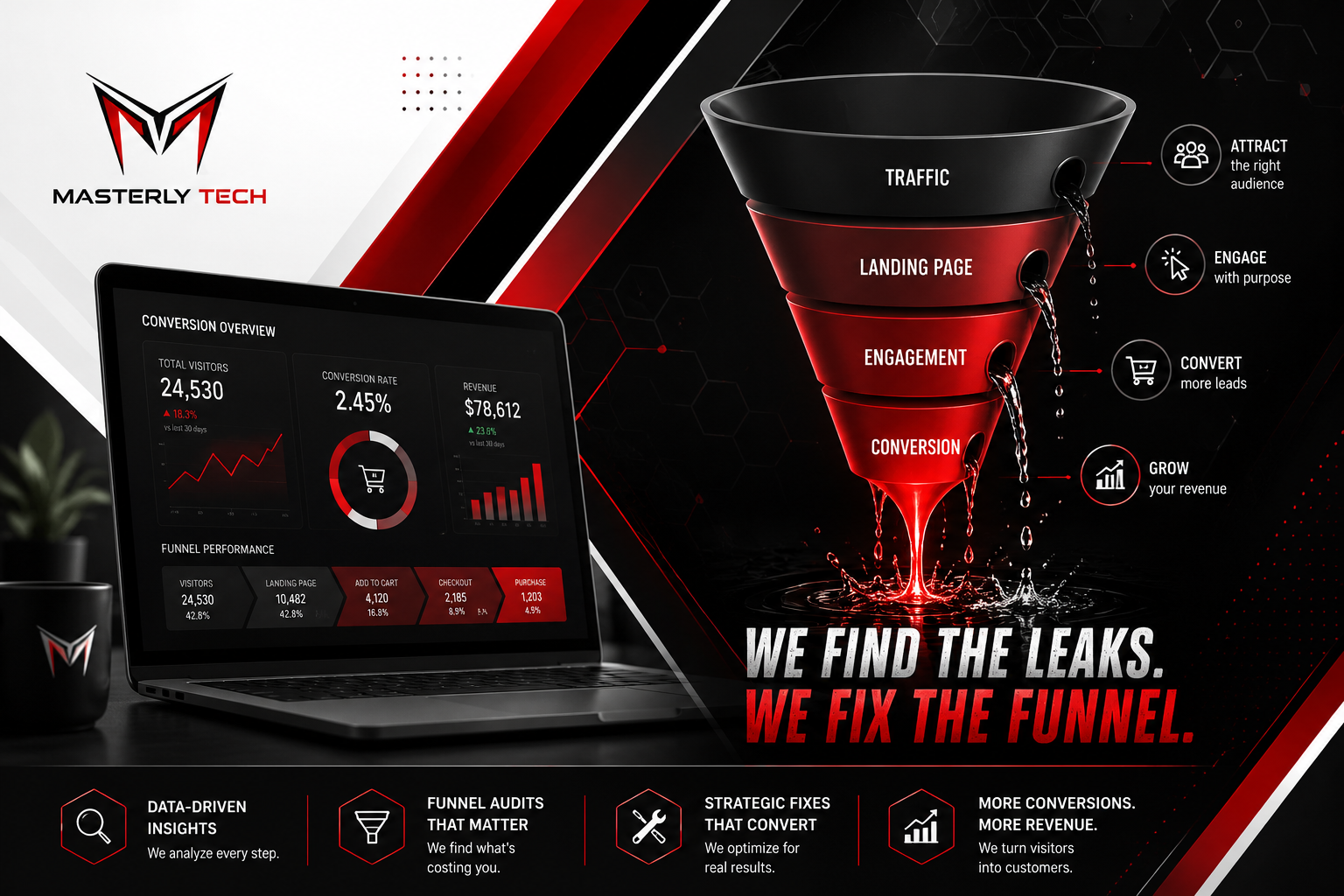
Step 1 – Funnel Review: Mapping Where Qualified Leads Drop Off
You can't fix what you haven't mapped. Most companies have never charted their entire funnel, and broken handoffs between marketing, sales, and product quietly bleed revenue every month.
Here's how Masterly Tech conducts a funnel review:
- Map the full journey from ad or search result → landing pages → pricing or content pages → forms or checkout → confirmation
- Segment by traffic source - organic traffic, paid search, paid social media marketing, email, and direct - because different sources convert differently
- Identify specific stall points - a Google Ads campaign with a strong click-through rate (CTR) that measures how many people clicked on your site link, but near-zero form completions; or an e commerce funnel with 70% cart abandonment between shipping and payment
- Distinguish volume from qualified volume by cross-referencing lead quality metrics (sales-accepted leads, pipeline dollars) rather than raw form fills
- Visualize drop-offs using GA4 funnel reports, heatmaps, and session recordings to see where users consistently stall or exit
User behavior analysis identifies where visitors drop off on websites, and CRO agencies use that user behavior analysis to identify conversion barriers. CRO helps identify issues with positioning and messaging quickly. Our Conversion Review deliverable includes a visual funnel diagram showing exactly where qualified leads are leaking out.
Step 2 – Aligning Page Intent With Visitor Expectations
Page intent is simple: what the visitor expects to accomplish on a page versus what the page actually emphasizes. When there's a mismatch, people hit the back button within seconds.
Common 2026-era examples of intent misalignment:
- A "free consultation" PPC ad that lands on a generic homepage with no mention of consultations
- A "compare pricing" keyword that drops users on a blog article instead of a pricing-focused landing page
- Category pages organized by internal catalog logic rather than how users actually search (by use case, size, or industry)
We fix this by aligning headlines, subheads, and calls to action on landing pages with the exact queries or ad promises that brought the visitor. We use market research and search term reports to understand what visitors need at each funnel stage-awareness, consideration, and decision.
A streamlined user experience can improve customer satisfaction and trust. This step typically yields early gains in conversion rates even before full split testing, because it reduces immediate bounces. Enhancing user experience at the intent level is one of the highest-leverage optimization techniques available.
Step 3 – Removing Friction: Navigation, Copy, and UX Roadblocks
Friction is anything that makes converting feel confusing, slow, or risky. Here are the friction categories we prioritize:
Navigation friction: Too many menu options, vague labels like "Solutions," or no clear path for distinct personas (small businesses vs. enterprises). Website visitors leave when they can't find pricing or contact information within two clicks.
Copy friction: Jargon-heavy headlines, walls of text, unclear next steps, and CTAs that read "Submit" instead of "Book a 30-Minute Strategy Call." Weak copy kills user engagement before forms are ever reached.
Performance friction: The first five seconds of page load time impact conversion rates significantly. Improving website loading speed can significantly increase conversion rates. Intrusive pop-ups, layout shifts, and confusing multi-step flows compound the problem.
A typical improvement: simplifying a 6-step quote flow into a 2-step process with progress indicators and clear microcopy about what's required and how long it takes. We prioritize fixes by impact and effort so the client sees conversion rate improvements quickly while deeper continuous testing cycles run in the background.
Step 4 – Form Optimization: From Abandoned Fields to Completed Leads
Forms are the tightest pinch points in any website funnel. Small UX problems here have outsized impact on lead generation and revenue.
Our approach to form optimization:
- Field-level analytics - identifying exactly which fields cause drop-off, which error messages confuse users, and how long completion takes
- Reduce non-essential fields - one Convertify case study cut a B2B demo form from 12 fields to 4, yielding a 42% increase in demo bookings
- Smart defaults and prefill - use autofill, optional vs. required field clarity, and multi-step wizard layouts for complex forms
- Trust elements near forms - privacy microcopy ("We'll never share your data"), short testimonials, client logos, and benefit reinforcement ("Get a custom quote in 1 business day")
- Guest checkout for e commerce - reducing cart abandonment by eliminating forced account creation
Conversion rate optimization can improve rates by 10% to 30%. Effective CRO can improve conversion rates by 10% to 30% within six months. In some cases, CRO can increase online revenue by up to 41%. We measure impact not only on form conversion rates but also on lead quality where sales data is available, to avoid generating more unqualified inquiries.
Step 5 – Mobile Experience: Fixing the Small-Screen Drop-Off
Many prospects discover your brand via mobile search or social media and attempt first contact from a phone-even for high-ticket B2B or service purchases. Mobile site performance is non-negotiable.
Common mobile problems we address:
- Tiny tap targets and forms that are difficult to complete with one thumb
- Key CTAs pushed far below the fold
- Pop-ups that are hard to dismiss on smaller screens
- Slow load times that tank website conversion rate
Our process includes device and breakpoint audits, scroll-depth analysis by device, and mobile session replay. Heat maps visualize user engagement on website elements, showing us exactly where mobile users struggle or abandon.
Technical optimizations that support conversion include improving Core Web Vitals, compressing images, and prioritizing above-the-fold content. Sites meeting all three Core Web Vitals average roughly 24% better conversion than those that fail.
Specific fixes include turning phone numbers into click-to-call links, adding sticky "Book a Call" buttons, and simplifying mobile navigation for service-area businesses. Mobile improvements also reveal new opportunities-SMS callbacks, shorter mobile-optimized lead capture flows, and creative solutions for on-the-go users.
Step 6 – Trust, Proof, and Risk Reversal on Key Landing Pages
Even when user behavior research shows strong interest-repeat visits, deep scrolling, pricing page views-visitors will not convert if they don't trust your company with their time, data, or money.
Concrete trust signals we implement:
- Customer logos and recognizable client brands
- Industry certifications relevant to the vertical (HIPAA, SOC 2, FINRA)
- Review snippets and case study highlights with specific dates and outcomes
- Satisfaction guarantees and clear refund policies
- Explicit post-submission expectations ("We reply within 1 business day-no credit card required")
We tailor proof by segment: for e commerce, show recent customer photos and reviews; for B2B, emphasize ROI metrics, timeframes, and conversion sciences that back the claims. In one enterprise case, adding social proof, value messaging, and personalized CTAs to key landing pages increased contact form submissions by 20%.
CRO can lower customer acquisition costs, increasing profit margins. Look for agencies with proven industry expertise and tailored strategies. CRO agencies should provide transparent communication and measurable results. Trust content is woven into page layouts naturally, not dumped at the bottom-and we test variations of proof placement using conversion research for maximum impact.
Step 7 – Analytics, User Behavior Data, and Testing Framework
Without solid data and a structured testing framework, conversion optimization efforts are guesswork. Here's how Masterly Tech structures this work:
Analytics foundation: We ensure Google Analytics (GA4) is correctly tracking key events-form submissions, add-to-cart, checkout steps, phone clicks-and setting up conversions and audiences relevant to your business model. We track user behavior through both macro-conversions (sales, booked calls) and micro-conversions (scroll depth, key button clicks, form starts).
Qualitative tools: We layer in heatmaps, scroll maps, form analytics, and user feedback widgets for user behavior research that goes beyond numbers. This is the conversion research layer that reveals why users behave the way they do.
Testing framework: A/B testing requires a minimum of 500 conversions per month to produce reliable results. A CRO agency should not discuss A/B testing without 500 conversions monthly. CRO agencies often require a minimum of 10,000 monthly visitors for effective A/B testing. A/B testing helps determine which webpage version performs better, while multivariate testing evaluates multiple changes simultaneously for optimal results.
CRO agencies conduct A/B testing to optimize website elements-but we focus on meaningful tests (offer, layout, messaging, trust assets) over superficial ones. Many tests need several weeks to reach statistical significance, especially for lead-generation sites with modest volume. Reporting for each test includes uplift in conversion rates, confidence levels via statistical significance metrics, and prioritized recommendations for rolling out winners. Our dedicated conversion scientist oversees this as an ongoing process.

Who Our Website Conversion Optimization Services Are Best For
Our cro services work best for:
U.S.-based businesses with established traffic (5,000–100,000+ monthly sessions) but underperforming leads, calls, bookings, or online sales
B2B services, SaaS, and professional services (legal, financial, healthcare) where each fractional lift in conversion rates meaningfully impacts customer lifetime value
E commerce brands looking to improve average order value and reduce cart abandonment across multiple industries
Website conversion optimization services are not a fit for brand-new websites with negligible traffic, businesses seeking "instant ranking," or companies wanting a set-it-and-forget-it fix.
Existing marketing channels-SEO, PPC, email-become far more profitable when paired with a broader growth strategy that includes systematic website conversion optimization. If you recognize your situation-good traffic, weak pipeline-a structured Conversion Review delivers the most value.
FAQs: Practical Questions About Website Conversion Optimization Services
How long until we see results? Early wins from friction fixes and intent alignment typically appear within 30–60 days. More substantial, compounding gains emerge over 3–6 months of testing. Expect conversion rate improvements of 10% to 30% within six months of a structured cro program.
Do we need a lot of traffic? For reliable A/B testing, we look for at least 10,000 monthly visitors to the pages being tested. For moderate-traffic sites, we rely more on qualitative user research (session replay, heatmaps) and larger-scope changes rather than incremental split testing.
How is this different from hiring another conversion rate optimization agency? Masterly Tech functions as a specialized cro agency with focus on funnel review, form and mobile UX, trust signals, and accurate analytics-not one-off redesigns. Our conversion scientists and project management process ensure every test builds on previous learnings, producing measurable outcomes month over month.
Will this interfere with our SEO or paid campaigns? No. Our optimization strategies are coordinated with existing digital marketing services and campaigns. CRO protects and often improves SEO site performance while lowering acquisition costs on paid channels by improving ad spend efficiency.
What internal involvement is needed? We handle strategy, data analysis, and implementation. Your team provides access, timely approvals, and-where possible-feedback from sales on lead quality. This quality service model keeps demands on your staff minimal.
Is there a guarantee of overnight success? No, and any conversion rate optimization company promising that should raise a red flag. Our structured process ensures each month's work builds on proven track record learnings, producing scalable solutions and measurable results over time through key performance indicators and key metrics.
Next Step: Request a Conversion Review From Masterly Tech
Traffic alone doesn't grow revenue. As this guide has shown, funnel review, intent alignment, friction removal, form and mobile optimization, trust building, and a disciplined testing framework are all required for reliable conversion improvements. Driving traffic without optimizing the destination is like filling a bucket with holes.
A Conversion Review from Masterly Tech includes:
- A focused audit of your current funnel and analytics setup
- Deep evaluation of 2–3 priority landing pages and main forms
- A findings summary with prioritized recommendations for conversion rate improvements
- Identification of your highest-impact opportunities to increase conversions
To get started: fill out a brief form on our site or call Masterly Tech directly at (888) 209-4055. We respond within 1 business day.
If you have meaningful website traffic and know your current website conversion rate is limiting growth, this is the logical next step. Our digital marketing team combines technical expertise with data driven approach methodology to uncover revenue you're currently leaving on the table-and turn more of today's website visitors into tomorrow's customers.