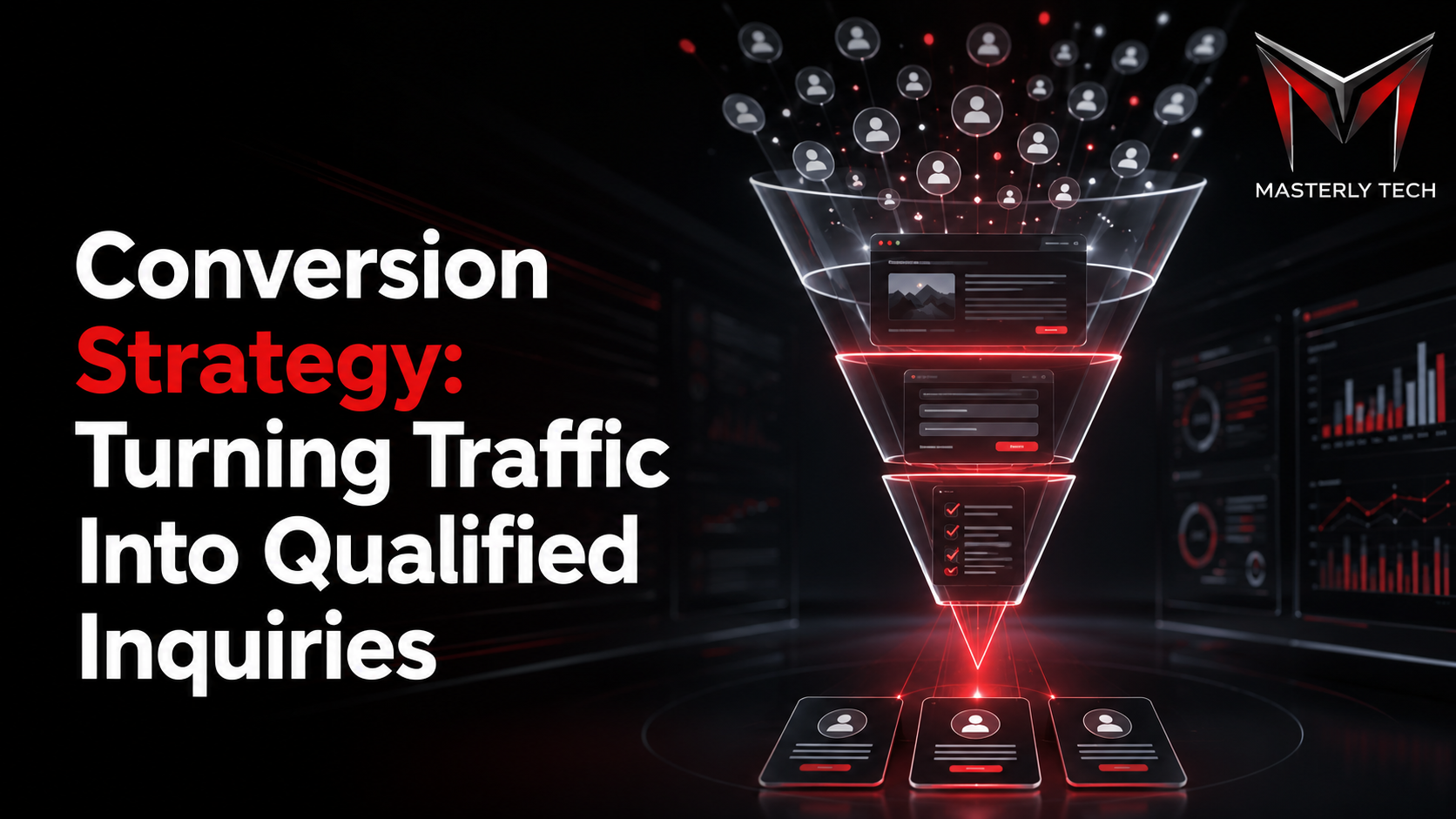
Conversion Strategy: Turning Traffic Into Qualified Inquiries
engines, advertisements, email campaigns, referrals, social media, and other incoming traffic, but many leave the site without taking the desired action, whether that is to sign up, request a demo, schedule a consultation, or make first contact.
The problem is not always traffic or even low conversion rates on their own. It may be an unclear message, a weak offer, a confusing page structure, inconsistent page layouts, missing pricing context, a form that asks for too much information, or site content that does not clearly communicate value. In other cases, the website generates leads, but the CRM, automation, or sales team follow-up fails at the point where interest should turn into a real sales conversation.
A strong conversion strategy is the plan that connects a visitor’s first interaction with your business to a qualified inquiry or other meaningful business action. It helps the right people understand what you sell, trust your business, decide on the next step, and move through the buyer's journey with relevant content, clear offers, and follow-up that does not waste too much time or money.
Masterly Tech provides done-for-you conversion strategy services for founders, marketers, and growth teams that want their websites, marketing campaigns, CRM platforms, inbound marketing, and automation systems to work together. On this page, we explain our approach to website conversion strategy, lead generation and lead conversion strategy, conversion optimization across channels, form design and qualification balance, measurement of conversion quality, common conversion problems, and the practices, examples, case studies, and customer testimonials that help businesses gain a clearer path from traffic to qualified opportunities.
Traffic Has Little Value When Visitors Do Not Take Action
Many businesses focus on increasing website traffic before understanding what happens after people arrive.
More traffic can create more activity, but it does not always create better leads. If visitors cannot quickly understand what the business offers, who the service is for, or what they should do next, they are unlikely to move forward.
A website can appear professional while still creating friction. The design may be polished, but the message may be too broad. The service pages may include useful information, but the calls to action may be hard to find. A form may collect inquiries, but it may not ask the questions needed to qualify them.
Common conversion problems include:
- Service descriptions that do not address the buyer’s real concern
- Pages that present several competing actions
- Forms that are too long or too vague
- Important proof placed too late on the page
- Weak connections between advertisements and landing pages
- Mobile pages that are difficult to use
- Inquiries that do not reach the correct employee
- Delayed or inconsistent lead follow-up
- CRM records that lack campaign or service information
- Reports that count submissions without measuring lead quality
These problems can cause the business to spend more on marketing without improving revenue opportunities. A clear conversion strategy helps leadership determine whether the issue is traffic quality, website experience, lead capture, follow-up, or a combination of these factors.
Why Conversion Problems Affect Your Brand
A potential client begins judging the company before making direct contact.
The website, landing page, form, confirmation message, scheduling process, and first follow-up all shape that judgment. If the experience feels confusing or disconnected, the visitor may question whether the business can manage a professional engagement.
Trust is especially important for service businesses. Prospects may be sharing private information, considering a major investment, or choosing a long-term partner. They need clear signs that the company understands their needs and has a reliable process.
A strong digital experience supports that confidence. The page explains the service in plain language. The proof supports the claims. The call to action makes sense for the buyer’s stage. The form requests only useful information. The follow-up confirms what will happen next.
This consistency strengthens the brand because the customer experience matches the professional standard the company wants to represent.
A Website Conversion Strategy Built Around Buyer Intent
A website conversion strategy should reflect why the visitor came to the page and what decision the person is prepared to make.
Someone reading an educational article may not be ready to request a consultation. A visitor reviewing a specific service page may be much closer to taking action. A returning prospect who has already spoken with the team may need a different path than a first-time visitor.
When every page uses the same message and call to action, the website may fail to meet these different needs.
Masterly Tech reviews the purpose of important pages and the role each one plays in the buyer journey. We examine whether the page attracts the right audience, answers the buyer’s main questions, presents useful proof, and offers a reasonable next step.
This review may include:
- Homepage messaging
- Service pages
- Location pages
- Landing pages
- Contact pages
- Lead forms
- Scheduling pages
- Confirmation pages
- Mobile experiences
- Calls to action
The goal is not to place more buttons on every page. It is to create a clear and appropriate path for visitors who are a strong fit for the business.
Lead Conversion Strategy Beyond the Form Submission and Sales Process
A completed form is not the end of the conversion process. It is the beginning of a business response.
A company may receive several inquiries but still struggle to create qualified sales conversations. Forms may not collect enough information to route the lead correctly. Notifications may reach a shared inbox without a clear owner. Sales representatives may not know which page or campaign led to the inquiry.
A lead conversion strategy connects lead capture with qualification, routing, CRM updates, follow-up, and reporting.
Masterly Tech helps businesses create a more dependable process after the submission. Depending on the company’s needs, this may include:
- Sending inquiry details to the correct CRM pipeline
- Recording the service, source, and campaign
- Assigning the lead to the appropriate employee
- Sending a clear confirmation message
- Creating an internal follow-up task
- Notifying the team when a high-priority inquiry arrives
- Directing qualified prospects to scheduling
- Separating customer support requests from sales leads
- Tracking progress from inquiry to opportunity
This structure reduces the risk that valuable inquiries will be delayed or lost. It also helps the team respond with better context.
Digital Conversion Optimization Strategy Across Marketing Channels
Potential customers may reach the business through organic search, paid advertising, email marketing, social media, LinkedIn, referral links, online directories, or partner campaigns. Each source creates a different level of awareness and intent.
For many B2B companies, LinkedIn can play an outsized role in lead generation, with 80% of B2B leads are generated through LinkedIn marketing.
A visitor clicking an advertisement for a specific service expects the landing page to continue the same message. If the page changes the subject, uses different language, or sends the visitor to a general homepage, trust can fall quickly.
A digital conversion strategy connects the campaign promise with the page experience and the next step. It also connects the lead with the correct source data so leadership can evaluate which marketing activities create qualified opportunities.
Masterly Tech reviews the full path from marketing source to website action. We look for gaps in messaging, tracking, forms, routing, CRM updates, and follow-up.
This helps the business move beyond general measures such as clicks and page views. Leadership gains a clearer view of which channels create useful inquiries and which campaigns generate attention without business value.
Reduce Friction Without Removing Important Qualification
A shorter form is not always a better form. Removing every field may increase submissions while lowering lead quality.
The right form asks enough to help the business understand the inquiry without creating an unnecessary burden for the visitor. The required information depends on the service, sales process, and level of risk. A one-second delay in page load can sharply raise abandonment before a visitor even starts the form, and speeding up page load times can significantly improve conversion rates.
A simple request may need only contact information and a short description. A complex professional service may require additional details before the team can determine whether the inquiry is appropriate.
Masterly Tech helps companies balance ease of use with practical qualification. We evaluate how streamlining forms can reduce abandonment while preserving qualification. We evaluate:
- Which information is required immediately
- Which questions can wait until a later conversation
- Whether the form matches the page offer
- How errors and required fields are explained
- What happens after submission
- Whether mobile users can complete the form easily
- How the information enters the CRM
- Who receives and reviews the inquiry
This creates a smoother experience for prospects while giving employees the information they need.
Conversion Measurement and Lead Generation Should Focus on Lead Quality
A high conversion rate can be misleading if most inquiries are not a good fit.
A page may generate many form submissions from people outside the company’s target audience. An advertisement may produce low-cost leads that never become qualified opportunities. A scheduling page may create meetings, but many attendees may not meet the basic service requirements.
Masterly Tech helps businesses define conversion events that reflect real business value. These may include qualified form submissions, completed consultations, accepted sales opportunities, proposal requests, or another meaningful stage.
We can also review whether the systems capture the data needed to connect marketing activity with later outcomes.
Useful conversion reporting may show:
- Which pages generate qualified inquiries
- Which channels produce sales opportunities
- How many leads receive timely follow-up
- Where visitors leave the conversion path
- Which forms create incomplete or unsuitable inquiries
- How mobile and desktop performance differ
- Which campaigns lead to meetings or proposals
- Where CRM stages stop progressing
Better measurement allows leadership to invest based on quality, not activity alone.
Masterly Tech Provides a Done-for-You Conversion Strategy
Masterly Tech works with founders and growth teams that need professional support improving the path from traffic to qualified inquiry.
Our conversion strategy services may include:
Conversion and Systems Review
We examine key pages, traffic sources, calls to action, forms, CRM connections, automation, lead routing, and reporting.
Buyer Path Assessment
We identify how different visitors enter the website, what information they need, and where they may experience confusion or friction.
Website and Landing Pages Recommendations
We develop recommendations for messaging, page structure, proof, forms, calls to action, and mobile usability.
Lead Capture and CRM Planning
We define how inquiry data should be collected, recorded, assigned, and moved through the sales process.
Automation and Follow-Up Design
We plan confirmation messages, internal alerts, tasks, routing rules, and follow-up workflows around the approved lead process.
Measurement Planning
We identify useful conversion events and the data required to measure lead quality and marketing performance.
Our work is built around the company’s services, audience, sales process, and current technology. The result is a practical plan that connects the website with the systems responsible for turning interest into a business conversation.
Give Buyers the Information They Need to Act
Many marketers send visitors to a home page that tries to describe every service instead of guiding them toward one clear decision. A focused service or pricing page should provide as much information as qualified buyers need to understand the offer, evaluate the purchase, and take the next step.
Masterly Tech can strengthen the story with clear copy, relevant images, useful video, social proof from existing customers, and a direct call to action. As one example, a free consultation or systems review can give interested prospects a practical way to begin without distracting them from the main conversion path.
Connect Inbound Marketing With the Sales Team
A strong conversion strategy connects inbound marketing, website inquiries, and email marketing with a clear sales process. When visitors sign up, request information, or complete a form, the sales team should receive the context needed to respond and guide each qualified prospect toward the next step. Masterly Tech connects these touchpoints so businesses can improve conversion rates and create more consistent follow-up.
Create a Clear Path From Interest to Action
For instance, a qualified visitor may arrive on a service page, review the company’s proof, submit an inquiry, and receive a clear confirmation message. Masterly Tech connects each step with the CRM and follow-up process so the correct sales team member can respond quickly and move the opportunity forward.Masterly Tech connects each step with the CRM and follow-up process so the correct sales team member can respond quickly and move the opportunity forward. This seamless integration ensures that qualified leads are promptly addressed, improving the chances of conversion and fostering a positive customer experience. By aligning website interactions with backend systems, businesses can reduce delays, avoid lost inquiries, and maintain consistent communication throughout the sales journey. This strategic connection between digital touchpoints and sales operations is essential for turning website traffic into meaningful business outcomes.
Frequently Asked Questions About Conversion Strategy
What is a conversion strategy?
A conversion strategy is a plan for helping qualified visitors move from initial interest to a meaningful action, built around a specific desired action, such as submitting an inquiry or scheduling a consultation.
What does a website conversion strategy include?
A website conversion strategy may address messaging, page structure, trust signals, calls to action, forms, mobile usability, and the path visitors take through the site between pages.
What is a lead conversion strategy?
A lead conversion strategy connects inquiry capture with qualification, CRM routing, follow-up, sales ownership, and performance measurement.
How does a digital conversion strategy support marketing?
It connects traffic sources, campaign messages, landing pages, lead actions, CRM data, and follow-up so the business can measure which activities create qualified opportunities.
Can Masterly Tech review our existing website?
Yes. Masterly Tech can assess your current website, forms, marketing paths, CRM connections, automation, and reporting before recommending changes.
Does conversion strategy mean increasing every form submission?
No. The goal is to increase appropriate actions from qualified visitors, not simply collect more low-quality submissions.
How long does a conversion strategy project take?
The timeline depends on the number of pages, campaigns, forms, systems, and buyer paths involved. Masterly Tech defines the scope after reviewing the current environment.
Request a Systems Review
If your business is attracting traffic without generating enough qualified inquiries, Masterly Tech can help identify where the conversion path is breaking down.
Our done-for-you conversion strategy services connect your website, marketing campaigns, lead forms, CRM, automation, and follow-up process to help your website and related systems turn incoming traffic into qualified inquiries more efficiently. Whether you need a website conversion strategy, lead conversion strategy, or broader digital conversion strategy, we can develop a practical plan around your audience and business goals.
Visit Masterly Tech or call (888) 209-4055 to Request a Systems Review.