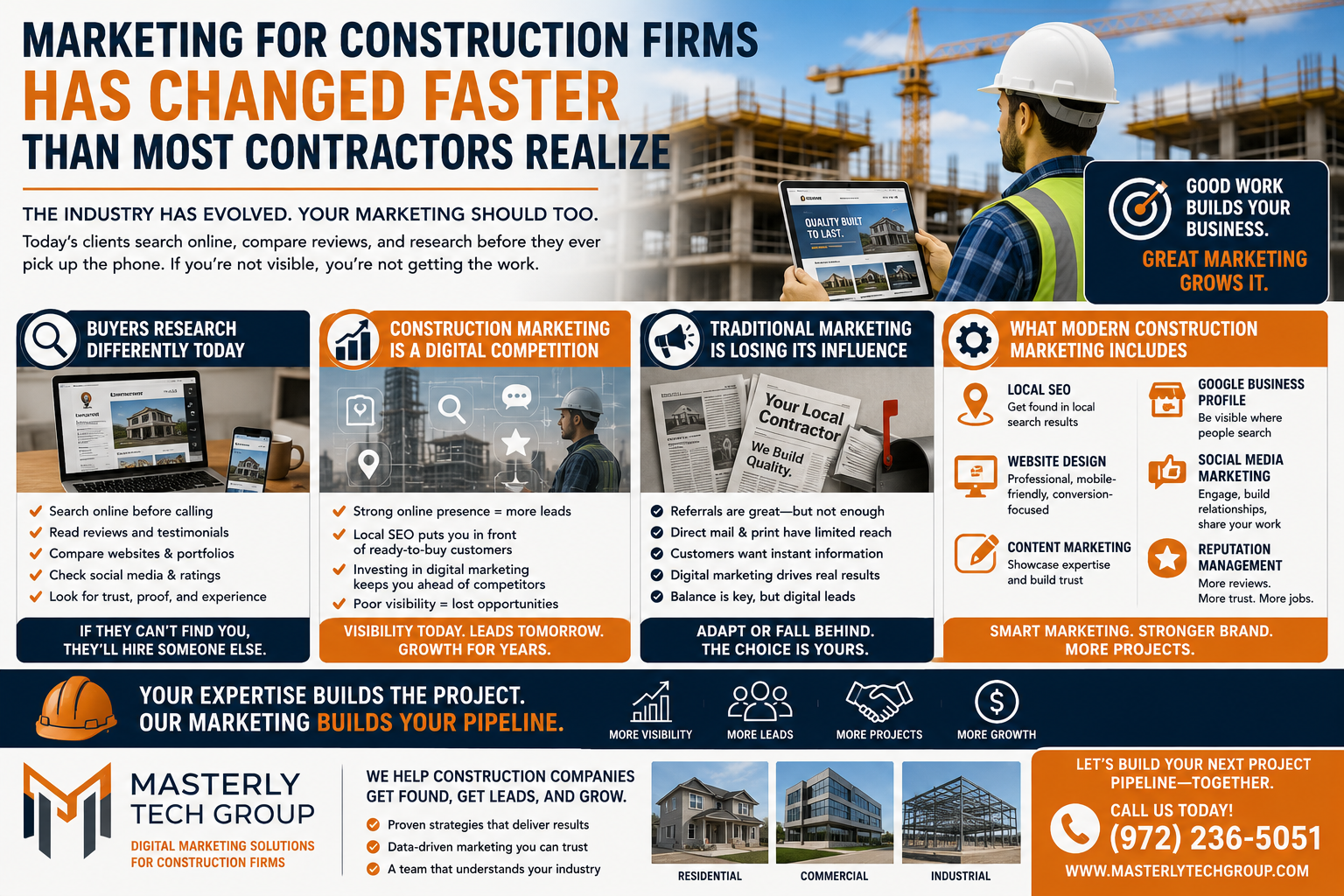
Marketing for Construction Firms Has Changed Faster Than Most Contractors Realize
The Construction Industry Is No Longer Growing Through Referrals Alone
For years, many construction companies depended heavily on word of mouth, referrals, direct mail campaigns, and long-standing community relationships to keep projects coming in. Those methods once created steady growth, especially for local contractors with strong reputations in residential construction and commercial development. Today, however, consumer behavior has shifted dramatically, and many contractors are realizing too late that older marketing efforts are no longer enough to stay competitive.
Most homeowners, property managers, and developers now begin their search online long before making a phone call. They compare reviews, visit websites, search social media platforms, and study completed projects before deciding which company deserves their trust. In many situations, a construction business that lacks a strong digital presence becomes invisible to potential customers, regardless of how talented the company may be.
At Masterly Tech Group, we have seen how quickly the construction industry has changed. Construction firms that fail to adapt to modern construction marketing strategies often lose valuable leads to competitors investing aggressively in digital marketing, local SEO, content marketing, and professional branding.
Modern Buyers Research Construction Companies Differently
The average customer no longer hires the first contractor they hear about through a friend or neighbor. Instead, most people spend days or even weeks researching construction companies online before making contact.
Potential clients frequently compare websites, read testimonials, examine before and after photos, and study company reviews on multiple social media platforms. They want reassurance that the company is trustworthy, experienced, responsive, and capable of handling the project professionally.
If a contractor’s business visible online presence appears outdated or incomplete, the customer often moves on immediately. In many cases, the deciding factor is not price alone but the level of confidence a company creates through strong online marketing and professional presentation.
This shift in behavior has permanently changed marketing for construction companies across the country.
Construction Marketing Has Become a Digital Competition
Many construction contractors still believe excellent craftsmanship alone guarantees consistent business growth. While quality work remains essential, it is no longer enough to sustain a thriving business in highly competitive markets.
Today, construction company marketing requires visibility across search engines, social media, local listings, and mobile-friendly platforms. If a contractor cannot be found online quickly, potential customers may never even discover the company exists.
Construction marketing now involves far more than yard signs, print materials, and referral programs. Modern digital marketing strategies focus heavily on ranking within the search engine results that customers use every day.
A company with poor online visibility often loses leads before the sales process even begins.
Traditional Marketing Is Losing Its Influence
Traditional marketing still has value in some situations, but its influence has changed significantly over the last decade. Many construction firms continue investing heavily in direct mail, print materials, billboards, and promotional campaigns while ignoring the importance of search engine optimization and online visibility.
The problem is not that traditional marketing completely stopped working. The problem is that customers no longer rely on it as their primary source of research when hiring contractors.
Today’s consumers want immediate information. They expect professional websites, strong reviews, quick customer communication, and easy access to project galleries. If they cannot find those details quickly online, they often assume the company is outdated or unreliable.
Construction marketing strategy now requires balancing traditional marketing with aggressive digital marketing services.
Search Engines Have Become the New Referral Source
Years ago, referrals mostly came from friends, family members, or business contacts. Today, search engines function as the new referral system for the construction industry.
When homeowners search for roofing companies, remodeling experts, or commercial contractors, Google determines which businesses appear first. Companies ranking near the top of search engine results often receive significantly more website traffic and more leads than competitors buried several pages down.
This is why search engine optimization has become one of the most important parts of modern construction marketing. Without SEO, even highly skilled contractors may struggle to compete against firms investing heavily in digital advertising and online marketing.
At Masterly Tech Group, we focus on helping construction companies strengthen their rankings and stay competitive in crowded local markets.
Construction Firms Are Losing Leads Without Realizing It
One of the biggest problems facing construction firms today is invisible lead loss. Many contractors believe business has simply “slowed down” when the reality is that potential customers are finding competitors online first.
A contractor may have decades of experience and excellent craftsmanship, yet still lose projects because another company invested in local SEO, social media marketing, and a professional website. Customers naturally trust businesses that appear more active, modern, and accessible online.
Unfortunately, many construction companies do not recognize the problem until annual revenue begins declining or inbound calls become inconsistent.
By the time they realize competitors dominate local search rankings, rebuilding visibility becomes much harder.
A Professional Website Has Become Essential
A professional website is no longer optional in construction company marketing. It is now one of the first things potential clients evaluate before deciding whether to make contact.
An outdated website creates immediate doubts about professionalism and reliability. Slow loading pages, poor mobile design, missing contact details, and weak project galleries often push customers toward competitors.
A strong professional website should clearly explain construction services, showcase past projects, display testimonials, and provide easy ways for prospective customers to reach the company.
It should also support search engine optimization strategies designed to improve rankings and generate more leads over time.
Customers Expect Immediate Information
Modern consumers want answers quickly. They expect to find project photos, service information, reviews, and pricing guidance online without needing multiple phone calls.
Construction businesses that fail to provide accessible information often frustrate prospective clients before the relationship even starts. Consumers are increasingly impatient when navigating websites that are outdated, confusing, or incomplete.
This change in customer behavior has transformed construction marketing strategy across the industry. Contractors who delay responding to digital expectations risk becoming invisible to potential customers.
Social Media Influences Buying Decisions
Many construction companies underestimate the impact social media has on modern purchasing decisions. Platforms like Facebook, Instagram, LinkedIn, and YouTube now play a major role in how homeowners and developers evaluate contractors.
Before and after photos, completed projects, educational videos, and customer reviews create trust and credibility online. Social media allows contractors to demonstrate expertise while building relationships with prospective clients.
A weak social media presence often signals inactivity or lack of professionalism to younger consumers researching contractors online.
Social media marketing also helps construction firms remain visible long after someone visits the website for the first time.
Construction Marketing Strategy Requires Consistency
One of the biggest mistakes construction companies make is treating marketing as a short-term effort instead of a long-term strategy. Successful construction marketing strategy requires consistency across multiple channels over time.
This includes:
- Content marketing
- Email marketing
- Local SEO
- Website updates
- Customer reviews
- Social media platforms
- Referral programs
- Digital advertising
Companies that remain consistent with marketing efforts typically outperform competitors who rely only on seasonal campaigns or temporary promotions.
Local SEO Is Changing How Contractors Compete
Local SEO has become one of the most important tools in marketing for construction firms. Most customers search for contractors within a specific service area, making local search visibility essential.
Construction companies appearing in local listings and Google Maps results often receive the majority of calls in their region. Contractors who ignore local SEO frequently struggle to compete, even if they provide exceptional work.
Optimizing a google business profile, maintaining accurate contact details, and generating customer reviews are now critical parts of construction marketing.
At Masterly Tech Group, we help construction companies improve local SEO performance so they appear where customers are actively searching.
Customers Compare Multiple Companies Online
Consumers rarely hire the first contractor they discover. Instead, they compare several companies before making decisions.
They review project photos, evaluate company brand identity, study online reviews, and compare marketing materials across multiple websites and social media channels.
If one contractor appears modern and professional while another looks outdated or inactive, the customer often chooses the stronger digital presence regardless of pricing.
This is why professional marketing has become such an important investment within the construction industry.
Construction Businesses Need Strong Branding
Branding is no longer reserved for large corporations. Even smaller construction companies now need clear branding strategies to remain competitive.
A memorable company logo, consistent messaging, polished marketing materials, and strong visual presentation all influence customer perception. A weak or inconsistent brand often creates doubts about reliability and professionalism.
Strong branding also helps contractors build relationships with existing customers and increase repeat business opportunities.
Construction marketing strategy should always include brand development alongside SEO and digital marketing.
Marketing for Construction Companies Requires Specialized Knowledge
Construction marketing differs significantly from marketing in many other industries. Contractors face unique challenges involving local competition, trust building, visual credibility, and long sales cycles.
A generic marketing company may not fully understand how homeowners evaluate contractors or how commercial buyers research construction services online.
This is why many construction companies benefit from working with a construction marketing agency familiar with the construction industry and its specific challenges.
Masterly Tech Group focuses on helping construction companies create scalable digital marketing strategies designed specifically for contractors and builders.
Referrals Still Matter but They Are No Longer Enough
Referrals remain valuable, but they no longer guarantee steady growth by themselves. Even when customers hear about a contractor through referrals, they still research the company online before making contact.
Potential customers often search social media, review websites, and Google listings before deciding whether to move forward.
This means every referral eventually turns into an online evaluation process. Contractors with poor digital visibility often lose referred leads to competitors with stronger online reputations.
The Construction Industry Has Become More Competitive
Competition within the construction industry has increased dramatically over the last several years. More contractors are investing in digital marketing, search engine optimization, and online branding than ever before.
Construction firms that fail to adapt risk falling behind quickly. Companies dominating search engine rankings today are often capturing leads that once would have been distributed more evenly across local markets.
Digital visibility now directly affects who gets calls, estimates, and project proposals.
Website Traffic Means Nothing Without Conversion Strategy
Some contractors focus heavily on increasing website traffic but fail to convert visitors into actual leads. A successful construction marketing strategy requires more than simply attracting clicks.
Websites should guide visitors through the sales process clearly and professionally. Strong calls to action, easy navigation, project galleries, testimonials, and fast response systems all improve conversion rate optimization.
A website that generates traffic without creating inquiries ultimately wastes marketing dollars.
Email Marketing Still Creates Valuable Opportunities
Many construction businesses overlook the value of email marketing. However, email marketing campaigns remain highly effective for staying connected with existing customers and generating repeat business.
Construction companies can use email marketing to share updates about completed projects, seasonal promotions, educational content, and company news.
Consistent customer communication helps maintain relationships while increasing the likelihood of referrals and future projects.
Content Marketing Builds Trust Over Time
Content marketing has become a powerful tool in marketing for construction. Homeowners and developers want helpful information before committing to expensive projects.
Educational blog posts, project case studies, FAQs, videos, and design guides help construction companies establish authority and trust online.
Well-written content also supports search engine optimization by improving keyword rankings and increasing website traffic.
At Masterly Tech Group, we help contractors create content marketing strategies that attract both search engines and real customers.
Construction Contractors Need Multichannel Marketing
Modern consumers interact with businesses across multiple platforms before making decisions. This is why multichannel marketing has become essential for construction companies.
Customers may discover a contractor through search engine results, visit the website, review social media pages, and later respond to email marketing campaigns before finally making contact.
Companies relying on only one marketing channel often miss valuable opportunities to stay visible throughout the customer journey.
Paid Ads Alone Are Not Sustainable
Some construction companies depend heavily on paid ads and pay per click advertising for lead generation. While digital advertising can create short-term visibility, it often becomes expensive and unpredictable over time.
Search engine optimization provides longer-lasting growth because strong rankings continue generating leads without constant ad spending.
The most effective construction marketing strategies usually combine SEO, content marketing, local SEO, and targeted digital advertising.
Up to Date Marketing Matters More Than Ever
Consumer expectations continue evolving rapidly. Construction businesses must remain up to date with marketing techniques, digital trends, and online customer behavior.
An outdated website or inactive social media account can quickly damage credibility. Customers often assume companies with weak online presence are less organized, less successful, or less trustworthy.
Keeping marketing assets current is now critical for maintaining competitiveness.
Construction Marketing Agency Support Can Accelerate Growth
Many contractors attempt to handle marketing internally while already managing projects, employees, estimates, and customer relationships. Unfortunately, marketing often becomes inconsistent or neglected entirely.
Working with a construction marketing agency allows business owners to focus on operations while professionals handle SEO, branding, content creation, and digital marketing services.
Masterly Tech Group specializes in helping construction companies scale through custom marketing strategy solutions built for long-term growth.
Existing Customers Can Become Powerful Marketing Assets
Satisfied customers remain one of the strongest marketing tools available to construction businesses. Positive reviews, testimonials, and referral programs help build credibility online while attracting prospective customers.
Construction companies should actively encourage existing customers to leave reviews and share experiences online.
Strong online reputation management supports local SEO while helping companies stand out from competitors.
Community Visibility Still Matters
Although digital marketing dominates modern construction marketing, community events and local involvement still provide value when combined with strong online presence.
Customers appreciate seeing contractors involved within the communities they serve. Sponsoring local events, participating in charity projects, and maintaining visibility in the service area all contribute to stronger brand recognition.
However, these efforts work best when supported by strong digital marketing strategies.
Construction Firms Need Faster Response Systems
Modern consumers expect quick responses when requesting estimates or project information. Slow follow-up times often result in lost opportunities.
Many construction firms lose leads because competitors respond faster through online forms, automated systems, or direct communication tools.
Improving customer communication systems can significantly improve lead conversion rates.
Digital Marketing Is Now a Long-Term Investment
Construction companies sometimes view digital marketing as an expense rather than a long-term investment. In reality, strong SEO and online visibility continue generating value for years.
A well-optimized website, strong local SEO strategy, quality content marketing, and consistent branding all contribute to sustainable growth over time.
Construction businesses investing in digital marketing today are often building stronger market positions for the future.
Contractors Without SEO Often Realize the Problem Too Late
Many contractors wait until leads decline significantly before investing in search engine optimization. Unfortunately, SEO takes time to produce meaningful results.
Competitors already dominating local search rankings may have spent years building authority online. Catching up becomes more difficult when a company delays action.
Construction firms that begin SEO early typically create stronger long-term visibility and more consistent lead generation.
Helping Construction Companies Stay Competitive Online
At Masterly Tech Group, we understand the pressure construction companies face in today’s competitive digital environment. We know many contractors built successful businesses through referrals and traditional marketing only to discover customer behavior has changed faster than expected.
Our team focuses on helping construction companies improve search engine visibility, generate more leads, strengthen branding, and create sustainable digital growth strategies.
We provide digital marketing services designed specifically for construction businesses that want stronger online visibility and long-term scalability.
Construction Company Marketing Requires Immediate Attention
Many contractors assume they have more time before investing seriously in online marketing. Unfortunately, competitors are already building stronger rankings, capturing leads, and increasing visibility every day.
The longer a construction business delays improving its digital presence, the harder it often becomes to compete effectively.
Construction company marketing is no longer optional for firms wanting steady growth and predictable lead generation.
Speak With Masterly Tech Group About Marketing for Construction Firms
If your construction business is struggling with online visibility, inconsistent leads, outdated branding, or weak search rankings, now is the time to act. Modern customers rely heavily on search engines, reviews, social media, and professional websites before hiring contractors.
At Masterly Tech Group, we specialize in helping construction companies build stronger digital visibility through SEO, local SEO, content marketing, branding, digital advertising, and strategic construction marketing solutions.
Whether you need help improving website traffic, strengthening your google business profile, generating more leads, or creating a long-term construction marketing strategy, our team is ready to help.
Contact Masterly Tech Group at (888) 209-4055 to book a free consultation and learn how marketing for construction companies can help your business stay competitive, increase visibility, and attract more qualified customers in today’s rapidly changing market.