The Days of Organic Real Estate Leads Are Gone Without High-Level SEO Services
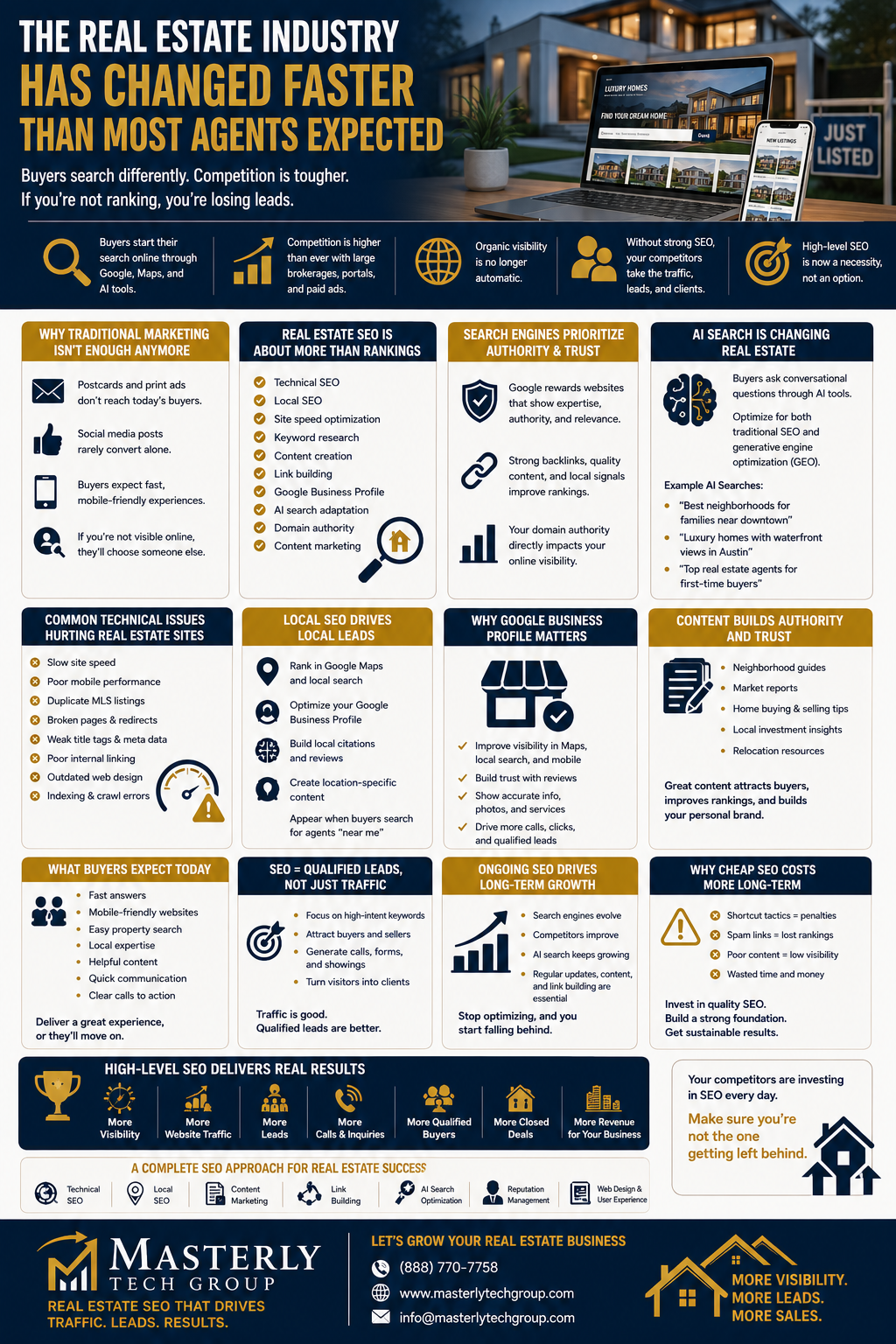
The Real Estate Industry Has Changed Faster Than Most Agents Expected
There was a time when real estate agents could rely on referrals, postcards, open houses, and simple websites to generate steady business. Years ago, many real estate professionals were able to rank online with minimal effort because competition across search engines was far less aggressive than it is today. A basic website and a few listings were often enough to attract website visitors searching for homes in local markets.
That reality no longer exists in today’s real estate market. The modern buyer searches differently, consumes content differently, and makes decisions much faster than previous generations of home buyers. Real estate companies now compete against massive brokerage websites, national listing platforms, paid advertising campaigns, and AI-driven search tools that dominate search results. Organic visibility is no longer automatic, even for experienced professionals with strong reputations.
At Masterly Tech Group, we have watched the real estate sector shift into one of the most competitive digital spaces online. Real estate businesses that once relied on word-of-mouth alone are now struggling to maintain visibility because search engine optimization has become essential instead of optional. Without advanced real estate SEO services, many agents and brokers are watching qualified leads disappear month after month.
Why Traditional Real Estate Marketing No Longer Works Alone
Many real estate companies still spend heavily on print advertisements, mail campaigns, or generic social media posts while ignoring the actual place buyers begin their search. Most potential buyers start online through search engines, Google Maps, local search results, or AI search tools before they ever contact an agent.
Today’s buyers expect fast access to information, mobile-friendly real estate websites, interactive MLS listings, and immediate answers to their questions. If a website loads slowly or fails to appear in search results, users simply move on to another company within seconds.
Real estate professionals who fail to adapt to modern digital marketing trends often see declining lead generation over time. Even highly skilled agents may struggle to compete if their online presence does not reflect the expectations of today’s consumers.
This is where professional real estate SEO becomes critical.
Real Estate SEO Is No Longer Just About Rankings
Many people still think real estate SEO simply means adding keywords to pages or blogging occasionally. Modern search engine optimization has become far more advanced than that.
Effective real estate SEO services involve:
- Technical SEO improvements
- Local SEO strategies
- Site speed optimization
- Keyword research
- Content creation
- Link building
- Google Business Profile optimization
- AI search adaptation
- Domain authority development
- Content marketing strategies
A real estate SEO company must now understand how users search, how search engines evaluate websites, and how AI search technology is reshaping online visibility.
Without a complete solution, many real estate agent websites fail to compete in an increasingly crowded market.
Search Engines Are Prioritizing Authority More Than Ever
Search engines have become significantly smarter over the last several years. Google no longer rewards websites simply for existing online. Instead, search engines prioritize businesses that demonstrate authority, trust, expertise, and relevance.
This means real estate websites must now provide valuable content, strong technical performance, and consistent signals of credibility across the internet.
For example, authoritative backlinks, strong Google Business Profile activity, high-quality content marketing, and local SEO strategies all contribute to stronger rankings.
Many real estate companies still underestimate how important domain authority has become. Without a strong digital foundation, even beautiful real estate websites may remain invisible in competitive search results.
Why Organic Traffic Has Become Harder to Earn
Organic traffic used to come much easier to smaller real estate businesses. Today, national real estate sites dominate many search results because they invest millions into SEO services, technical expertise, and digital marketing infrastructure.
Large companies aggressively target high intent keywords related to:
- Homes for sale
- Local neighborhoods
- Property values
- MLS listings
- Real estate services
- Luxury homes
- Commercial properties
As competition increases, smaller real estate professionals often find themselves buried beneath larger websites with stronger search presence.
This is why modern real estate SEO requires much more than basic optimization techniques.
AI Search Is Changing the Real Estate Landscape
AI search tools are dramatically changing how people find information online. Buyers are increasingly using AI search systems to ask detailed questions about neighborhoods, pricing, schools, taxes, and local market conditions.
Traditional search behavior is evolving quickly. Instead of searching simple keywords, users now ask conversational questions through AI platforms and generative engine optimization systems.
For example, potential buyers may search:
- “Best neighborhoods for families near downtown”
- “Luxury real estate websites with waterfront properties”
- “Top real estate agents for first-time buyers”
Real estate companies that fail to optimize for AI search may lose visibility even if they previously ranked well in traditional search engines.
Modern real estate SEO experts must now understand both traditional SEO and emerging generative engine optimization strategies.
Most Real Estate Websites Are Technically Weak
One of the biggest problems in the real estate industry is that many real estate websites are poorly optimized from a technical standpoint.
Common issues include:
- Slow site speed
- Broken pages
- Poor mobile performance
- Weak title tags
- Duplicate MLS listings
- Weak internal linking
- Outdated web design
- Poor indexing structure
These technical SEO problems quietly damage rankings and reduce visibility over time.
Most website owners never realize how much traffic they are losing because of these hidden technical issues.
Local SEO Is Essential for Real Estate Companies
Real estate is highly location-based, which makes local SEO one of the most important parts of any digital strategy.
Buyers typically search for:
- Real estate agents near them
- Local property listings
- Neighborhood information
- Nearby schools
- Local market insights
Without strong local search optimization, even experienced agents may struggle to appear in Google Maps or local search results.
A professional real estate SEO agency understands how to optimize location pages, Google Business Profile listings, and localized content to improve visibility within specific markets.
Why Google Business Profile Optimization Matters
Many real estate professionals underestimate the importance of a properly optimized Google Business Profile.
A strong profile helps businesses appear in:
- Google Maps
- Local search
- Mobile searches
- Voice searches
Your Google Business Profile often becomes the first impression potential clients have of your business online.
Profiles with poor optimization, weak reviews, or inconsistent information often lose visibility against competitors with stronger local SEO strategies.
This is one reason Masterly Tech Group focuses heavily on local optimization for real estate companies.
Real Estate SEO Requires Deep Market Knowledge
Successful real estate SEO is not just about understanding search engines. It also requires deep market knowledge and understanding how buyers behave within specific real estate markets.
For example, luxury buyers search differently than first-time home buyers. Commercial property investors search differently than residential buyers.
A real estate SEO company must understand how to create content that matches user intent and local market trends.
Generic SEO agencies often fail because they lack specialized experience within the real estate sector.
Why Generic SEO Agencies Often Fail Real Estate Clients
Most SEO agencies claim they can work with any industry. However, real estate SEO requires specialized technical expertise, local strategy development, and deep understanding of buyer behavior.
Many generic agencies fail to understand:
- MLS integration challenges
- Property search filters
- Brokerage website structures
- Real estate lead funnels
- Local housing trends
- Buyer search intent
As a result, many real estate businesses waste money on ineffective SEO services that fail to generate qualified buyers or serious buyers.
A specialized real estate SEO agency understands the unique demands of the industry.
Real Estate SEO Is About Qualified Leads, Not Empty Traffic
Traffic alone does not pay commissions. Real success comes from attracting qualified leads who are actively searching for real estate services.
This is why keyword research matters so much.
Effective SEO campaigns focus on high intent keywords that attract users who are ready to:
- Buy homes
- Sell properties
- Contact agents
- Schedule showings
- Request valuations
A strong SEO agency understands how to target search phrases that generate real business opportunities instead of meaningless clicks.
Content Creation Has Become Critical for Real Estate Success
Modern SEO depends heavily on content creation.
Search engines reward websites that consistently create content demonstrating expertise, authority, and local relevance.
For real estate companies, valuable content may include:
- Neighborhood guides
- Market insights
- Buyer education articles
- Local investment trends
- Relocation resources
- Home selling strategies
Content marketing also helps establish personal brand authority for the individual agent.
Without consistent content creation, many real estate sites struggle to compete long-term.
Real Estate Clients Expect More Than Listings
Today’s real estate clients expect far more than simple MLS listings.
They want:
- Market education
- Local expertise
- Fast responses
- User friendly websites
- Mobile access
- Clear calls to action
- Helpful content
- Direct access to agents
If real estate websites fail to provide these experiences, users often leave within seconds.
Modern SEO strategies must focus not only on rankings, but also on improving the overall user experience.
Site Speed Directly Impacts Real Estate Conversions
Slow websites quietly kill conversions.
If pages take too long to load, potential buyers often abandon the site before viewing listings or contacting agents.
Search engines also penalize websites with poor site speed performance.
Real estate websites frequently struggle with large images, complex MLS integrations, and outdated web design systems that reduce speed and hurt rankings.
Technical SEO improvements focused on speed optimization may dramatically improve both rankings and lead generation.
Mobile Devices Are Dominating Real Estate Searches
Most modern real estate searches now happen on mobile devices.
Buyers search while:
- Driving through neighborhoods
- Touring homes
- Attending open houses
- Relocating
- Traveling
If real estate agent websites are not fully optimized for mobile users, businesses lose visibility and conversions quickly.
Mobile-friendly web design is no longer optional for the real estate industry.
Luxury Real Estate Websites Face Even More Competition
Luxury real estate websites operate within an especially competitive market.
High-end buyers expect polished digital experiences, advanced search tools, fast performance, and strong visual branding.
Luxury real estate SEO requires sophisticated strategies involving:
- High authority content
- Local optimization
- Advanced technical SEO
- Reputation management
- Personal branding
Without premium SEO services, even experienced luxury agents may struggle to compete online.
Link Building Still Matters in Modern SEO
Many people assume link building no longer matters because search algorithms have evolved. In reality, authoritative backlinks remain one of the strongest ranking signals within search engines.
Real estate SEO experts focus on acquiring:
- Industry citations
- Local business mentions
- Authoritative backlinks
- Media coverage
- Relevant partnerships
Strong link building strategies help increase domain authority and improve long-term rankings.
Weak backlink profiles often prevent real estate companies from competing effectively online.
Technical SEO Is the Foundation of Long-Term Success
Technical SEO is often the hidden difference between websites that succeed and websites that disappear from search results.
Strong technical SEO includes:
- Proper indexing
- Clean site architecture
- Schema markup
- Mobile optimization
- Crawl efficiency
- Secure website protocols
Without technical SEO improvements, even excellent content may fail to rank properly.
Most real estate businesses never realize how many hidden technical problems are limiting their visibility.
Brokerage Websites Require Advanced SEO Strategies
Brokerage websites are often significantly more complex than standard business websites.
They may contain:
- Thousands of MLS listings
- Multiple agent profiles
- Interactive search filters
- Dynamic content
- Neighborhood pages
Without advanced optimization, brokerage websites can quickly become difficult for search engines to crawl effectively.
This is why brokerage SEO requires specialized experience and technical expertise.
Real Estate Companies Must Build a Strong Personal Brand
The modern real estate market is heavily influenced by trust and reputation.
Buyers increasingly choose agents who demonstrate expertise online through:
- Educational content
- Strong branding
- Consistent visibility
- Professional website design
- Helpful resources
A strong personal brand helps real estate professionals stand out in crowded search results.
SEO strategies that support personal brand growth often generate stronger long-term lead generation results.
Competitor Analysis Is Essential in Real Estate SEO
Real estate businesses operate in highly localized and competitive environments.
Competitor analysis helps SEO agencies identify:
- Ranking opportunities
- Keyword gaps
- Backlink weaknesses
- Content opportunities
- Local search advantages
Without competitor analysis, many real estate SEO campaigns operate blindly.
Understanding what competing real estate companies are doing online is critical for long-term growth.
Why High-Level SEO Is Now a Business Necessity
SEO is no longer just a marketing add-on.
For modern real estate companies, SEO directly impacts:
- Lead generation
- Visibility
- Brand authority
- Market share
- Revenue growth
Real estate professionals who ignore SEO often experience declining online visibility year after year.
Meanwhile, businesses investing aggressively into search engine optimization continue capturing more traffic and more leads.
Clear Calls to Action Matter More Than Ever
Many real estate websites generate traffic but fail to convert visitors into actual leads.
Weak websites often lack:
- Clear calls to action
- Strong contact forms
- Mobile accessibility
- Fast response systems
SEO is not only about attracting visitors. It is also about converting those visitors into potential clients and qualified buyers.
Conversion-focused design plays a major role in successful lead generation.
Why Real Estate Sites Need Better User Experience
User experience strongly affects rankings and conversions.
Real estate sites should feel:
- Fast
- Organized
- User friendly
- Easy to navigate
- Mobile optimized
Property search filters, MLS listings, and interactive features should work smoothly across all devices.
If users become frustrated, they leave quickly and search elsewhere.
Generative Engine Optimization Is Becoming Critical
Generative engine optimization is rapidly becoming one of the most important emerging strategies within digital marketing.
AI search tools increasingly summarize information directly for users instead of sending traffic to traditional websites.
Real estate SEO experts must now optimize content for both human readers and AI-driven systems.
Businesses ignoring generative engine optimization may lose visibility as search behavior continues evolving.
Real Estate Businesses Need a Complete Solution
Modern SEO success requires much more than occasional blog posts or simple keyword updates.
Real estate businesses now need a complete solution involving:
- Technical SEO
- Content marketing
- Local SEO
- Link building
- AI search adaptation
- Web design improvements
- Google Maps optimization
Fragmented marketing strategies rarely produce consistent long-term results.
Comprehensive SEO services help businesses compete more effectively within the modern digital landscape.
Why Real Estate Professionals Must Adapt Quickly
The real estate industry is changing rapidly.
Buyers now expect:
- Instant information
- Mobile access
- Educational content
- Fast communication
- Strong digital experiences
Real estate professionals who fail to adapt risk losing visibility to more aggressive competitors investing heavily into digital marketing and SEO strategies.
The businesses dominating search results today are often the ones investing most aggressively into long-term online growth.
More Leads Come From Better Visibility
The relationship between visibility and lead generation is straightforward.
Businesses appearing consistently within search results generate:
- More leads
- More calls
- More website traffic
- More qualified buyers
- More opportunities
Without strong search presence, even excellent real estate services may remain invisible to potential clients.
SEO directly affects whether your business gets found online.
Real Estate SEO Requires Ongoing Strategy
SEO is not a one-time setup process.
Search engines constantly evolve. Competitors continuously improve their websites. AI search systems continue changing user behavior.
Real estate SEO campaigns require:
- Ongoing optimization
- Regular content updates
- Technical monitoring
- Link development
- Performance analysis
Businesses that stop investing in SEO often lose rankings over time.
Why Cheap SEO Often Costs More Long-Term
Some businesses choose low-cost SEO providers focused on cheap shortcuts instead of sustainable growth.
Unfortunately, poor-quality SEO may lead to:
- Weak rankings
- Spam backlinks
- Poor content
- Technical penalties
- Lost visibility
A fair price for professional SEO services should reflect real expertise, technical work, and long-term strategy development.
Low-cost SEO often creates larger problems later.
Real Estate Companies Need Modern Digital Presence
A strong digital presence now affects nearly every stage of the buyer journey.
Potential buyers often research:
before ever making direct contact.
Without strong online visibility, businesses lose opportunities before conversations even begin.
Modern SEO strategies help ensure businesses remain visible where buyers are actively searching.
The Days of Passive Lead Generation Are Over
The old days of passively waiting for organic leads are disappearing quickly.
Real estate companies now compete against:
- National brands
- Massive listing sites
- AI search systems
- Aggressive advertisers
- Sophisticated SEO campaigns
Without high-level real estate SEO services, businesses often struggle to maintain consistent lead flow.
The real estate professionals growing today are the ones investing intentionally into long-term digital visibility.
How Modern Real Estate Platforms Help Agents Streamline Growth
Today’s real estate professionals need more than just a basic website to stay competitive. Modern platforms now give agents and brokers better ways to manage leads, automate communication, and improve how clients access property information online. Many successful real estate companies are also offering services that go beyond listings alone, including relocation guidance, neighborhood insights, virtual tours, and educational resources for buyers and sellers. Advanced digital systems with customizable templates also help agents create branded marketing materials quickly while maintaining a professional online presence. These tools not only improve efficiency but also help real estate professionals focus more time on closing deals and building stronger relationships with potential buyers and sellers.
Work With Masterly Tech Group to Build Real Estate SEO That Actually Performs
At Masterly Tech Group, we understand how competitive the real estate market has become online. Our team works with real estate companies, brokerage websites, individual agent brands, property developers, and real estate professionals who want more than temporary marketing trends. We focus on building long-term SEO strategies designed to generate qualified leads, increase search presence, and help businesses compete in today’s evolving digital landscape.
Our services include technical SEO, local SEO, content creation, web design, Google Business Profile optimization, competitor analysis, link building, AI search optimization, and advanced real estate SEO strategies tailored specifically for the modern real estate industry. Whether you are trying to improve real estate agent websites, increase organic traffic, strengthen your digital presence, or attract serious buyers, our team is committed to delivering customized solutions built around your goals.
We understand that many real estate businesses are tired of working with SEO agencies that overpromise and underdeliver. That is why our approach focuses on transparency, performance, technical expertise, and long-term growth instead of generic marketing tactics or unnecessary setup fee structures that fail to produce results.
If you are ready to work with a google ads expert and SEO agency that understands the real estate sector at a deeper level, contact Masterly Tech Group at (888) 209-4055 to book a free consultation. We can answer your questions, evaluate your current search visibility, and discuss how high-level SEO services may help your real estate business generate more leads, stronger rankings, and long-term online growth in an increasingly competitive market.