SEO for Accountants: How to Increase Client Acquisition and Outperform Competitors
The Accounting Industry Has Changed More Than Many Firms Realize
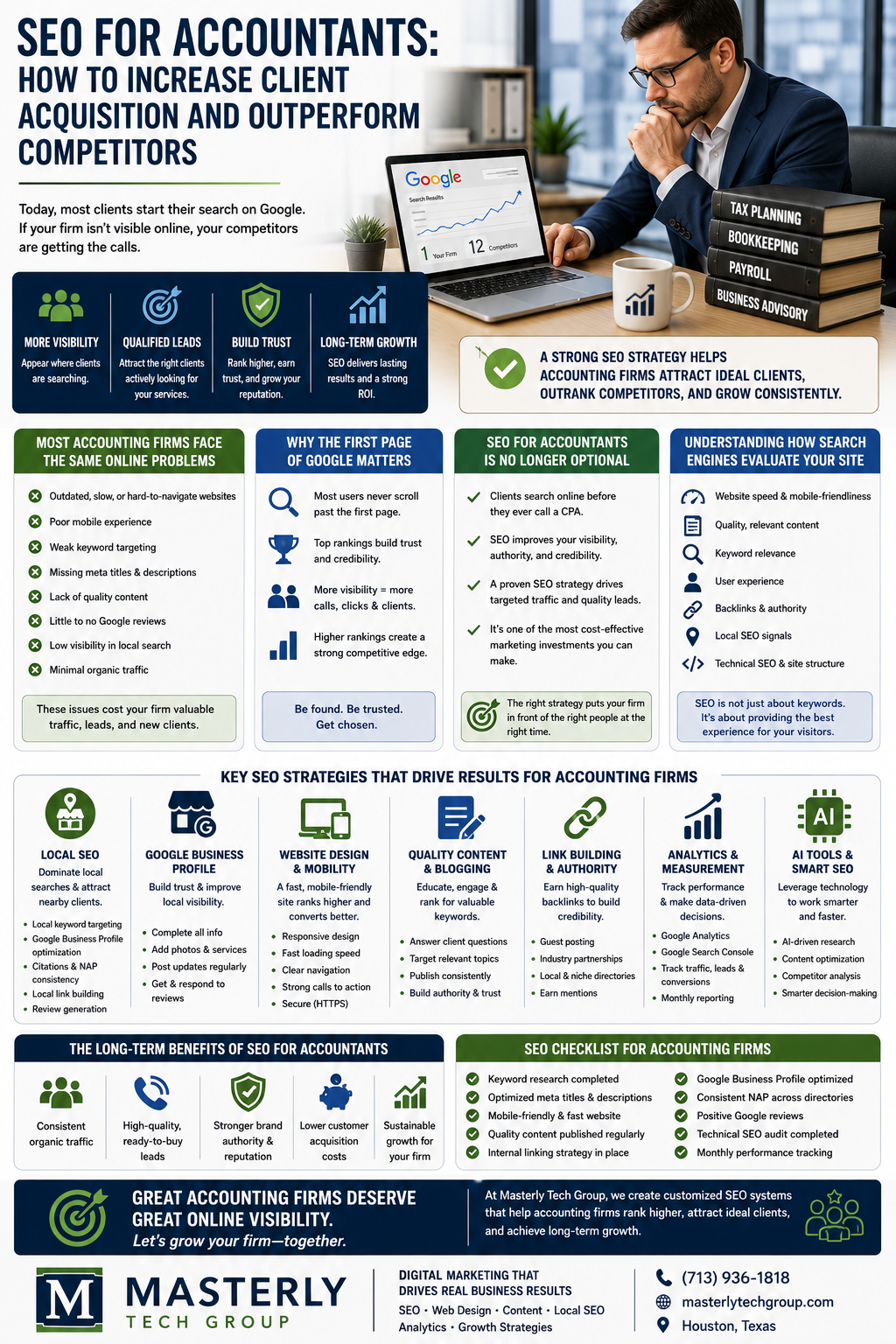
A decade ago, many accounting firms relied heavily on referrals, networking events, and word-of-mouth relationships to grow their client base. While referrals still matter, the modern client journey usually begins online. Before calling a CPA, most people now turn to Google search to compare services, read reviews, and research local professionals. If your website is difficult to find, outdated, or poorly optimized, those potential clients are likely choosing another firm before ever contacting you.
The accounting industry has become significantly more competitive online. Many CPA firms now invest heavily in search engine optimization because they understand visibility on search engines directly affects client acquisition. Businesses and individuals searching for tax planning, bookkeeping, payroll, audits, or consulting services often trust the firms appearing near the top of search results. Firms buried on page three or four rarely receive meaningful traffic or quality leads.
This shift has changed how accounting firms approach marketing. Traditional advertising still has value, but digital visibility now plays a major role in long-term growth. A strong SEO strategy helps accounting firms attract ideal clients organically while building trust and authority over time. Firms that ignore SEO often lose opportunities to competitors who understand how modern search behavior works.
At Masterly Tech Group, we help accounting firms improve online visibility, increase organic traffic, and create sustainable lead generation systems designed for long-term business growth. A professionally optimized website can become one of the most powerful business development tools an accounting firm owns.
SEO for Accountants Is No Longer Optional
Many firm owners still assume SEO is something only large corporations need. However, SEO for accountants has become one of the most important marketing investments a firm can make. When someone searches for tax planning, payroll support, business accounting, or financial consulting services, they usually contact one of the first firms they see in Google search results.
Search engine optimization helps improve visibility inside search engines by making your accounting website more relevant, trustworthy, and technically optimized. A properly executed seo strategy helps accounting firms appear higher in search results when users search for accounting services in their area.
Without SEO, even a great accounting firm may struggle to compete online. Many accounting firm websites fail to generate traffic simply because they were never properly optimized for search engines. A beautiful website alone does not guarantee visibility. Search engines must understand what the website offers, where the business operates, and which services the firm specializes in.
A professionally developed accountant seo strategy helps firms reach more people at the exact moment they are actively searching for accounting support. That timing makes SEO one of the most cost effective forms of marketing available today.
Most Accounting Firms Face the Same Online Problems
Most accounting firms experience similar SEO challenges. Their website may look professional, but it fails to rank competitively inside search engine results pages. Others rely on outdated websites that load slowly, lack mobile friendly design, or contain duplicate content that weakens SEO performance.
Some firms also struggle because they never developed consistent website content. Search engines prioritize websites that regularly publish helpful and relevant information. A stagnant accounting website with only a few pages often struggles to compete against firms publishing relevant blog posts consistently.
Other common SEO problems include:
- Weak keyword research
- Missing meta titles
- Poor meta description optimization
- Broken links
- Lack of internal links
- Poor technical seo
- Weak local search visibility
- Minimal organic traffic
- Limited google reviews
Without correcting these issues, accounting firms may continue losing visibility to competitors investing more heavily in search engine optimization.
The First Page of Google Search Matters More Than Ever
Appearing on the first page of Google search results dramatically increases visibility, trust, and lead generation opportunities. Most users never scroll beyond the first few search results when searching for accounting services online.
Potential clients often assume firms ranking higher are more established, trustworthy, and authoritative. Search engines reward websites demonstrating expertise, consistency, technical quality, and strong user experience. Firms appearing near the top of organic search results usually receive far more clicks, calls, and form submissions than competitors ranking lower.
This visibility becomes especially important during tax season when consumers and small businesses actively search for accounting help. Firms ranking prominently during these periods often experience major increases in website traffic and client inquiries.
At Masterly Tech Group, we help accounting firms improve search visibility through customized seo services designed specifically for the accounting industry. Our strategies focus on long-term growth rather than short-term tricks that fail over time.
Understanding How Search Engines Evaluate Accounting Websites
Search engines evaluate hundreds of ranking factors when deciding where accounting firm websites appear inside search results. The goal of search engines is to deliver the most useful, trustworthy, and relevant information to users.
Several major factors influence rankings, including:
- Website speed
- Mobile friendly design
- Quality content
- Keyword relevance
- User experience
- Technical seo
- Internal links
- External links
- Local seo signals
- Google business profile optimization
Search engines also analyze how users interact with the website. If visitors leave quickly because pages load slowly or content lacks value, rankings may suffer over time.
A strong seo strategy focuses on improving all of these areas together. Successful SEO involves much more than simply adding keywords throughout a website. Modern search engine optimization requires strategic planning, technical improvements, and ongoing content development.
Keyword Research Helps Firms Reach the Right Audience
One of the most important parts of SEO for accountants involves keyword research. Firms must understand exactly what their target audience is searching for online before creating content or optimizing pages.
For example, some users may search for “small business accountant near me” while others search for “tax planning for medical practices” or “CPA for real estate investors.” Effective keyword research helps accounting firms target the phrases most likely to generate quality leads.
Strong keyword targeting also helps search engines understand what services the firm provides. Without clear keyword signals, search engines may struggle to determine where the website belongs within search results.
At Masterly Tech Group, we help accounting firms identify valuable search opportunities that align with their services, specialties, and geographic market. Strategic keyword research often becomes the foundation of long-term seo success.
Local SEO Helps Accounting Firms Dominate Nearby Searches
Local seo is especially important for accounting firms because many clients prefer working with professionals in their local community. When someone searches for an accountant nearby, Google search often prioritizes businesses with strong local search signals.
An optimized google business profile plays a major role in local visibility. Accounting firms with complete profiles, positive google reviews, accurate business information, and regular updates tend to perform better inside local search results.
Local seo also involves:
- Location-based website content
- Local keyword targeting
- Citation consistency
- Map optimization
- Review generation
- Local link building
Firms serving multiple states or multiple jurisdictions may require more advanced local seo strategies to compete effectively across different regions.
Strong local visibility often generates highly qualified traffic because users searching locally are frequently ready to contact a firm immediately.
Google Business Profile Optimization Builds Trust Quickly
A properly optimized google business profile often becomes one of the first impressions potential clients see online. Profiles containing complete information, accurate categories, updated photos, and positive reviews generally perform better inside local search results.
Google business profile optimization helps accounting firms appear more trustworthy and accessible. Many users review profiles before even visiting the website itself. A neglected business profile may create doubts regarding professionalism or responsiveness.
An optimized google business profile should include:
- Accurate contact information
- Service descriptions
- Relevant categories
- Updated hours
- Service areas
- High-quality images
- Consistent reviews
This optimization also tells search engines the business is legitimate and active within its market.
Website Design Affects SEO Performance
Many accounting firms underestimate how heavily accounting website design affects rankings and user behavior. A poorly designed website may frustrate visitors, increase bounce rates, and reduce lead generation opportunities.
Websites should load quickly, work well on mobile devices, and offer easy navigation, according to modern users. Search engines monitor these user experience signals closely.
An effective accounting website should include:
- Mobile friendly layouts
- Fast loading pages
- Easy navigation
- Clear calls to action
- Secure browsing
- Optimized content structure
- Simple contact forms
Good accounting website design supports both SEO performance and conversion optimization simultaneously. A website should not only attract traffic but also encourage visitors to become clients.
Mobile Optimization Matters More Than Many Firms Realize
More people now browse websites using mobile devices than desktop computers. Search engines prioritize mobile friendly websites because user experience on smaller screens significantly affects engagement and rankings.
An accounting website failing to function properly on smartphones may lose visibility inside google search results. Users frustrated by difficult navigation, slow loading speeds, or unreadable content often leave immediately.
Mobile optimization includes:
- Responsive design
- Fast page loading
- Touch-friendly navigation
- Readable text formatting
- Optimized images
Accounting firms investing in mobile optimization often see improvements in both SEO performance and lead generation.
Content Helps Establish Authority Online
One of the most effective ways to improve seo for accountants involves publishing valuable and informative website content regularly. Search engines reward websites that consistently provide useful information for users.
Relevant blog posts allow accounting firms to answer common client questions while targeting important keywords naturally. Topics involving tax planning, bookkeeping tips, payroll compliance, business deductions, and financial strategy often perform well within organic searches.
Publishing quality content also helps establish authority within the accounting industry. Potential clients searching for information online often trust firms demonstrating expertise through educational content.
At Masterly Tech Group, we help firms develop content strategies designed to improve search rankings while building credibility with potential clients.
Blog Content Supports Long-Term SEO Growth
A single blog post may continue generating traffic for years when optimized correctly. This makes content marketing one of the most sustainable long-term SEO investments available for accounting firms.
Effective blog content should:
- Target relevant keywords
- Answer client questions
- Include internal links
- Provide valuable insights
- Use optimized meta description tags
- Avoid keyword stuffing
Search engines prioritize websites publishing original and informative content consistently. Firms relying only on service pages often struggle to compete against websites producing ongoing educational material.
Regular blogging also creates more opportunities for organic traffic and keyword rankings over time.
Internal Links Improve User Experience and SEO
Internal links help connect pages throughout the website while improving navigation and SEO structure. Search engines use internal links to understand how content relates together.
For example, a blog post discussing tax planning may internally link to service pages involving business tax preparation or consulting services. These connections help search engines better understand the website’s content hierarchy.
Internal links also help users explore additional information naturally. Visitors staying longer on the website often signal positive engagement to search engines.
Strong internal linking strategies improve crawlability, strengthen page authority, and support overall SEO performance.
Link Building Remains Important for Rankings
Link building continues playing a major role in search engine optimization. Search engines view links from other websites as signals of trust and authority.
However, not all backlinks provide value. Some low-quality links may actually harm rankings. This is why quality matters more than quantity during link building campaigns.
Accounting firms may strengthen authority by:
- Publishing high-value content
- Earning mentions from industry sites
- Building local partnerships
- Write guest posts on relevant websites
- Earning media coverage
Strong external links from reputable websites help improve trust signals within search engines over time.
Technical SEO Often Gets Ignored
Technical seo involves optimizing the behind-the-scenes structure of the website so search engines can crawl and index content effectively.
Many accounting firms overlook technical problems that quietly damage rankings, including:
- Broken links
- Slow page speeds
- Duplicate content
- Poor mobile optimization
- Missing metadata
- Crawl errors
Tools like google search console and google analytics help identify technical issues affecting visibility. Regular seo audit reviews may uncover problems before they significantly impact traffic.
At Masterly Tech Group, we help firms identify and correct technical SEO issues that prevent stronger rankings and improved user experience.
Google Analytics Helps Measure Real Growth
Google analytics allows accounting firms to measure how users interact with the website. Firms can track traffic sources, conversion behavior, user engagement, and lead generation trends.
This data helps determine which SEO efforts are working and which areas require improvement. Metrics involving form submissions, organic traffic, bounce rates, and user behavior provide valuable insight into SEO performance.
Without tracking systems in place, many accounting firms make marketing decisions blindly. Google analytics helps firms measure return on investment more accurately while improving strategic decision-making.
Monthly reporting also helps firms understand long-term progress rather than relying only on short-term ranking changes.
Google Search Console Provides Critical SEO Data
Google search console gives accounting firms direct insight into how search engines view their website. It identifies crawl issues, indexing problems, search impressions, keyword performance, and technical errors.
Using google search console regularly helps firms:
- Monitor keyword rankings
- Identify broken links
- Track click-through rates
- Review search queries
- Improve indexing
Many accounting firm websites experience technical problems without realizing it. Search console often helps uncover hidden issues affecting visibility inside search results.
AI Tools Are Changing SEO Rapidly
Modern ai tools are reshaping how accounting firms approach digital marketing and content development. While ai tools can help generate ideas, automate research, and support optimization, human oversight still remains critical.
Search engines prioritize authentic, accurate, and valuable content rather than mass-produced low-quality articles. Firms relying entirely on automation often create duplicate content or shallow material lacking real authority.
Successful SEO combines technology with professional insight. At Masterly Tech Group, we use advanced tools strategically while ensuring every SEO strategy remains personalized, accurate, and focused on long-term growth.
Avoiding Keyword Stuffing Is Important
Some businesses mistakenly believe repeating keywords excessively improves rankings. In reality, keyword stuffing often harms readability and may negatively affect SEO performance.
Search engines now prioritize natural language and user experience rather than repetitive keyword placement. Effective SEO uses keywords strategically while maintaining clear and professional communication.
A strong blog post should sound informative and conversational rather than overly optimized. Quality content designed for real people generally performs better long term than robotic keyword-heavy writing.
Social Media Marketing Supports SEO Efforts
While social media marketing does not directly determine rankings, it often supports broader SEO efforts by increasing visibility, engagement, and traffic.
Sharing relevant blog posts and educational content across social platforms may help accounting firms:
- Increase brand awareness
- Reach new audiences
- Build trust
- Generate website visits
- Encourage content sharing
Social media also helps strengthen relationships within the local community and improve online visibility beyond search engines alone.
CPA Firms Need Stronger Online Authority
CPA firms operate in a trust-based industry where authority and credibility matter tremendously. Potential clients often compare multiple accounting firms online before making contact.
Strong SEO helps position firms as knowledgeable professionals rather than just another option inside search results. Publishing quality content, maintaining strong reviews, and optimizing the website all contribute toward stronger online authority.
An expert cpa with strong online visibility often gains competitive advantages over firms relying solely on referrals or outdated marketing methods.
SEO Is a Long-Term Investment
SEO success rarely happens overnight. Search engine optimization requires ongoing effort, strategic planning, and consistent improvements over time.
However, unlike paid advertising, SEO often continues delivering value long after initial optimization work is completed. Strong rankings may generate organic traffic and quality leads for years when maintained properly.
Accounting firms investing in SEO often build sustainable visibility that compounds over time. A well-optimized website becomes a long-term business asset supporting consistent client acquisition.
Great Accounting Firms Deserve Better Visibility
Many great accounting firm websites underperform online simply because nobody optimized them properly for search engines. Technical issues, weak content, poor local seo, and limited authority signals often prevent firms from reaching their full potential online.
Strong SEO allows high-quality accounting firms to compete more effectively against larger competitors with bigger advertising budgets. Search engine optimization helps level the playing field by rewarding expertise, relevance, and user experience.
At Masterly Tech Group, we help firms build customized SEO systems focused on measurable growth and long-term visibility improvements.
Your Website Should Generate Clients Consistently
A website should function as more than an online brochure. Properly optimized accounting firm websites become active lead generation tools capable of attracting new clients consistently.
An effective website should:
- Rank competitively
- Generate organic traffic
- Encourage form submissions
- Convert visitors into consultations
- Establish authority
- Build trust
Without strong SEO, many websites fail to generate meaningful business opportunities despite substantial development costs.
SEO Helps Firms Outperform Competitors
Accounting firms competing in crowded markets need strategic advantages to stand out. SEO provides one of the most effective ways to outperform competitors online.
Firms investing consistently in SEO often gain stronger rankings, higher visibility, better authority, and more organic searches over time. Meanwhile, competitors ignoring SEO may slowly lose market share digitally.
An effective seo strategy helps firms:
- Attract ideal clients
- Improve online authority
- Generate quality leads
- Increase visibility
- Strengthen brand recognition
The firms dominating search results tomorrow are usually the firms investing in SEO today.
Partner With Masterly Tech Group for Accountant SEO
If your accounting website is not generating the visibility, traffic, or client inquiries your firm deserves, it may be time to evaluate your current SEO strategy. Many accounting firms struggle online not because they lack expertise, but because their website was never properly optimized for search engines, local search visibility, or lead generation.
At Masterly Tech Group, we specialize in accountant seo strategies designed to help accounting firms improve rankings, increase organic traffic, attract quality leads, and outperform competitors online. From technical seo and local seo to content strategy, keyword research, website optimization, and google business profile management, our team develops customized solutions tailored to the accounting industry.
Contact us at (888) 209-4055 to book a free consultation. We can answer questions regarding seo for accountants, accounting website optimization, lead generation, search engine optimization strategies, and long-term growth solutions designed specifically for accounting firms and CPA firms ready to expand their online presence.