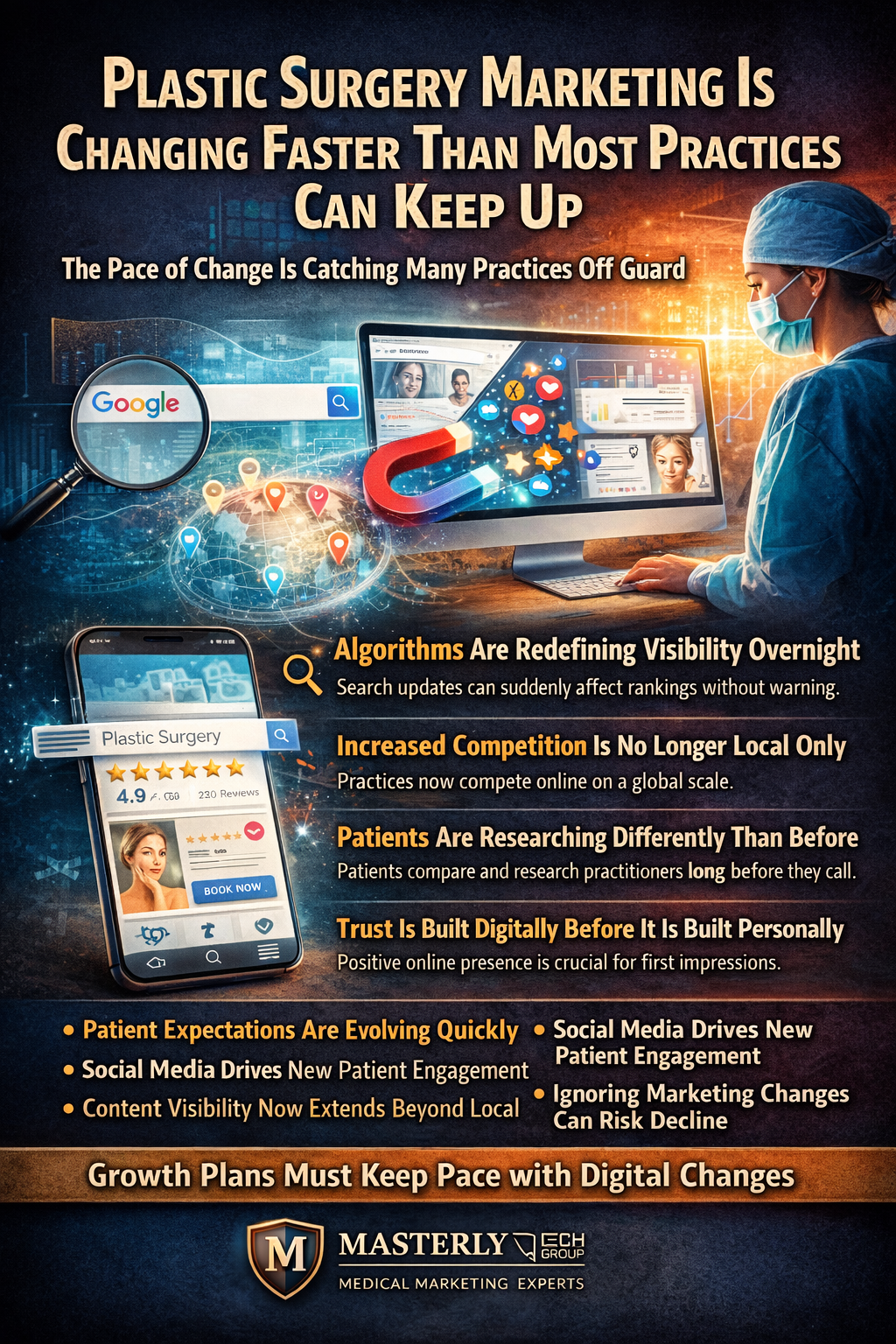
Plastic Surgery Marketing Is Changing Faster Than Most Practices Can Keep Up
The Pace of Change Is Catching Many Practices Off Guard
Plastic surgery marketing no longer moves at a comfortable or predictable pace. What worked even two years ago can now quietly fail without obvious warning signs. Many plastic surgeons believe their reputation alone will continue to bring in patients, but digital behavior tells a different story. Patients are researching faster, comparing more options, and trusting online signals more than ever before.
The challenge is not a lack of skill in plastic surgery itself. The challenge is that marketing systems, algorithms, and patient expectations are evolving simultaneously. Practices that do not adjust often fall behind before they realize anything has changed.
Algorithms Are Redefining Visibility Overnight
Search engines update constantly, and those updates directly affect how plastic surgery clinics appear in search results. A practice website that once ranked well can slip without any visible error. This shift leaves many plastic surgeons confused and unsure where to start.
Search engine optimization is no longer about basic keywords alone. It now depends on technical performance, content quality, local relevance, and user behavior. Without ongoing adjustments, even established practices lose visibility to competitors who adapt faster.
Increased Competition Is No Longer Local Only
Plastic surgery now competes in a digital-first competitive market. A plastic surgery practice is no longer only competing with nearby clinics. It is competing with anyone visible within the same search results.
Cosmetic surgeons who invest in modern marketing strategies dominate attention before patients ever make contact. Those who delay adaptation often find themselves overshadowed without understanding why phone calls slow down.
Patients Are Researching Differently Than Before
Most patients begin their journey online long before contacting a practice. They review websites, watch video content, read patient testimonials, and analyze online reviews. These early impressions shape trust before a consultation is ever scheduled.
Plastic surgery patients expect clarity, education, and transparency. Practices that fail to meet these expectations lose potential patients early in the decision process.
Trust Is Built Digitally Before It Is Built Personally
Patient trust now starts on screens, not in consultation rooms. Search results, social media presence, and patient reviews all contribute to credibility. A weak digital presence creates doubt, even for highly skilled plastic surgeons.
Positive reviews and visible engagement reassure potential patients that others have had good experiences. Without social proof, even strong reputations struggle to convert interest into action.
Plastic Surgeons Often Don’t See the Decline Immediately
One of the biggest risks in plastic surgery marketing is delayed awareness. Appointments may stay steady for a time due to referrals or repeat patients. Meanwhile, online traction quietly declines.
By the time fewer new patients are booking consultations, the gap has already widened. Recovering lost momentum requires far more effort than maintaining it consistently.
The Shift Toward Digital-First Patient Decisions
Digital marketing has become the primary driver of patient discovery. Patients no longer rely solely on word-of-mouth or traditional advertising. They rely on what they see across search engines and social media platforms.
Marketing for plastic surgeons must align with how people search, scroll, and engage today. Ignoring this shift leaves practices disconnected from how decisions are actually made.
Plastic Surgery Websites Are No Longer Just Informational
A practice website must now convert attention into action. It must be mobile friendly, fast, and structured for patient engagement. If it fails to guide users clearly, visitors leave without contacting the office.
The practice website is often the first interaction patients have with a plastic surgeon. That moment determines whether trust begins or ends.
Local Visibility Determines Appointment Volume
Local search results heavily influence which practices receive calls. Google business profile optimization plays a critical role in visibility. Practices that neglect local signals lose nearby patients actively searching.
Local online marketing ensures that the right people see the practice at the right time. Without it, even strong branding struggles to compete.
Reviews Now Influence Decisions More Than Credentials
Patient reviews strongly affect how prospective patients evaluate cosmetic surgery practices. Most patients read multiple reviews before making contact. A lack of reviews or unanswered negative reviews raises concerns.
Encouraging satisfied patients to leave reviews builds credibility steadily. Ignoring reviews allows competitors to dominate perception.
Negative Reviews Can Shape a Narrative Quickly
Negative reviews are not just reputation issues. They affect search visibility and patient trust. Addressing concerns professionally helps protect credibility.
Leaving negative reviews unaddressed suggests inattention. Active review management is now a necessary part of plastic surgery practice marketing.
Social Media Is No Longer Optional
Social media has become a primary channel for patient education and engagement. Plastic surgeons who avoid social media miss opportunities to connect with ideal patients. Platforms favor consistent, authentic communication.
Social media engagement helps generate attention and build familiarity. Without it, practices appear distant or outdated.
Video Content Is Driving Modern Engagement
Video content allows plastic surgeons to explain cosmetic procedures clearly. Short videos humanize the practice and build confidence. Patients often trust faces and voices more than text alone.
Video ads and educational clips perform especially well across social media platforms. Practices using video content stay visible longer.
Content Builds Authority Before Consultations
Content marketing supports patient education and trust. Informative content answers common questions and reduces uncertainty. It positions the plastic surgeon as a credible authority.
Without consistent organic content, patients may choose practices that appear more transparent and informative.
Email Marketing Still Plays a Strategic Role
Email marketing supports patient retention and follow-up communication. It keeps the practice visible between visits and inquiries. When used correctly, it strengthens long-term relationships.
Practices that ignore email lose opportunities to re-engage interested patients. Consistent messaging supports business growth.
Advertising Is More Complex Than It Appears
Advertising requires more than budget allocation. Compelling ad copy, targeting, and lead management determine success. Poorly structured campaigns waste resources.
Digital marketing strategies must align ads with patient intent. When advertising is disconnected from messaging, results suffer.
Paid Ads Demand Strategic Oversight
Search engines and social media ads now require constant monitoring. Changes in policies and algorithms affect performance quickly. Unmanaged campaigns decline fast.
Professional oversight ensures advertising continues to generate more leads efficiently.
Marketing Plans Must Be Adaptive
A marketing plan cannot remain static. Current trends shift rapidly within the cosmetic surgery space. Practices that fail to update strategies fall behind.
Adaptive marketing strategies allow practices to respond quickly to new patient behaviors.
Cosmetic Procedures Are Searched Differently Today
Search behavior for cosmetic surgery procedures continues to evolve. Patients search for specifics like breast augmentation or reconstructive surgery with intent-based phrasing. Understanding these patterns is critical.
Targeting the right search terms improves visibility and conversion.
Target Audience Precision Matters More Than Volume
Reaching a broad audience is no longer enough. Marketing must reach ideal patients with relevant messaging. Patient demographics influence how and where outreach should occur.
Clear targeting improves patient engagement and conversion rates.
Direct Marketing Has Become Highly Targeted
Direct marketing is no longer mass outreach. It now relies on data-driven targeting and personalization. Generic messages no longer perform well.
When messaging aligns with patient needs, response rates improve significantly.
Lead Management Determines Conversion Success
Generating interest is only half the process. Lead management ensures timely follow-up and patient communication. Delays reduce booking rates dramatically.
Effective systems turn interest into scheduled consultations.
Patient Engagement Drives Long-Term Growth
Engaged patients are more likely to return and refer others. Patient engagement happens across multiple touchpoints. Digital consistency strengthens relationships.
Retention strategies support sustainable business growth.
Social Proof Influences Decision-Making
Social proof reassures potential patients. Seeing others share positive experiences reduces hesitation. This includes testimonials, reviews, and visible interactions.
Without social proof, trust builds slower.
Marketing Experts Understand Algorithm Behavior
Marketing experts monitor algorithm shifts and adjust strategies accordingly. This proactive approach protects visibility. Practices without expert guidance often react too late.
Staying up to date requires constant oversight.
Medical Marketing Requires Industry-Specific Knowledge
Medical marketing is regulated differently from other industries. Messaging must balance compliance with persuasion. Plastic surgery marketing requires this balance carefully.
Specialized experience reduces risk and improves results.
Online Reviews Affect Google Ranking
Online reviews influence local search ranking. More reviews and consistent engagement improve placement. Practices that encourage reviews gain visibility.
Ignoring this factor limits growth potential.
New Patients Follow Digital Signals
New patients trust digital indicators when choosing providers. Search results, ratings, and content shape perception. Practices that manage these signals grow faster.
Digital visibility leads to new customers consistently.
Marketing Activities Must Work Together
Isolated marketing efforts fail to create momentum. Marketing activities must align across platforms. Consistency improves recognition and recall.
Integrated strategies create a significant impact.
Social Media Platforms Favor Consistency
Algorithms reward consistent posting and engagement. Inconsistent activity reduces reach. Practices that maintain presence stay visible longer.
Social media rewards commitment.
Cosmetic Surgery Clinics Face Rising Expectations
Patients expect clarity, professionalism, and responsiveness. Cosmetic surgery clinics must meet these expectations digitally. Falling short reduces conversion.
Modern patients compare quickly and move on easily.
Marketing Is Now a Core Business Function
Marketing is no longer secondary to operations. It directly affects revenue and stability. Treating marketing as a core business function supports longevity.
Strategic investment protects growth.
Plastic Surgery Marketing Requires Ongoing Attention
Plastic surgery marketing cannot be set and forgotten. Continuous evaluation ensures relevance. Practices that remain passive lose ground.
Active oversight maintains competitiveness.
Falling Behind Often Goes Unnoticed
The most dangerous risk is slow decline. Metrics may drop gradually. By the time action is taken, recovery becomes harder.
Early intervention saves time and cost.
Professional Audits Reveal Hidden Gaps
A professional audit identifies unseen weaknesses. It evaluates visibility, messaging, and conversion. Many practices discover issues they never suspected.
Audits provide clarity and direction.
Strategic Intervention Restores Momentum
Strategic intervention realigns marketing efforts. It prioritizes improvements with the highest impact. This approach accelerates recovery.
Without intervention, decline continues.
Marketing for Plastic Surgeons Demands Expertise
Marketing for plastic surgeons requires understanding both patients and platforms. Generic approaches rarely succeed. Specialized strategy delivers measurable results.
Experience matters in execution.
Masterly Tech Group Focuses on Sustainable Growth
Masterly Tech Group specializes in helping plastic surgeons adapt to change. Our services support long-term stability, not quick fixes. We focus on visibility, engagement, and conversion.
Our approach aligns marketing with business goals.
Customized Strategies Replace Guesswork
Every plastic surgery practice is different. Customized strategies outperform templates. Understanding unique positioning drives better outcomes.
Personalization strengthens results.
Digital Marketing Is an Ongoing Investment
Digital marketing supports consistent patient flow. It evolves alongside platforms and behavior. Treating it as an investment protects future growth.
Neglect increases long-term costs.
Staying Competitive Requires Proactive Decisions
Practices that lead make proactive decisions. They adjust before decline begins. Those who wait often struggle to recover momentum.
Proactivity defines growth.
Partnering With the Right Marketing Agency Matters
Choosing the right marketing agency determines success. Industry experience, transparency, and strategy matter. The wrong partner slows progress.
Expert guidance accelerates results.
The Window to Act Is Narrowing
As competition increases, opportunities shrink. Early adopters dominate visibility. Late adopters must work harder to regain position.
Timing matters more than ever.
Take Control Before Falling Further Behind
If your practice feels stagnant or uncertain, it may already be slipping. Recognizing the need for help is the first step. Strategic support can reverse decline.
Action creates momentum.
Speak With a Digital Marketing Specialist Today
If you are unsure where your plastic surgery marketing stands, a professional review can provide clarity. Masterly Tech Group offers a free consultation to evaluate your current digital marketing performance and identify opportunities for improvement.
Call (888) 209-4055 to book a free consultation and learn how strategic digital marketing can help your practice stay competitive, visible, and aligned with today’s patient expectations.