CRM Strategy: Deciding What the System Must Support Before Custom Fields and Automations Multiply
Introduction: What Is a CRM Strategy and Why It Matters in 2026
A CRM strategy is the practical blueprint for how a company uses customer relationship management to hit concrete business goals: higher customer retention, lower acquisition cost, better upsell rates. It connects people, internal processes, customer data, and CRM software into one system that every team operates from daily.
An effective CRM strategy goes beyond choosing a CRM platform. It aligns marketing and sales teams, service teams, workflows, and the customer journey around personalized experiences that drive revenue. In KPMG's 2025 survey, 53% of high-revenue-growth companies reported strong CRM adoption, compared to just 24% among companies with stagnant or declining growth. A well-executed CRM strategy drives measurable business growth; choosing the wrong tool or skipping the strategy entirely does the opposite.
This article walks through the key steps of strategy design, CRM implementation, and CRM adoption, with practical examples for both B2B and B2C.
What Is Customer Relationship Management (CRM)?
Customer relationship management is a mix of practices, culture, and technology for managing customer interactions across the entire customer lifecycle. It covers everything from initial contact and acquisition through onboarding, retention, renewal, and advocacy.
A modern CRM system centralizes customer data from multiple channels: website forms, social platforms like TikTok and LinkedIn, email, phone, in-app behavior, and offline events. CRM systems streamline data across departments for better collaboration, giving sales, marketing, and service a shared view of every customer.
The concept of CRM (philosophy and practices) is different from CRM software (the actual tool). CRM tools enable companies to track:
- Contacts (individual people)
- Accounts (companies or households)
- Deals and opportunities
- Support tickets
- Marketing campaigns and engagement history
Modern CRM platforms combine these records with automation, reporting, and AI capabilities that support personalized experiences at scale.
What Is a CRM Strategy and Why It's a Business Imperative
A CRM strategy is a company-wide plan for how customer data, CRM software, and internal processes combine to achieve specific business objectives. Core components of a strong CRM strategy include clear objectives and customer data management, paired with governance rules that keep everything consistent.
The key aspects of a CRM strategy include aligning sales, marketing, customer success, and service teams around a shared view of the customer; mapping the customer journey end to end; and specifying who owns data quality and workflow standards. Creating a CRM strategy before CRM implementation prevents "feature dumping," where teams activate every available feature without connecting them to outcomes.
Companies using CRM effectively see improved lead conversion rates and shorter sales cycles. Consider two concrete scenarios:
- A B2B SaaS company sets a goal to cut churn by 20% in 12 months. It tracks monthly renewal rate, accounts flagged by a predictive churn model, and customer health scores inside its CRM. Each metric ties to a specific workflow: at-risk accounts trigger outreach from customer success within 48 hours.
- A B2C e-commerce brand targets a 15% lift in repeat purchase rate. It uses CRM-driven email sequences triggered by purchase history and browsing behavior, measuring time between first and second purchase and retention cohort curves.
Both examples start with a business strategy, then configure CRM technology to serve it.
Key Aspects of an Effective CRM Strategy
Strong CRM strategies share several building blocks regardless of industry. An effective CRM strategy aligns people, processes, and technology to maximize customer lifetime value and satisfaction. Organizations must align CRM with shared customer lifecycle processes to make these blocks work together.
Measurable goals and KPIs. Every CRM initiative needs time-bound targets. Without them, teams default to tracking activity (calls made, emails sent) instead of outcomes (deals closed, retention rate).
Customer journey stages. Map awareness through advocacy with defined touchpoints and ownership. Each stage should specify what the customer does and what the organization does in response.
Data model and quality standards. Only about 47% of organizations believe their CRM data quality is high. Enterprises with 2,000+ employees lose an average of US$12.9 million per year from poor CRM data, including missed revenue, wasted outreach, and productivity losses. A unified CRM strategy improves collaboration across departments; dirty data undermines it.
Workflows aligned to customer needs. CRM strategies can increase customer retention by addressing needs faster. Standardized handoff processes between marketing, sales, and service prevent leads from falling through cracks.
Roles and governance. Define who owns account records, who updates lifecycle stages, and how conflicts get resolved. Proper governance keeps the system trustworthy.
CRM as single source of truth. The CRM platform should integrate with marketing tools, ERP, support software, and any data sources relevant to the business. Integration capabilities determine whether teams trust the system or revert to spreadsheets.
Continuous improvement. Regularly review CRM metrics and adjust. Strategy is iterative, not a one-time project.
Step 1: Define Business Goals and CRM KPIs
CRM strategy starts from business goals, not system features. Pick three to five measurable targets before configuring a single field.
Examples by function:
- Sales team: Increase win rate by 8% in two quarters; shorten average sales cycle from 45 days to 30 days.
- Marketing team: Raise lead-to-customer conversion rate from 4% to 6%; improve marketing campaign ROI by 20%.
- Service teams: Cut average resolution time from 18 hours to 6 hours; lift CSAT from 7.2 to 8.5.
- Leadership: Increase customer lifetime value by 15%; reduce annual churn from 12% to 9%.
Key performance indicators include customer satisfaction scores and sales conversion rates. Translate each goal into CRM metrics: deal stage conversion rates, email engagement rates, number of support cases per account, and CRM user adoption rates (login frequency, records updated per rep per week).
Goals should be time-bound, for example, "increase repeat purchases by 10% in Q4 2026." These targets become the reference point for all CRM performance reporting.

Step 2: Map the Customer Journey and Define Target Customers
Understanding the customer journey is foundational to any effective CRM strategy. Without it, teams automate the wrong touchpoints and miss the moments that shape buying decisions.
Start by defining your target customer using data already in the CRM system: demographics, firmographics, purchase history, engagement with content, and support history. Customer segmentation involves dividing audiences into groups based on demographics or behavior, so you can tailor messaging, offers, and workflows to each group.
Build buyer personas for B2C and ideal customer profiles (ICPs) for B2B with specific attributes: industry, company size, job title, budget range, location, and observed behavior. Then map the customer journey stages:
- B2B: Lead → marketing-qualified lead → sales-qualified lead → demo → proposal → closed-won → onboarding → expansion → renewal. Touchpoints include webinar attendance, content downloads, demo requests, and case study sharing.
- B2C: Awareness → browsing → cart abandonment → purchase → post-purchase → loyalty/advocacy. Touchpoints include digital ads, social media engagement, abandoned cart emails, returns, and loyalty program enrollment.
A journey map should show each stage, the customer's actions, the internal owner (marketing team, sales team, or service), the CRM data captured, and the success metric for that stage. This map becomes the blueprint for every workflow and automation rule in your CRM software.
Step 3: Design Internal Processes and Workflows Around the Customer Journey
CRM should support internal processes, not dictate them. The system works when business processes reflect how current and potential customers actually buy and interact.
Start by documenting existing processes and sales processes: how leads get handled, how opportunities move through the sales pipeline, how onboarding works, and how renewals get managed. Identify friction points. A CRM strategy is essential for aligning sales and marketing teams around shared definitions and handoff rules.
CRM success requires standardized processes for customer interactions. Redesign workflows so each customer journey stage has clear internal actions, owners, and SLAs:
- A new marketing-qualified lead must be contacted by sales within 24 hours. Godrej & Boyce reduced first response time from over 24 hours to under 2 hours after consolidating 10 business units onto a single CRM with automated lead routing.
- When a deal reaches proposal stage, the CRM triggers a task for the sales engineer to prepare a technical assessment within 48 hours.
- Ninety days before a contract renewal, the CRM creates a task for the account manager and sends the customer an engagement survey.
These workflows save time for every team. Cross-functional collaboration is the foundation: marketing, sales, service, and finance working from shared lifecycle stage definitions and statuses inside one system.
Step 4: Choose and Configure the Right CRM System
CRM technology must fit strategy and internal processes, not the other way around. After defining goals, journeys, and workflows, you have a requirements document. Now evaluate CRM software against it.
Practical selection criteria:
- Scalability: Can it handle your growth in contacts, deals, and data volume?
- Usability: Will your teams actually use it daily, or will the interface drive them back to spreadsheets?
- Integration capabilities: Does it connect with your marketing tools, ERP, support software, and data providers?
- Reporting: Can it produce the dashboards tied to your CRM metrics?
- Automation: Does it support the workflow triggers you defined in Step 3?
- Data security and compliance: Does it meet GDPR, CCPA, or industry-specific requirements? Security features must cover access controls, encryption, and audit trails.
- Mobile access: Can field sales reps update records from a phone?
Translate business requirements into CRM requirements. "We need to track multi-touch B2B buying committees" becomes account-based features, contact-to-account mapping, and custom role fields. "We need to generate personalized content for abandoned cart flows" becomes marketing automation integration and template logic.
A phased CRM implementation approach works best in practice. Pilot with one region or business unit in Q1, collect feedback, refine configuration, then roll out to additional teams. CRM replacement rates dropped to 9.7% in 2025 after running 22-34% annually in prior years, which suggests organizations are getting more deliberate about choosing platforms they intend to keep.
Step 5: Drive CRM Adoption and Long-Term User Engagement
A successful CRM implementation means nothing if people don't use the system. CRM user adoption typically develops over several months post-implementation, and sales teams often face the biggest challenges in CRM adoption because they see data entry as time taken away from selling.
Common obstacles to CRM adoption:
- Perception of CRM as "admin work" with no personal benefit
- Clunky interfaces requiring too many clicks for basic tasks
- Misaligned incentives (reps compensated on calls made, not pipeline accuracy)
- Lack of role-specific training
- Disconnected business processes that force duplicate entry
Techniques that improve adoption:
Leadership buy-in. When executives run pipeline review meetings using CRM reports only, reps learn that data in the system is the data that counts. If a deal isn't in the CRM, it doesn't exist for forecasting.
Tie CRM activities to outcomes. Show reps that logging and using customer data in the CRM helps them focus on the right opportunities and close deals more consistently. Align bonus structures with data quality metrics: record completeness, pipeline stage accuracy, and customer engagement scores.
Reduce friction. Configure the system so daily workflows are easier inside CRM than outside it. Auto-populate fields where possible. Remove unused custom fields. Make mobile entry fast.
Change management. Assign champions in each department to surface feedback. Run monthly governance reviews. Communicate wins: "Since we started using the CRM pipeline view, average deal cycle dropped from 38 days to 29 days."
Step 6: Use Automation and AI for Personalized Experiences at Scale
Modern CRM software automates routine internal processes and enables personalized experiences across the customer journey. 80% of consumers prefer personalized experiences from companies, and 73% of customers now feel treated as individuals, up from 39% in 2023. Automation and AI are what make that possible at scale.
Specific automation use cases:
- Lead routing: Auto-assign potential customers to reps by territory, deal size, or industry.
- Follow-up reminders: Trigger tasks when a prospect goes silent for 7 days.
- Onboarding sequences: Send step-by-step guides to new customers based on their product tier.
- Renewal alerts: Notify account managers 90 days before contract expiration.
- Re-engagement campaigns: Trigger win-back emails when existing customers show declining usage.
AI capabilities inside CRM platforms go further. AI can predict customer behavior based on past interactions, surfacing churn risk or expansion opportunity before a human would spot it. AI-driven lead scoring improves sales team efficiency and conversion rates by ranking leads based on fit and engagement signals. It can also identify patterns in customer data and interactions that humans might miss. Grupo Falabella deployed AI agents that autonomously resolved over 50% of support requests, with about 70% of those interactions rated 4-5 stars by customers.
Automation reduces workload by handling routine tasks in CRM systems, but human oversight remains essential. Test AI-generated outputs for accuracy and bias before scaling. Governance rules should define which workflows AI can execute autonomously and which require a human review step, especially around data security and privacy.

Measuring CRM Performance and Optimizing Over Time
A CRM strategy is never "finished." It evolves based on data, customer behavior, and business shifts.
Key CRM metrics and dashboards to track:
- Revenue influenced by CRM: Deals and renewals traced to CRM-driven touchpoints.
- Sales pipeline health: Total pipeline value, velocity, and stage-by-stage conversion rates.
- Customer retention: Renewal rates, churn rates, and net revenue retention. Customer retention rates are crucial for measuring CRM strategy success.
- Customer satisfaction: CSAT, NPS, and resolution time for improving customer satisfaction over time.
- CRM adoption metrics: Login frequency, records updated per user, feature usage rates.
Regularly analyze CRM metrics to understand what's working and what isn't. Set up a measurement rhythm: monthly operational reviews (pipeline, adoption), quarterly strategic reviews (retention, CLV, campaign ROI), and annual roadmap updates for CRM improvements. Using analytics allows businesses to make informed decisions based on customer behavior metrics rather than gut feel.
For example, if lifecycle stage reporting reveals a 40% drop-off between "proposal" and "closed-won," that bottleneck points to a specific problem: pricing objections, slow legal review, or weak competitive positioning. Fixing it requires adjusting the sales process, not adding more CRM features. Data driven decisions like these close the loop between reporting and continuous improvement.
Tailoring Your CRM Strategy for B2B vs. B2C Models
The principles of customer relationship management are universal, but execution differs across B2B and B2C.
B2B CRM strategy revolves around accounts, not individuals. Sales cycles run weeks to months. Multiple stakeholders form buying committees; the CRM must track each contact's role, influence, and engagement level. Opportunities link to accounts, not just contacts. Workflows support longer nurturing sequences: content drip campaigns, webinar invitations, proposal follow-ups. A B2B small business selling consulting services might have 200 active accounts; each one gets a tailored renewal workflow.
B2C CRM strategy prioritizes volume and behavioral triggers. A retail brand may have millions of contacts. Customer engagement depends on identifying patterns in purchase history, browsing behavior, product preferences, and loyalty tier. Abandoned cart workflows, birthday offers, and re-engagement emails are standard. The CRM configuration emphasizes segmentation rules, dynamic content blocks, and high-throughput automation.
The key difference is structural: B2B tracks relationships across a buying committee over months; B2C tracks individual behavior across transactions at scale. Both require a detailed roadmap that specifies which customer needs get addressed at which stage and by which team.
Common CRM Strategy Pitfalls and How to Avoid Them
Many CRM initiatives fail not because of technology, but because of strategy and execution gaps. About 41% of organizations halt or delay strategic initiatives due to poor data quality, averaging six delayed initiatives per quarter.
Unclear business goals. Teams configure CRM features without knowing what outcome they're chasing. Fix: define three to five measurable goals before touching the system.
Over-customization. Too many custom fields, stages, and permission layers increase training friction and slow adoption. Fix: start with the minimum viable configuration and add complexity only when a workflow demands it.
Poor data quality. Stale, duplicate, and inaccurate records degrade every downstream process, from lead routing to AI predictions. Fix: assign data ownership by account segment, run quarterly audits, and enforce deduplication rules.
No executive sponsorship. Without visible leadership support, CRM feels like an admin burden. Fix: tie executive reviews to CRM dashboards and make CRM data the single source of truth for forecasting.
Treating CRM as a one-off project. A successful CRM strategy requires ongoing investment in training, process refinement, and system updates. Fix: budget for post-launch optimization and regularly review what's changed in your customer base and market.
Ignoring pain points in daily use. If reps spend 20 minutes logging a single call, they'll stop doing it. Fix: observe users, collect feedback monthly, and remove friction wherever it appears.
Bringing It All Together: From CRM Strategy to Everyday Practice
The path from strategy to practice follows a clear sequence: define business goals, map the customer journey, design internal processes, select and configure the CRM system, drive adoption, layer in automation, and measure results. Higher customer retention rates, higher customer lifetime value, and stronger customer relationships are the outcomes when each step connects to the next.
A practical 6-12 month timeline might look like this: months 1-2 for goal setting, journey mapping, and process documentation; months 3-4 for CRM implementation and pilot; months 5-7 for broader rollout and training; months 8-12 for optimization, AI activation, and stabilization. Effective CRM strategies improve customer retention and drive revenue growth when given this kind of structured approach.
CRM capabilities will keep evolving. Agentic AI, new communication channels, and consumption-based pricing models are reshaping the market. The organizations that benefit most are those that regularly revisit their CRM strategy to keep it aligned with business goals and customer expectations.
Three actions to take this week:
- Schedule a cross-functional CRM review with sales, marketing, and service leads.
- Define your top three CRM metrics and confirm they tie to specific business objectives.
- Audit your current customer journey map against what your CRM actually tracks.
Frequently Asked Questions About CRM Strategy
What is a CRM strategy?
A CRM strategy defines how a company will use its customer relationship management system to support sales, marketing, service, and long-term customer relationships.
Why should CRM planning happen before customization?
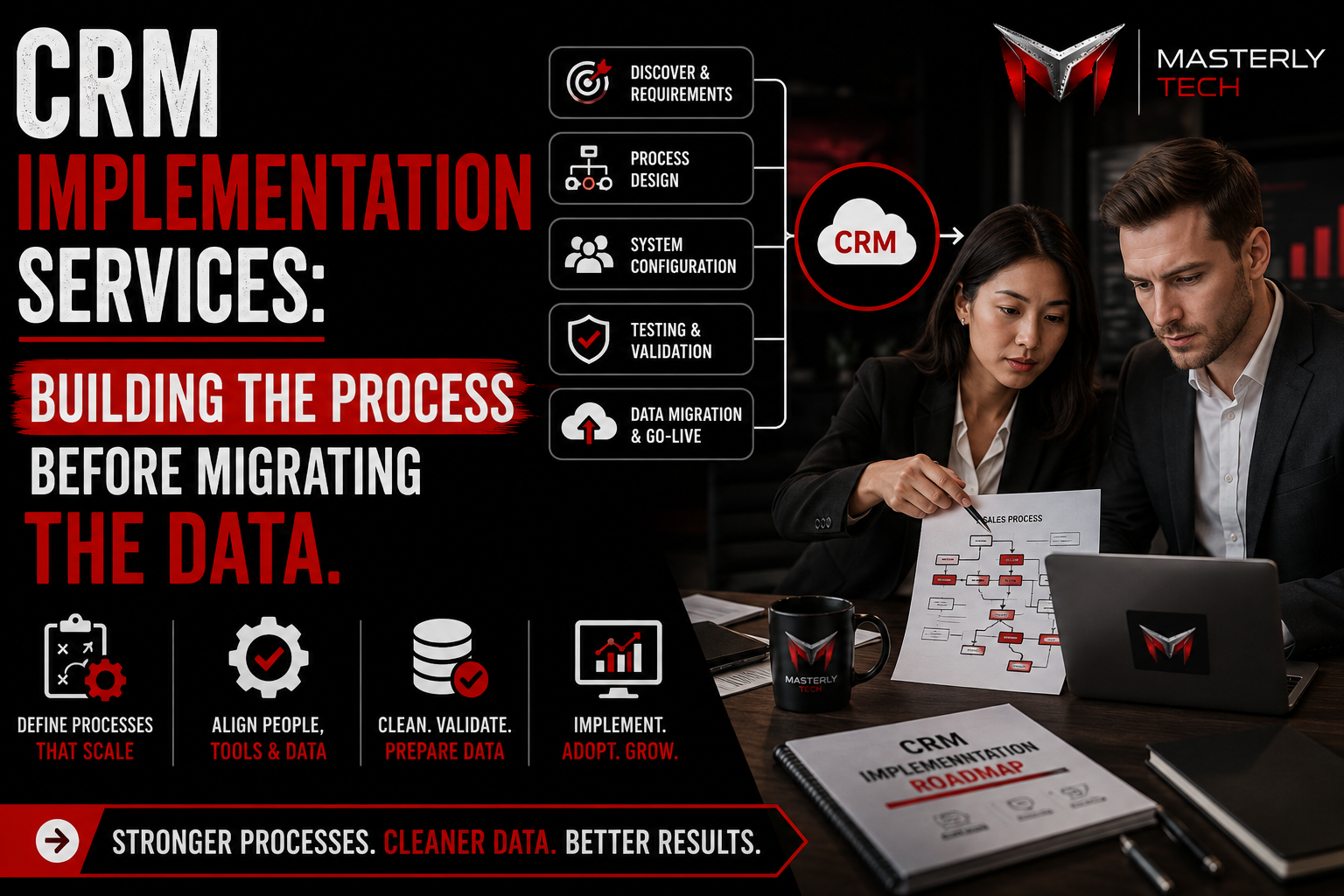
CRM planning identifies the processes, users, goals, and reporting needs the system must support. This prevents unnecessary custom fields and disconnected automations.
How do lifecycle stages support a CRM strategy?
Lifecycle stages show where each contact stands in the customer journey. Clear stages help teams manage leads, coordinate handoffs, and measure conversion performance.
Why are data standards important in a CRM?
Data standards define how information should be entered, updated, and maintained. Consistent data improves segmentation, automation, reporting, and decision-making.
What improves CRM adoption?
Strong CRM adoption requires a system that fits the team’s real workflow. Clear responsibilities, practical training, and consistent leadership expectations also encourage regular use.
How does CRM reporting support business decisions?
Accurate reporting helps leaders evaluate pipeline activity, conversion rates, sales performance, customer behavior, and areas where prospects may be dropping out.
What is automation governance?
Automation governance establishes rules for creating, reviewing, documenting, and maintaining CRM automations. It reduces duplicate workflows, conflicting actions, and unnecessary system complexity.
When should a company review its CRM strategy?
A company should review its CRM strategy when processes change, reporting becomes unreliable, CRM adoption declines, or custom fields and automations begin to multiply without clear oversight.
Request a CRM strategy review before adding more fields, workflows, or integrations.
Masterly Tech Group can review your CRM strategy, data structure, workflows, reporting needs, and integrations before additional customizations create confusion. Call (888) 209-4055 to request a CRM strategy review.