Ecommerce Website Development Services: What Must Work Before Paid Traffic Begins
Paying to send shoppers to an online store does not solve problems inside the store.
If visitors land on confusing product pages, struggle to find what they need, or encounter friction before checkout, more traffic simply sends more people into the same poor experience. A beautiful homepage cannot make up for an unclear buying journey.
That is why ecommerce website development services should address the store itself before a business puts significant effort into sending paid traffic to it.
Retailers, product brands, publishers, and growing businesses need an ecommerce website that does more than display products. The website needs to help shoppers understand what they are buying, navigate products with confidence, and move naturally toward a purchase.
Masterly Tech provides custom website design and development as part of its broader digital marketing services. Its published website services focus on user-friendly design, functionality, SEO, and websites tailored to the needs of the client's brand.
Paid Traffic Cannot Fix a Weak Ecommerce Website
A business preparing to sell online may focus first on attracting visitors.
That makes sense. Without traffic, people cannot discover the products.
But traffic is only one part of the process.
Once a shopper clicks an ad or another marketing link, the website takes over. The customer is no longer evaluating the advertisement. They are evaluating the store.
Can they understand the product?
Can they find the information they need?
Does the site feel professional?
Is the next step clear?
Does the buying process create unnecessary confusion?
These questions become especially important when a company begins paying for traffic. Professional ecommerce web development should create a strong destination for the marketing that brings shoppers to the site.
Ecommerce Website Development Services Should Support the Entire Buying Journey
Effective ecommerce website development services are not simply about putting a shopping cart on a website.
The store needs to work as a connected experience.
A shopper may enter through a homepage, category page, product page, search result, or advertising landing page. Wherever that journey starts, the website should make it easy to understand where to go next.
Current ecommerce development providers commonly treat navigation, product discovery, product presentation, cart functionality, checkout, mobile usability, and performance as connected parts of the shopping experience rather than isolated website features.
For an established business, this is where professional planning matters.
The website needs to represent the brand while also helping customers buy.
Your Online Store Is Part of Your Brand
A physical retailer pays attention to how products are displayed, how customers move through the store, and how the business feels when someone walks inside.
An ecommerce website deserves the same attention.
Poor organization, inconsistent pages, difficult navigation, or an outdated appearance can create a digital experience that does not match the quality of the company or its products.
Professional online store development helps bring the brand and buying experience together.
The visual design should feel consistent with your company. Product information should be easy to understand. Navigation should make sense. The path toward purchasing should feel intentional rather than pieced together.
The goal is not complexity.
It is clarity.
What Must Work Before You Send Paid Traffic to Your Store?
Before investing in traffic, a business should have confidence in the destination.
That means looking beyond whether the website is technically online. The important question is whether the store gives prospective customers a clear and professional buying experience.
Product Discovery Must Be Clear
Customers need an easy way to move from general interest to the right product.
For businesses with multiple products, collections, categories, editions, or product variations, website organization becomes especially important.
Navigation and page structure should help shoppers narrow their choices rather than create more questions.
A person who cannot find the right product cannot buy it.
Professional ecommerce development considers how shoppers move through the catalog and how important products are presented within that journey.
Product Page Design Must Answer Buying Questions
The product page is one of the most important parts of an ecommerce store.
It is where interest becomes evaluation.
Strong product page design should present the information a shopper needs in a clear, organized way, with a user interface that makes the layout and page elements easy to understand. Product names, descriptions, images, available options, and purchase actions should work together rather than compete for attention.
The exact information needed will vary by product and business.
A publisher selling books will have different product information needs from a retailer selling apparel or a company selling specialty products. The website design should reflect those differences.
The purpose of the page is to help customers understand the product and decide whether it is right for them. Clear product pages also support the customer journey by helping shoppers move from evaluation to purchase.
Mobile Shopping Must Feel Intentional
Many customers will encounter an online store on a smaller screen.
Mobile transactions will account for nearly 50% of US ecommerce sales by 2027, so mobile readiness matters before advertising starts to scale.
That means the mobile experience cannot be treated as a reduced version of the desktop site.
Navigation needs to remain understandable. Product information should be readable. Images should support the shopping decision. Buttons and other important controls need to be practical to use. In fact, 57% of consumers wouldn't recommend a company with a poorly designed mobile website.
Professional ecommerce development services commonly emphasize responsive and mobile-friendly shopping experiences, including mobile optimization, as a core part of modern online store development.
For businesses preparing to advertise online, mobile usability deserves attention before campaigns begin sending visitors to the store, and fast-loading sites improve SEO and user experience for mobile shoppers.
Ecommerce Conversion Starts Before Checkout
It is easy to think about ecommerce conversion as something that happens at the final purchase button.
The decision begins much earlier.
Every interaction can either help the shopper continue or give them another reason to leave. That shows up directly in your conversion rate.
The first page needs to establish relevance. Navigation needs to make products accessible. Product pages need to communicate clearly. Calls to action need to make sense.
By the time someone reaches the cart or checkout stage, the website has already played a major role in shaping the buying decision.
That is why conversion-focused ecommerce design looks at the complete journey, boosting conversions across the full shopping experience rather than treating checkout as the only important step.
Checkout Optimization Should Reduce Unnecessary Friction
When a shopper reaches checkout, they have already shown meaningful buying intent.
The website should not make the remaining process harder than necessary.
Checkout optimization focuses on creating a clear path through the final stages of the purchase. The exact checkout experience will depend on the ecommerce setup, business requirements, and technology used.
What matters is that customers understand what they need to do next.
Unnecessary complexity can introduce hesitation at the point where a shopper is closest to completing the transaction. Ecommerce development providers commonly identify shopping-cart usability and streamlined checkout as important parts of a conversion-focused store experience.
The objective is straightforward: remove avoidable confusion from the path to purchase.
Your Ecommerce Website Should Support Your Marketing
An online store should not exist separately from the company's marketing strategy.
Paid advertising, SEO, and search engine optimization, content, email campaigns, social media, and other channels may all send people to the website.
The site needs to support those visitors when they arrive.
For example, someone who clicks an advertisement for a specific product should reach a page that clearly continues the message and intent that brought them there. Sending that person into a confusing website can weaken the effectiveness of the marketing that generated the visit. Fast-loading sites improve user satisfaction and SEO rankings.
Masterly Tech combines website design and development with digital marketing services that include SEO, content writing, Google Ads, and other areas of digital strategy.
This broader perspective can be valuable when the ecommerce website will serve as the destination for multiple marketing channels, where keyword research, technical SEO work to boost search engine visibility, and stronger search rankings all need to support the site together.
A Professional Ecommerce Build Should Fit the Business
There is no single ecommerce website structure that is right for every company.
The right approach depends on the company’s business model.
A growing retailer may need to organize a broad product catalog.
A product brand may need stronger visual storytelling around a smaller collection.
A publisher may need individual pages that clearly present books, authors, editions, or related products.
Another business may be replacing an older website that no longer reflects its products, branding, or current marketing strategy.
Professional ecommerce web development should begin with those business needs and business goals rather than forcing every company into the same approach.
Masterly Tech states that its custom website design is tailored to a brand's needs and that its team enhances existing websites for functionality, appearance, and SEO. Choose a partner with proven eCommerce expertise and experience. Evaluate a development partner’s portfolio for relevant projects.
The Cost of Sending Traffic to the Wrong Experience
A company can have a strong product and still create a weak online impression.
This is one reason website quality matters before a business expands its advertising.
A potential customer may have never heard of your company before clicking an ad. Your website may become their first meaningful interaction with the brand. In fact, 92% of consumers feel more confident in businesses with smooth websites.
They will notice whether the store feels organized.
They will notice whether product information is easy to understand.
They will notice whether the site feels current and professional.
They may not describe these factors using terms such as user experience or conversion design, but they experience the effects.
For a growing brand, the ecommerce website becomes more than just a website: part store, part salesperson, and part representation of the business.
It needs to support all three roles.
Why Businesses Choose a Done-for-You Ecommerce Website Solution
Retailers and business owners already have products, customers, inventory, marketing, growth priorities, sales channels, and day-to-day business operations demanding their attention.
They should not need to become web developers to create a professional online presence.
A done-for-you ecommerce solution allows the website project to be handled as a professional business initiative rather than another technical project placed on the owner's desk. It should also include seamless integrations as part of a professional build.
Masterly Tech's website design and development services include custom website design and website optimization. The company also provides broader digital marketing capabilities, including SEO, content, and digital advertising. Ecommerce integration services can automate data flow between business systems. They can also connect ecommerce platforms with payment gateways and shipping providers.
For a business preparing to sell online or rebuild an existing store, the conversation can begin with what the website needs to accomplish. Ongoing maintenance and support also help ensure uptime and protect customer data post-launch.
Prepare the Store Before You Increase the Traffic
More customers are valuable when the website is ready to receive them.
Before expanding paid advertising, a retailer, publisher, product brand, or growing business should be confident that its ecommerce site presents products clearly and provides a professional path from arrival to purchase.
That does not mean every website needs to be complicated.
It means the important parts need to work together.
They should create a consistent customer experience.
Your brand presentation, navigation, product page design, online store structure, mobile experience, calls to action, and checkout journey should support the same objective: helping the right customer move confidently toward a purchase.
A prepared store should also help boost sales.
That is the foundation professional ecommerce website development services should provide.
Building an Ecommerce Website That Can Support the Business Behind It
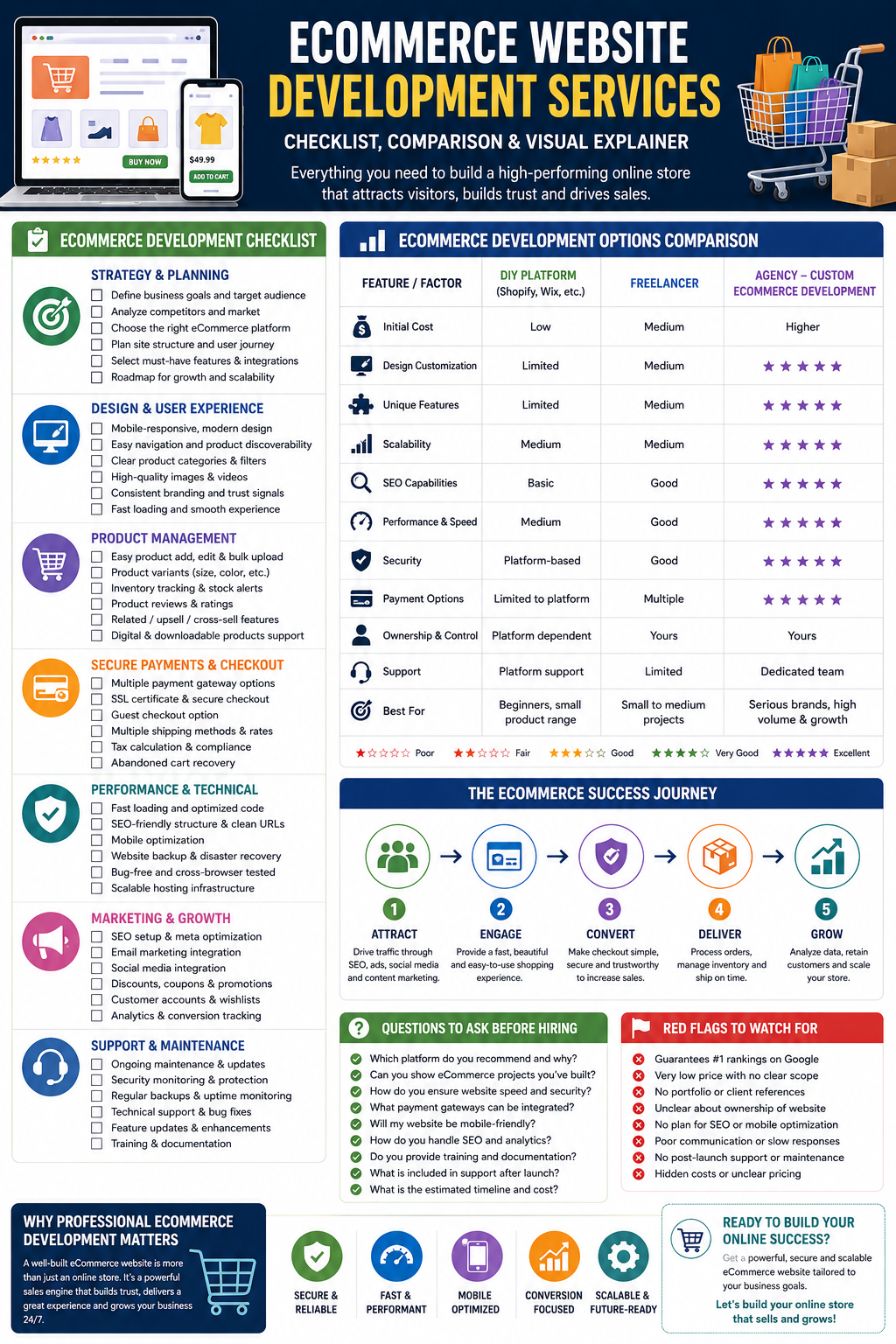
A successful ecommerce business needs more than an attractive e commerce website or a basic website builder. For an established online business, professional ecommerce website design services should connect ecommerce website design with the practical needs of selling in a competitive market. Depending on the requirements of the ecommerce project, an ecommerce developer may need to consider the selected e commerce platform, secure payment gateways, inventory management, an inventory management system, CRM systems, and compatible third party tools.
The right approach should focus on custom solutions, performance optimization, SEO capabilities, and a scalable architecture rather than assuming every retailer needs the same technology or own platform. Businesses may also use tools such as Google Analytics to better understand customer behavior, develop customer insights, measure customer engagement, and identify opportunities to support customer retention. Whether the company is growing in the e commerce market or competing with enterprise brands, the primary focus should be creating an effective online space that can streamline operations and accommodate appropriate extensive customization options when the project requires them. Careful planning can also help the business pursue more future proof solutions as its products, customers, and digital needs evolve.
Frequently Asked Questions About Ecommerce Website Development Services
What are ecommerce website development services?
Ecommerce website development services involve professionally planning, designing, and developing a website that allows a business to present and sell products online. The exact features and scope depend on the company's products, goals, and technical requirements, and they also cover the full development process from initial discovery and platform selection through post-launch maintenance.
Why should an ecommerce website be ready before paid advertising begins?
Paid advertising sends visitors to your website. If the store is confusing or difficult to use, increasing traffic does not address those underlying website problems.
What is ecommerce web development?
Ecommerce web development is the technical and functional work involved in creating an online store. It includes both the customer-facing shopping experience and backend development, which manages data processing and order management, while working alongside design and planning.
Why is product page design important?
Product page design helps shoppers understand what they are considering buying. Clear organization, product information, imagery, and purchase actions can make the evaluation process easier.
What does ecommerce conversion mean?
Ecommerce conversion generally refers to turning website visitors into customers or moving them toward another meaningful business action. Website clarity and the shopping journey can influence whether visitors continue toward a purchase.
What is checkout optimization?
Checkout optimization focuses on reducing unnecessary friction or confusion during the final stages of an online purchase. The specific approach depends on the store and its ecommerce technology.
Does Masterly Tech provide website design and development?
Yes. Masterly Tech offers custom website design and website optimization as part of its website design and development services, positioning the business as an ecommerce development company for brands that need online store design and build support. It can also be described as a development company offering those services within its stated website design and development scope.
Can Masterly Tech help with marketing after an ecommerce website is developed?
Masterly Tech provides digital marketing services that include SEO, content writing, Google Ads, and related services, with ongoing support available after launch where needed. Top agencies provide ongoing support after launch. Maintenance includes security updates and performance monitoring. Post-launch support can also include routine security updates and troubleshooting, helping protect uptime and customer data after launch. The appropriate services depend on the needs of the individual business.
Request an Ecommerce Website Planning Consultation With Masterly Tech Group
If you are preparing to sell products online, rebuild an existing store, or increase paid traffic, the website needs to be ready for the customers your marketing brings to it.
Masterly Tech provides professional ecommerce website development services within its website design and digital marketing capabilities. Start with a conversation about your products, customers, target audience, current website, and what your online store needs to accomplish. Planning also includes choosing the right ecommerce platform for your growth, integrations, and site requirements.
The discovery phase defines project goals and user journeys. A basic ecommerce site can often be developed in 4–8 weeks, while custom ecommerce solutions may take 3–6 months to develop. SaaS ecommerce platforms offer fast deployment and managed cloud infrastructure, which supports quick market entry with lower maintenance costs. Open-source platforms allow full code modification for customization. Headless commerce separates the customer interface from backend processes via APIs. MACH architecture allows independent development of frontend and backend. Custom ecommerce development can also support unique business logic and workflows.
Request an ecommerce website planning consultation with Masterly Tech Group.
Call: (888) 209-4055