Website Optimization Services: How to Prioritize Speed, UX, Conversion, and Search Without Chasing One Metric
Your website is getting traffic, but the traffic is not producing the response your business expected.
Visitors may arrive and leave without contacting you. Important pages may load slowly. Mobile users may struggle with the site. Search visibility may have stalled. Your website may look professional while still making it difficult for prospective customers to understand where to go next.
These problems rarely exist in isolation.
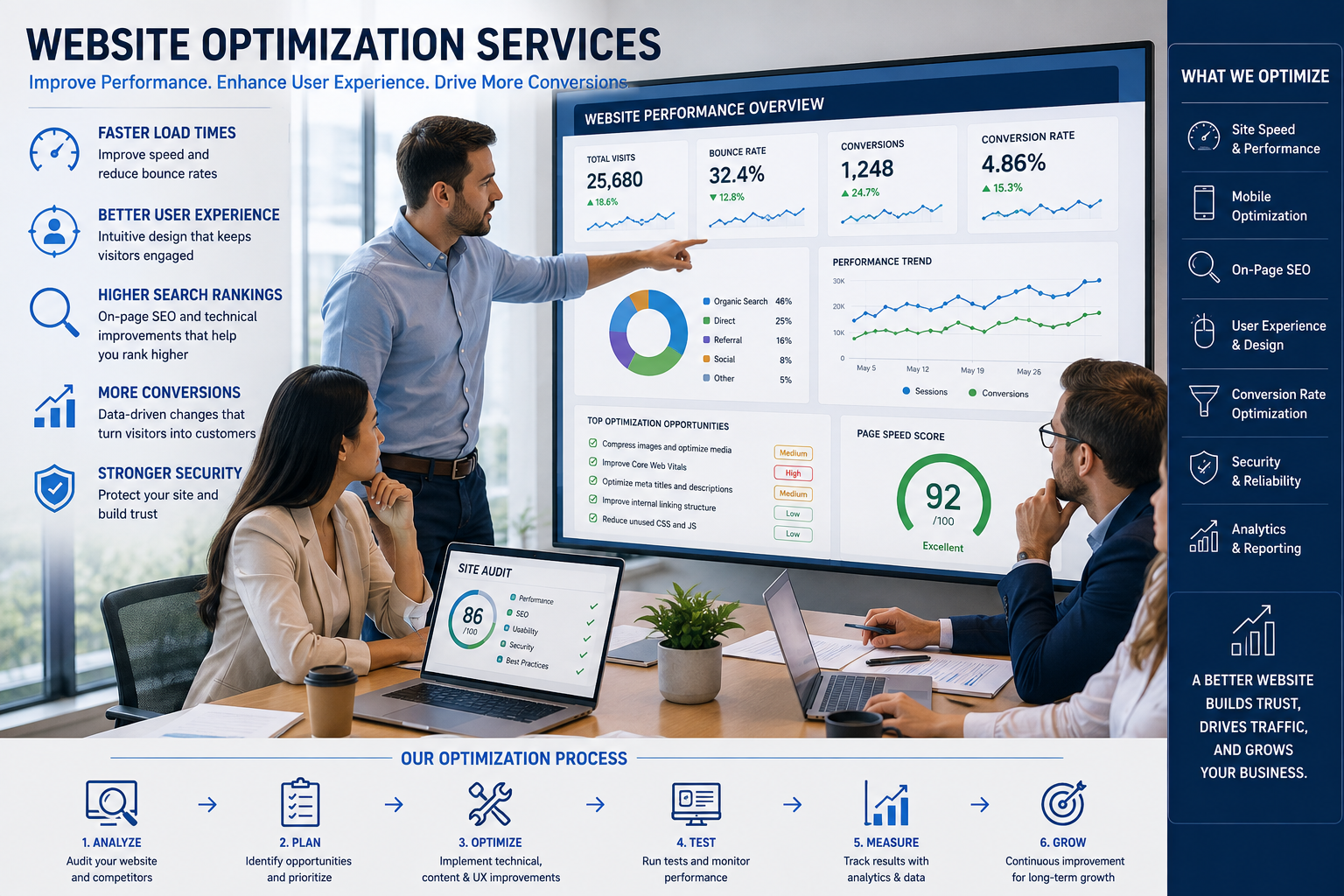
Professional website optimization services look at how performance, usability, search visibility, and conversion work together. Improving one number while ignoring the rest of the customer experience can leave the larger business problem unresolved.
For an established company, the goal should not be to chase a perfect score. The goal should be to create a website that better supports the people using it and the business behind it.
Masterly Tech provides website design, website optimization, SEO, and digital marketing services for businesses that need a stronger online presence.
Your Website Has Traffic. Why Is It Still Underperforming?
Traffic is valuable, but traffic alone does not make a website effective.
Imagine a prospective customer finds your company through search, advertising, a referral, or social media. They click through because something has already created interest.
Now the website has a job to do.
It needs to load properly. It needs to communicate clearly. The visitor needs to understand your services and find relevant information without unnecessary effort. When that person is ready to contact your company, the next action should be clear.
If one part of that journey breaks down, the value of the original visit can be reduced.
This is why an underperforming website should be evaluated as a complete business asset rather than as a collection of separate technical scores.
Website Optimization Services Should Address the Whole Experience
Effective website optimization services should begin with the problems affecting the website and its visitors, then measure outcomes such as engagement and conversions.
A company may initially believe that speed is its biggest concern. Further review may reveal confusing navigation or pages that do not clearly explain the company's services.
Another business may focus on search rankings while important pages provide a weak experience after searchers arrive.
The right priorities depend on the website.
Better prioritization can reduce bounce rates and, with effective CRO strategies, increase conversions by as much as 50%.
That is why website performance optimization, website UX, conversion optimization, technical SEO, and site speed should be considered as connected parts of a larger digital experience.
Site Speed Matters, but It Is Not the Only Goal
Nobody wants to wait unnecessarily for a business website to load.
Slow pages can make an otherwise professional website feel frustrating. Performance problems can become even more noticeable when visitors are using mobile devices or moving between several pages.
Improving site speed can therefore be an important part of optimization, including work such as compressing images and leveraging browser caching.
However, a fast website with unclear messaging is still unclear.
A fast service page that does not answer a prospective client's basic questions still has a content problem. A fast contact experience that is difficult to locate still creates unnecessary friction.
Speed should support the experience, not become the only definition of success, and it should follow performance best practices.
Website Performance Optimization Should Support Real Visitors
Technical performance matters because people experience its effects.
Website performance optimization can involve reviewing factors that influence how efficiently a website functions and delivers content to visitors. The specific work required depends on the website, its technology, content, and current condition. For example, that may include fixing inefficient code, broken links, and related technical issues when they interfere with how quickly or reliably content reaches visitors.
The business objective should remain clear throughout that process.
A prospective client does not visit your site to admire its technical configuration. They visit because they need information, a product, a professional service, or a way to contact your company.
Performance work should help make that interaction better.
This approach keeps optimization connected to business value instead of allowing technical measurements to become the only focus of the project.
Website UX Can Be the Missing Link Between Traffic and Action
A visitor can reach the right website and still have a poor experience.
That is where website UX, or user experience, becomes important.
UX includes how easily visitors can understand and use the site. A UX audit may review user behavior through heatmaps and analytics to identify friction points. Navigation, page organization, readability, mobile presentation, calls to action, and the way information flows from one section to another can all affect the experience.
Visitors Should Know Where to Go Next
A website should not make prospective customers solve a puzzle.
If someone arrives on a service page, the page should make the service understandable. If the visitor wants additional information, the path to that information should be logical. If they are ready to contact the company, they should be able to identify the next step.
An established business may have added pages, services, articles, landing pages, and other content over several years. As the website expands, its structure can become harder to navigate.
Optimization provides an opportunity to look at that experience again. Teams may use analytics, heatmaps, or a test such as A/B testing to see what helps visitors move forward.
The objective is not simply fewer pages or more buttons. It is greater clarity.
Conversion Rate Optimization Turns Attention Into a Clear Next Step
Businesses invest considerable effort in getting people to their websites.
Search engine optimization can attract organic visitors. Advertising can bring targeted traffic. Content can introduce potential clients to the brand. Referrals can send people directly to a company they are already considering.
The website needs to support what happens next.
Conversion optimization focuses on conversion rate optimization by making important actions easier and clearer for visitors.
For a professional services business, a meaningful conversion could be a consultation request or phone call. For another business, the desired action could be an inquiry or another appropriate step in the customer journey.
The exact conversion goal depends on the company. For example, a 10% conversion rate can generate 200 conversions monthly, depending on traffic volume.
Even modest gains in conversion rates can have a meaningful impact on revenue. What matters is that the website is designed around the actions that have value to that particular business.
Conversion Problems Are Not Always CTA Problems
Adding more calls to action does not automatically make a website more effective.
A visitor may not contact the company because the service description is unclear. They may not understand why the company is relevant to their needs. Navigation may have taken them to the wrong page. The mobile experience may make important information difficult to read.
This is why professional conversion work needs context. Not every set of ideas wins, and only 12% of CRO experiments produce a successful result.
The question is not simply, "Where should another button go?"
The better question is, "What is preventing a qualified visitor from confidently taking the next step?"
Technical SEO, Search Engine Optimization, and User Experience Need to Work Together
Search visibility is another important part of website performance.
A website needs to give search engines a clear technical foundation while also providing useful pages for the people who find the business through search.
That is where technical SEO connects with the larger optimization strategy.
Technical issues can affect how search engines access, understand, and evaluate parts of a website, and because crawling is the first step for visibility, indexing depends on a clear technical setup that supports inclusion in search results. HTTPS has been a ranking signal since 2014, and a sitemap helps Google find your webpages.
A business should therefore avoid treating SEO and website usability as unrelated projects.
The website needs to be accessible to search engines and useful to human visitors.
Search Visibility Has Little Value if the Website Loses the Visitor
Ranking for an important search term can bring a prospective customer to your website.
That is an opportunity, not the end result.
Once the visitor arrives, the quality of the website becomes part of the customer's evaluation of your company.
An outdated page can weaken confidence. Poor mobile usability can make information harder to access. Confusing service descriptions can leave visitors unsure whether they have found the right provider.
This is why website optimization can matter to both marketing and reputation.
Your website represents the company before many prospects ever speak with someone on your team.
Optimization Should Match the Problems on Your Website
Not every website needs the same work.
One business may have strong content but poor performance.
Another may have a technically sound website with a confusing customer journey.
A third may receive substantial traffic to informational pages but fail to create clear pathways toward relevant services.
Professional website optimization services should identify the issues that matter to the specific website instead of applying the same checklist to every business. Clear reporting helps the business understand what was changed and what impact to expect.
Do Not Optimize a Metric at the Expense of the Business
Website data can be useful. Reviewing the right metrics can be useful. Rankings can be useful.
But none of these should be viewed without context if you want useful insights.
A change designed purely to improve one measurement can create problems somewhere else if the broader website experience is ignored.
The better approach is balance.
Speed should support usability. Search improvements should support relevant visibility. Design should support communication. Conversion elements should support appropriate customer actions.
Each part should contribute to a stronger website rather than compete for attention.
Your Website Is Part of Your Company's Reputation
For many prospective customers, your website is one of their first meaningful interactions with your business.
They may have found you through Google. Someone may have referred them. They may have seen your company elsewhere and visited the website to decide whether to make contact.
That visit helps shape their impression.
An established company can provide excellent services and still have a website that makes the business appear outdated, difficult to understand, or less professional than it really is.
Website optimization helps address that gap.
The goal is to create an online experience that better reflects the quality of the company behind it.
When Does an Existing Website Need Optimization?
You do not necessarily need a complete website replacement simply because performance has declined.
Optimization may be worth discussing when the website already receives visitors but is not supporting business goals as effectively as it should.
Signs can include slow pages, weak mobile usability, confusing navigation, unclear calls to action, inconsistent service pages, technical search issues, or traffic that does not lead visitors toward meaningful actions.
A website can also become harder to use as a business grows.
New services, new content, new marketing campaigns, and changing priorities can place demands on a site that was originally built for a smaller or different company.
A professional review can function as an audit and help identify the areas most in need of improvement.
Masterly Tech Provides a Done-for-You Approach to Website Optimization
Business owners should not have to become experts in UX, web development, SEO, or website performance to improve an underperforming site.
Masterly Tech provides professional website design and optimization within its digital marketing services.
For businesses with existing websites, the starting point should be the actual problems affecting the site rather than assumptions about what needs to change.
That may mean examining how the website performs, how visitors move through important pages, how clearly services are communicated, how the site supports search and conversion goals, and whether it is generating qualified leads.
The result is a more practical approach to optimization.
Instead of chasing one isolated metric, the website can be evaluated around the role it plays in the company's broader marketing and customer journey, with a plan that prioritizes what to implement first.
Better Website Performance Starts With Better Priorities
An underperforming website does not always need more traffic.
Sometimes it needs to do a better job with the traffic it already receives, turning more of those visits into leads and more revenue.
That requires understanding where the current experience is creating friction.
Site speed may be part of the answer. So may website UX, technical SEO, website performance optimization, or conversion optimization.
The priority depends on what is holding the website back.
Masterly Tech helps businesses approach those issues as parts of one connected website experience, with the goal of building a stronger digital presence over time for both prospective customers and the company.
Stronger Web Pages Start With Understanding What Slows the Experience Down
Effective website optimization looks beyond appearance to understand how web pages, web content, and technical systems work together. Masterly Tech can evaluate factors that may affect load time, including how website resources use available space, communicate across a network, and depend on servers to deliver information to visitors. By analyzing the website as a connected experience, businesses can focus on changes that improve usability while protecting the relevance of important content. Performance should also be considered in real time, since devices, connections, page types, and other variations can affect how visitors experience a site. When appropriate, analytics and other reliable data can help cite specific areas that deserve attention rather than making decisions based only on assumptions.
Frequently Asked Questions About Website Optimization Services
What are website optimization services?
Website optimization services focus on improving an existing website's performance, usability, search readiness, and ability to support business goals. The exact work depends on the website and the issues identified, and can include technical SEO audits, UX review, and conversion-focused changes.
Is website optimization the same as redesigning a website?
Not always. Optimization can address problems within an existing website without necessarily requiring a complete redesign. It can also customize an existing website more effectively before a full rebuild is considered. Some websites may need broader design or development changes depending on their condition.
Why is site speed important?
Site speed affects how quickly visitors can access and interact with website content. Slow performance can create unnecessary friction, but speed should be considered alongside usability, content, and conversion needs.
What is website performance optimization?
Website performance optimization focuses on improving how efficiently a website functions and delivers its experience to users. The specific work depends on the site's technology and current performance issues. For example, it may include using a tool to review load issues and applying established practices to improve delivery.
What is website UX?
Website UX means website user experience. It covers how easily visitors can navigate the site, understand its content, find information, and complete important actions.
What is conversion optimization?
Conversion optimization focuses on improving the path between a website visit and a meaningful action, such as an inquiry, consultation request, or phone call. The right conversion goals depend on the business.
How does technical SEO relate to website optimization?
Technical SEO addresses technical factors that can affect how search engines access and understand a website. For example, it may involve securing HTTPS so users and crawlers are safely accessing pages, and using structured data so search engines can make sense of key elements on the page. It should work alongside strong site structure, content, usability, and overall website performance.
Can website optimization help if my site already receives traffic?
Yes. A website that already receives traffic may still have problems with speed, UX, page structure, search visibility, or conversion paths. Website optimization services can focus on identifying and addressing the areas that are limiting the site's effectiveness.
Does Masterly Tech provide website optimization services?
Yes. Masterly Tech provides website design and website optimization as part of its digital marketing services, and the appropriate scope may include an analytics review, UX findings, technical SEO, and conversion-focused recommendations depending on the website’s needs, condition, and technical details.
Request a Website Performance Review From Masterly Tech Group
If your website receives traffic but is not performing as well as it should, sending more visitors to the same experience may not address the underlying problem.
Masterly Tech provides website optimization services for businesses that want to improve the performance of an existing website while considering speed, user experience, conversion, and search visibility as connected priorities.
You'll receive clear next-step insights after the review.
Call: (888) 209-4055