
SEO Site Structure Organizing Pages So Search Engines and Buyers Understand What Matters
A business can have excellent service pages and still make those services difficult to find.
The problem often appears as the website grows. New services are added. Blog posts accumulate. New locations get pages. Navigation expands. Older pages remain in place even when the company's priorities have changed.
Eventually, the website becomes a collection of pages instead of a clear system.
SEO site structure is the organization of website pages so search engines and potential customers can clearly understand the site's important sections and how those pages relate to one another. For business owners, website managers, and digital marketers trying to improve SEO and user experience, that means building a website architecture with a clear hierarchy, navigation structure, service hubs, taxonomy, URL structure, and buyer pathways that match how people actually look for information. Good structure gives visitors clearer paths through the website while helping search engines understand how pages relate to one another. Google recommends organizing websites logically because doing so can help both users and search engines understand page relationships.
For growing businesses, fixing that structure can be more valuable than continuing to add pages to a website that is already difficult to understand, especially once content and service pages start multiplying.
When a Website Has Plenty of Content but No Clear Hierarchy
Consider a professional service company offering six major services.
Each service has several related offerings. The company also has industry pages, locations, resources, and hundreds of articles.
Yet the main navigation gives every subject nearly equal weight.
Some major service pages are buried several paths deep. Similar services appear in different sections. Blog posts compete with commercial pages for attention. URLs follow different naming patterns depending on when each page was created.
The individual pages may be good.
The website architecture is the problem.
A prospective customer should not have to study the website to understand what the company does. Search engines should also have clear relationships between the site's important pages.
Google says its systems analyze a site's link structure and recommends creating a logical structure that is easy for users to navigate, with important pages linked from relevant pages.
That makes architecture more than an organizational preference.
SEO Site Structure Helps Establish What Matters
Not every page has the same job.
A homepage may introduce the business.
A major service page may explain a core offering.
A more specific service page may address a narrower customer need.
A resource may answer a question that supports the buyer's research.
A strong SEO hierarchy creates relationships among those pages instead of treating them as independent destinations.
For example, imagine a consulting company with three primary services:
Business Consulting
→ Strategic Planning
→ Process Improvement
→ Growth Consulting
Human Resources
→ HR Consulting
→ Employee Relations
→ Workplace Training
Technology Consulting
→ Technology Strategy
→ Automation
→ Systems Integration
The specific structure would depend on the actual business, but the principle is clear.
Visitors can see the major areas first and then move toward more specific services.
The hierarchy reflects how the company wants its offerings understood.
Website Architecture Should Follow the Business
One common mistake is allowing the website's current structure to be determined by legacy decisions instead of the business as it exists today.
Perhaps the business started with three services and now has fifteen.
Maybe a once-important offering has become secondary.
Perhaps several new divisions were added, but the original navigation never changed.
The website architecture should reflect the business as it exists today and support where it is going.
That means considering which services are central, which subjects belong together, and which pages deserve stronger prominence.
This can be especially important during a website redesign.
Moving boxes around a page does not solve an architecture problem. The underlying relationships between pages may need to be reconsidered before the visual design is finalized.
Masterly Tech offers website design and development alongside SEO and technical optimization, making website structure relevant to both disciplines. Its published website services include custom website design and website optimization with SEO considerations.
Service Hubs Can Organize Related Offerings
Businesses with several related services can become difficult to navigate when every offering is presented as a separate top-level destination.
Service hubs can provide a clearer middle layer.
A service hub represents a meaningful business category and connects visitors with more specific offerings within that category.
Imagine a healthcare marketing company.
A digital marketing hub might connect visitors with SEO, paid advertising, content, and related services.
A website services hub might connect them with design, development, optimization, and accessibility services.
The hub gives the visitor context before asking them to choose a specific solution.
This can also help prevent a website from becoming a long, flat list of pages where everything appears equally important.
Navigation Structure Should Help Buyers Make Decisions
The main navigation is valuable website space.
Its purpose is not to display every page the company owns.
A good navigation structure helps visitors understand their choices. When possible, use html links instead of javascript for navigation because HTML navigation links are preferred for better SEO.
Someone arriving on a business website may want to answer a few basic questions quickly:
What does this company do?
Does it offer what I need?
Where can I learn more?
How do I contact someone?
Navigation should help answer those questions rather than introducing unnecessary complexity.
Google notes that its systems analyze link structure when determining useful sitelinks and recommends logical site structures, informative page titles and headings, and relevant internal linking.
For buyers, the benefit is even more direct. Clear navigation reduces the effort required to find the right service.
Site Taxonomy Prevents Growth From Becoming Disorder
A small website may function without a formal organizational model.
A large website rarely does.
Site taxonomy is the system used to classify and organize website content.
For a service business, that might involve categories such as services, industries, locations, resources, and company information.
The important issue is deciding what belongs where, rather than using random grouping of related things.
Without a clear taxonomy, similar pages may end up in different sections because it is unclear what kind of page each item is meant to be. A service can be treated as an industry in one part of the website and as a resource topic somewhere else.
That creates confusion as the site expands.
A thoughtful taxonomy gives future content somewhere logical to belong.
A general classification system keeps similar things together instead of scattering them across the site.
The business can add pages without repeatedly reinventing its structure.
URL Structure and Domain Should Reinforce Clarity
A URL structure should not be mistaken for the entire website hierarchy.
Google has specifically explained that it generally uses page linkages, rather than URL structure alone, to understand the relative importance of pages.
Still, URLs matter for usability and technical organization.
Google recommends simple, descriptive URLs that use readable words and are logically constructed for people.
A clean URL can make the destination easier to recognize.
For example:
example.com/services/accounting
is easier for a person to interpret than:
URLs should support the site's organizational logic without being expected to create that logic by themselves.
The relationships between pages still matter.
Flat Is Not Always Simple
Businesses sometimes assume every important page should be directly linked from the homepage.
That can create a different problem.
If dozens of services, locations, articles, and specialty pages all compete for homepage attention, the website loses hierarchy.
Important does not have to mean top-level.
A specific service page can be valuable while still belonging underneath a broader service category.
The goal is to create meaningful pathways.
The ideal approach balances simplicity with depth, so important pages stay reachable in about 4 clicks or less rather than being forced onto the homepage.
A visitor looking for a specialized service should be able to begin with a logical category and reach the relevant page without becoming lost.
Search engines should also encounter clear relationships between those pages.
SEO Hierarchy Can Support the Buyer Journey
SEO architecture and conversion architecture should not fight each other.
They can support the same goal.
A buyer may begin broadly.
They understand their problem but do not know which service solves it.
A service hub can provide orientation. Descriptive anchor text helps both users and search engines understand what the next page covers.
The buyer then reaches a specific service page that explains the offering in greater detail.
From there, related information can answer additional questions or provide a clear path toward contacting the business. Internal linking also helps search engines index all pages and discover important service content.
That creates a progression:
Business → Service Category → Specific Need → Decision
A strong SEO hierarchy can make that progression easier to understand, while weak internal linking can make important pages harder for search engines to discover.
This is especially useful for companies with complicated service portfolios where buyers may not know the company's internal terminology.
Structure Problems Become More Expensive as Websites Grow
A poorly structured 20-page website may be manageable.
A poorly structured 500-page website becomes a much larger problem.
Every new page has to go somewhere.
As sites grow, a sitemap helps improve crawlability.
Without clear architecture, teams begin creating exceptions.
New navigation items appear.
URLs follow new patterns.
Overlapping categories emerge.
Important pages become harder to distinguish from supporting content.
This is why website architecture should be considered before aggressive content expansion.
Publishing another 100 pages onto an unclear structure does not necessarily make the website easier for buyers or search engines to understand.
It may simply make the existing problem larger.
A Practical Framework for Evaluating SEO Site Structure
Business owners do not need to become website architects to recognize when professional review may be warranted. This practical framework is a general way to evaluate structure before a deeper technical review.
A useful evaluation can focus on four areas: hierarchy, grouping, pathways, and consistency. If the structure feels difficult to follow, the reason is usually unclear hierarchy, grouping, pathways, or consistency rather than a lack of content.
Hierarchy
Can someone quickly identify the company's primary services and most important website sections?
Grouping
Are related pages organized around logical service hubs, categories, or subcategories?
Pathways
Can buyers move from broad information toward specific services and conversion opportunities without getting lost?
Consistency
Do navigation, site taxonomy, URLs, and page relationships tell a coherent story about how the website is organized?
If those answers are unclear, the website may need more than another round of content.
It may need architectural work.
Website Architecture Also Shapes Brand Perception
Structure is not only an SEO concern.
It affects how sophisticated the business feels.
Imagine visiting the website of a professional firm and finding four different pages that appear to describe the same service.
One is in the navigation.
Another appears under an industry section.
A third uses different terminology.
The fourth is an old page still appearing through internal links.
Even if the company itself is highly organized, its website may communicate something different.
A clear website creates confidence.
Visitors can understand the business without having to decode it.
For organizations selling complex or high-value services, that clarity can be an important part of the brand experience.
Masterly Tech Connects Website Design With SEO Structure
A strong website requires more than attractive pages.
Those pages need relationships.
Masterly Tech provides website design and development, website optimization, SEO, and technical SEO services. Its current website describes custom website design as user-friendly and optimized for SEO, while its technical SEO work addresses website performance and search engine considerations.
That combination matters when a business has an architectural problem.
The solution should not force companies to choose between a website that makes sense to customers and one designed for search engines.
The stronger objective is a site that communicates clearly to both.
Internal Link Recommendation: Link this section to Masterly Tech's primary Website Design and Development or Technical SEO service page using descriptive anchor text such as SEO-focused website design and development. Avoid linking to another article primarily targeting SEO site structure.
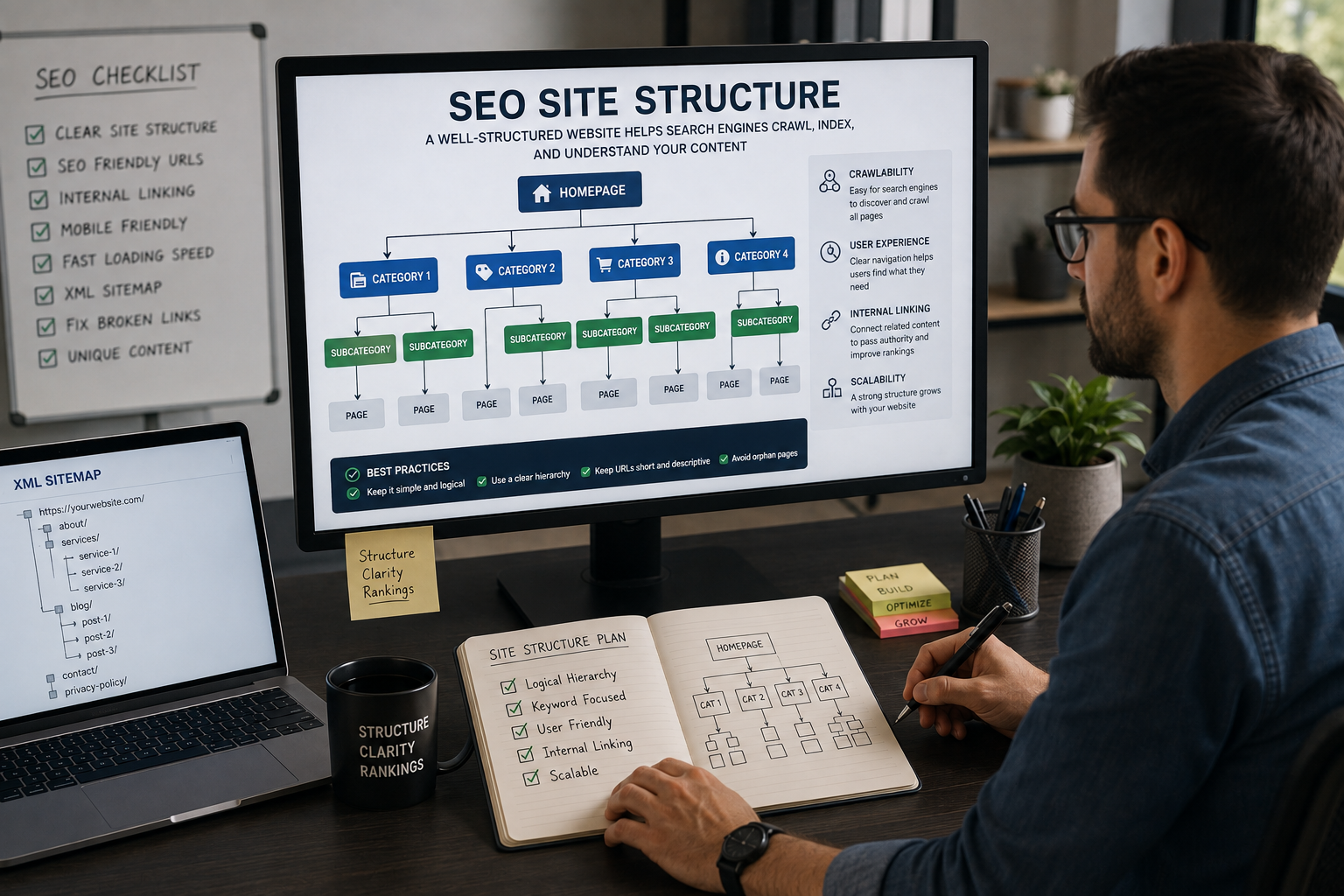
Visual Explainer: Example of What a Clear Website Hierarchy Looks Like
Think of the website as a business map:
Homepage Communicates the overall business and major paths.
↓
Primary Service Hubs Organize major categories of services.
↓
Specific Service Pages Address focused customer needs and commercial intent.
↓
Supporting Resources Answer related questions and provide useful context.
↓
Conversion Path Gives qualified visitors a clear way to contact the business.
The exact model should reflect the company, and the order of pages should reflect business priorities and how users move through the site. The purpose is not to force every website into the same template.
It is to ensure every important page has a clear role. The view should be of a planned system, not a collection of disconnected pages.
Frequently Asked Questions About SEO Site Structure
What is SEO site structure?
SEO site structure is the way pages are organized and connected so visitors and search engines can understand the website's important sections and page relationships. It is also sometimes called website architecture when discussing how pages are organized and connected.
Why does website architecture matter for SEO?
Logical website architecture can help users and search engines understand how pages relate. Internal links also help search engines index all pages effectively, not just understand page relationships. Google recommends logical site organization and relevant links between important pages, and stronger architecture can support better search results visibility.
What is an SEO hierarchy?
An SEO hierarchy organizes website content from broad sections into more specific pages, helping clarify the relationship between major topics and individual services. The ideal hierarchy helps users move from broad topics to specific services without confusion.
What are service hubs?
Service hubs are pages or sections that organize related offerings under a meaningful service category and help visitors reach more specific services.
Does URL structure determine website hierarchy?
Not by itself. Google has explained that page linkages provide information about site structure and relative page importance. However, Google also recommends simple, descriptive URLs for clarity. A consistent URL set can still reinforce that structure for users and search engines, even if URLs alone do not define hierarchy.
What is site taxonomy?
Site taxonomy is the classification system used to organize website content into meaningful categories and relationships. Teams should agree on the taxonomy early so new pages are classified consistently as the site grows. Categories are often found to work better when they match how the business actually groups its services and information.
Should every service be in the main navigation?
Not necessarily. The right navigation structure depends on the business, service portfolio, and user journey. The goal is to make important choices clear without overwhelming visitors.
Can Masterly Tech review an existing SEO site structure?
Masterly Tech currently offers website optimization, website design and development, SEO, and technical SEO services. A consultation can determine which services are appropriate for a specific website and its structural concerns. Structural recommendations should be based on the specific site, because what works for one company may seem fine for another only for a time.
Request an SEO Architecture Review
If customers struggle to understand your services, search engines may not be the only audience receiving mixed signals from poor structure.
Adding more content will not necessarily fix a website whose underlying organization has become unclear.
A thoughtful SEO site structure brings website architecture, SEO hierarchy, service hubs, navigation structure, URL structure, and site taxonomy into a clearer system built around the business and its buyers, with internal links and sitemaps helping search engines understand and crawl the site more effectively.
Masterly Tech can help evaluate how your website's design, content, and technical structure work together.
Call Masterly Tech at (888) 209-4055 or visit Masterly Tech to discuss your website and SEO needs, with the goal to improve clarity for users and search engines rather than keep adding pages in random ways.