Website Security Services What Business Websites Need Beyond SSL and Backups
Your website may be one of the most important systems your business operates.
Customers use it to learn about your company. Potential clients submit inquiries. Some businesses rely on their websites for transactions, account access, scheduling, content, or other important operations.
When that website has a security problem, the issue can extend beyond technology.
It can interrupt business, create concern for customers, damage confidence in the brand, and force your team to respond to a problem it may not be equipped to handle.
An SSL certificate and backups are important parts of managing a website, but they should not be mistaken for a complete security strategy. Professional website security services help businesses consider the broader technology and security needs surrounding the websites they depend on.
Masterly Tech helps business owners and organizations evaluate website technology and security without requiring their internal teams to become website security specialists.
Your Website Is Part of Your Business Infrastructure
A company website is no longer just an online brochure.
For many organizations, it plays a direct role in business operations.
Marketing campaigns send people to it. Search engines introduce potential customers to it. Existing clients may return for information or services. Employees may also rely on connected website systems.
That makes business website security an operational concern.
A security issue can affect the experience people have with your company at exactly the moment they are deciding whether to trust it.
Organizations that depend on their websites should therefore think about security as part of maintaining a professional digital presence.
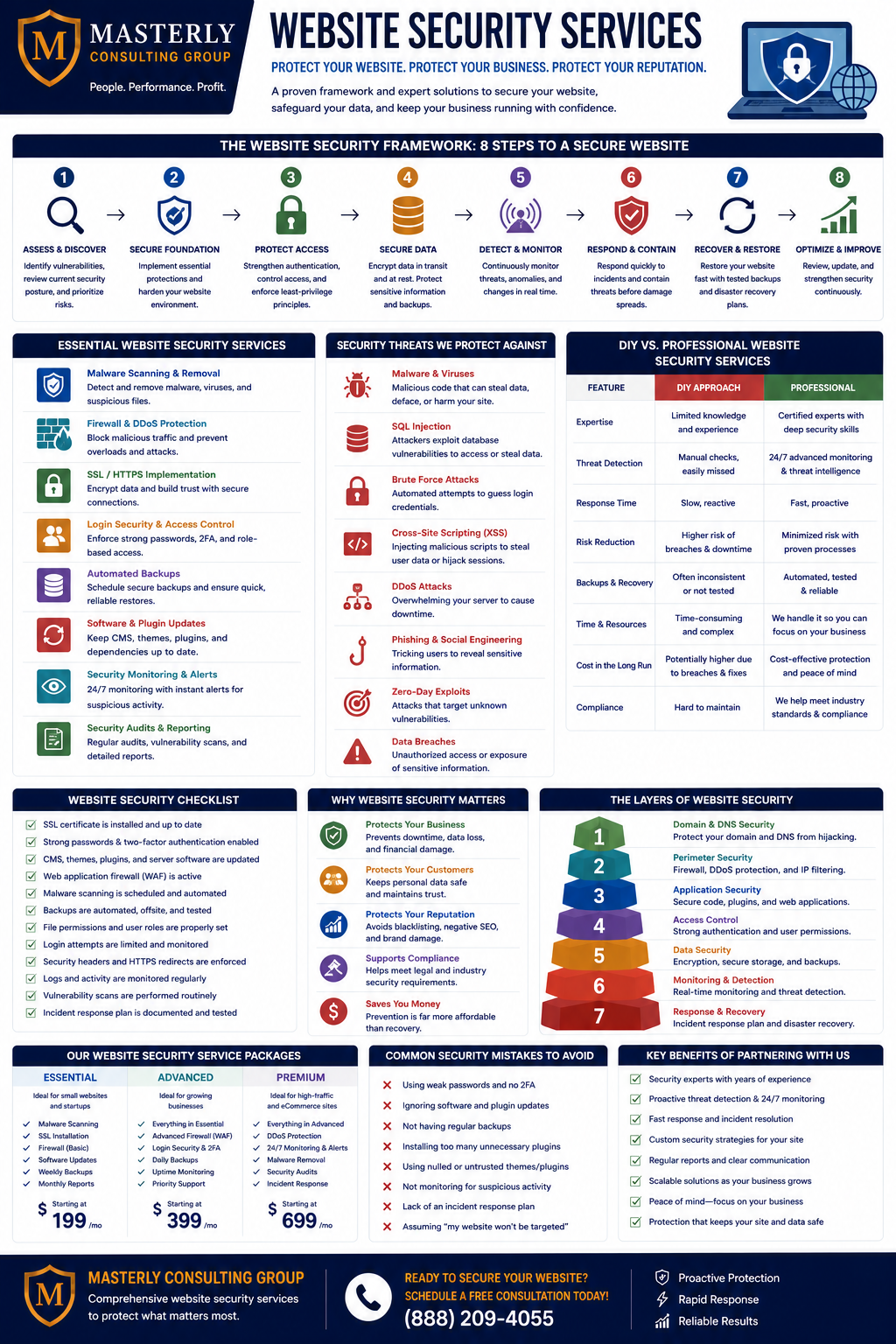
Website Security Services Go Beyond Having an SSL Certificate and Web Application Firewalls
Seeing a secure connection in a browser is important, but it does not mean every part of a website is protected from every potential problem.
Website security refers to the broader environment around a site and the steps taken to protect its technology, customer information, and availability.
The site itself, its software, access controls, hosting environment, integrations, plugins or extensions, forms, updates, web applications, and the handling of data all influence its security posture and how well teams secure data.
This is why website security services should consider more than whether a website has SSL enabled.
Weak security can lead to a data breach that exposes sensitive data and customer information.
The larger question is whether the technology supporting the website is being managed with security in mind. Unsecured websites can also affect SEO because search engines such as Google may treat security issues as a negative signal.
Backups Matter, but They Are Not the Same as Protection
Backups are another important part of responsible website management.
They can provide a recovery option when something goes wrong, helping protect backup data and keeping recovery copies available.
Backups should be scheduled based on how often the site changes, with at least monthly backups as a baseline for website data.
For safety, businesses should keep at least 30 days of backup copies.
But a backup does not prevent a security issue from occurring, and any backup strategy also needs regular testing so recovery procedures work when needed.
Businesses need to distinguish between having a way to restore information and having a broader approach to website security.
Both can matter, but they serve different purposes.
For a company that depends on its website for leads, transactions, client communication, or operations, relying on backups alone can leave important security questions unanswered.
Website Malware Protection and SQL Injection Defense Are Part of a Larger Security Picture
Malicious software can create serious concerns for a business website.
The impact can vary depending on what happens, the website involved, and the nature of the problem.
A compromised website may behave unexpectedly, display unwanted content, trigger malicious redirects, show seo spam, expose critical data, or experience other issues that require professional attention. Data breaches expose confidential information to unauthorized access.
Malware and related attacks can introduce malicious code or lead to unauthorized access to sensitive data.
Website malware protection should therefore be considered within the broader security strategy rather than as a separate box to check.
Businesses need a website environment that is managed with attention to potential threats and changing technology.
The appropriate protections depend on the website, platform, infrastructure, and business requirements.
Website Security Monitoring Can Help Businesses Stay Aware
One challenge with website security is that ongoing monitoring helps businesses detect issues they may not see during a quick visit.
A website can appear normal during a quick visit while another issue requires attention behind the scenes.
That makes website security monitoring an important consideration when evaluating how a business website will be maintained. Security teams may scan website files and databases for malware, and review web applications and connected servers to identify other vulnerabilities.
The specific monitoring needs depend on the technology and organization.
Vulnerability scanners automatically check systems for security vulnerabilities, and a vulnerability assessment scans web applications and servers for weaknesses so teams can prioritize critical vulnerabilities before they become critical issues.
What matters is recognizing that website security is ongoing.
Launching a secure website is not the end of the conversation. Websites change. Software changes. Content changes. Integrations change. New technology is added.
Security needs to remain part of that evolving environment.
A Secure Business Website and Secure Data Support Customer Trust
Imagine a potential customer discovers your business through search.
They click your website because they are interested in your services.
That visit may be the first direct interaction they have with your company.
If the website displays suspicious behavior, produces unexpected warnings, redirects incorrectly, or otherwise appears compromised, the visitor may not separate the technical problem from the business, and the incident can reduce trust and cost businesses website visitors.
They simply know something feels wrong.
A secure business website therefore supports more than technology.
It also helps protect customer information and maintain confidence when users submit data online.
It supports the professional experience surrounding the brand.
For companies that ask customers to submit information, make inquiries, purchase products, schedule services, or interact with the business online, that experience deserves careful attention.
Security Problems Can Become Business Problems
Website issues rarely stay confined to the IT conversation when the website is important to revenue or operations.
If lead forms stop working, marketing can be affected.
If customers cannot access important website functions, service teams may receive questions.
If a site becomes unavailable, sales or operations may be disrupted, and DDoS attacks are one example of attacks that can severely affect availability and performance.
If visitors lose confidence in the website, the brand may feel the effect.
This is why business website security should be considered in relation to the role the website plays within the organization and the need to maintain continuity when security threats arise.
The more important the site is to the business, the more important it becomes to understand the technology supporting it.
Website Complexity Can Increase the Need for Professional Attention
Modern business websites can contain many moving parts.
A site may include a content management system, forms, third-party services, plugins, ecommerce functions, customer tools, analytics, marketing technology, third party code, and other integrations.
Each business has a different environment.
As that environment becomes more complex, it can become harder for an owner or marketing team to understand which systems affect security.
A website may also change hands over time.
Different developers, agencies, employees, and vendors may have worked on it. Access permissions and technology decisions can accumulate. Forms and other user input should also be reviewed, and tools such as CAPTCHA can help reduce automated spam submissions.
A professional review can help a business look at the website as a technology system rather than simply evaluating what visitors see on the screen.
Your Marketing Team Should Not Have to Become a Security Team
Website responsibility often falls to people whose primary expertise is somewhere else.
A marketing director may manage the website because it supports campaigns. An office manager may have access because someone needs to make updates. A business owner may become the default person responsible for technology because no one else owns it. Basic access habits matter here: use a unique password for each account, avoid reusing the same login across services, and change it regularly. In practice, strong passwords should be at least eight characters long, include special characters, and user accounts should have two-factor authentication enabled where possible.
Those employees can be excellent at their actual jobs without being website security professionals.
Expecting them to research every possible security issue creates another responsibility and can leave uncertainty about what deserves attention, including when to review user permissions so unnecessary access can be removed and better control maintained.
Masterly Tech provides businesses with professional technology support so internal teams do not have to approach important website concerns alone.
Security Should Be Considered When the Website Changes
Business websites rarely remain unchanged.
Companies add services, redesign pages, introduce new integrations, change vendors, expand ecommerce operations, or connect new marketing systems.
Each major change is also an opportunity to review security protocols when services, integrations, or code change within the website's broader technology environment.
Security should not be considered only after something goes wrong.
Implementing secure coding practices and minimizing unnecessary source code changes or unreviewed components can enhance long-term protection.
A business planning a redesign or major website expansion can benefit from considering security alongside functionality, performance, user experience, and long-term maintenance.
This is part of building and maintaining a secure business website rather than treating security as a separate emergency service.
Masterly Tech Helps Businesses Look Beyond the Visible Website
A website can look polished while still raising technology questions behind the scenes.
Masterly Tech helps businesses and organizations examine their websites from a broader technology perspective.
That conversation can include how important the website is to operations, what concerns the organization has, how the site is currently managed, and what technology or security areas deserve further review. It may also cover any applicable compliance obligations tied to customer or business data.
The goal is not to overwhelm business owners with technical language.
It is to help them understand what their website may need and determine the appropriate professional support. Missed regulatory requirements can create legal exposure and heavy fines, not just technical problems.
For organizations that depend on their sites, website security services can be part of a larger approach to maintaining reliable business technology.
Professional Website Security Starts With Understanding What Is at Risk
Different websites carry different levels of business importance.
A small informational site does not have the same operating requirements as a website supporting ecommerce, customer interactions, lead generation, or other business functions.
That is why security decisions should reflect the organization.
Masterly Tech can discuss the role your website plays, the technology supporting it, and the concerns that brought you to seek professional help.
You do not need to become a security specialist before having that conversation.
You need a clear understanding of how important the website is to your business, which systems, data, and connected hardware are at risk, and professional support for determining what deserves attention.
Security experts can help identify which risks are most critical for your organization.
Frequently Asked Questions About Website Security Services
What are website security services?
Website security services address security considerations surrounding a website and its technology environment. These services can also include web application firewalls for web applications, helping defend sites on the internet from attackers. Web application firewalls filter internet requests at Layer 7 of the OSI model and can block malicious traffic before it reaches the site. As one protective tool within broader network and website security services, a WAF helps filter malicious traffic and can protect against sql injection and cross site scripting. The appropriate services depend on the website, platform, infrastructure, and organization's needs.
Is SSL enough for website security?
No single technology should be assumed to address every website security concern. SSL protects data in transit through encryption between a user's browser and the website, while broader website security can involve other parts of the site's technology environment. It does not address weak password practices, application flaws, or access control issues.
Are website backups enough to keep a business website secure?
Backups and security serve different purposes. Backups can support recovery, while security measures address other risks associated with operating and maintaining a website.
What is website malware protection?
Website malware protection refers to measures that detect and remove malicious code and related threats affecting website files, databases, and connected software. This can also include phishing-related content or compromised pages as part of the broader threat picture. Appropriate protections vary based on the website and technology involved.
What is website security monitoring?
Website security monitoring generally involves watching for security-related conditions or changes that may require attention. Specific monitoring capabilities depend on the service and technology environment.
Why does business website security matter?
A business may rely on its website for leads, transactions, customer interactions, marketing, or operations. Business website security therefore can affect more than the website itself. Risks can include SQL injection that exploits database vulnerabilities to access sensitive data, cross-site scripting that allows hackers to insert malicious scripts into web pages, and phishing schemes that trick users into revealing sensitive information.
Does website security guarantee that a site will never be compromised?
No. Website security should not be presented as a guarantee that an incident can never occur. Technology, threats, websites, and business environments change over time.
When should a business have its website security reviewed?
A review may be worth considering when a website is important to business operations, when significant technology changes are planned, when there are security concerns, or when the organization lacks a clear understanding of how the site is currently protected. Reviews may also include testing the site and related systems to identify vulnerabilities before attackers do. Some assessments use fuzzing tools to find coding errors that could create vulnerabilities.
Can Masterly Tech help with website security services?
Business owners and organizations that depend on their websites can contact Masterly Tech Group to discuss their technology environment and website security services needs.
Request a Website Technology and Security Review from Masterly Tech Group
Your website may be generating leads, supporting customers, processing important interactions, and representing your organization every hour of the day.
Its security deserves more attention than checking whether SSL and backups are enabled, because you need to protect customer data, maintain availability, and reduce the risk of attacks.
Masterly Tech helps businesses examine the technology and security needs surrounding the websites they rely on, which may include helping identify vulnerabilities, reviewing protection measures, and keeping websites reliable for customers and search visibility. If you have questions about website security services,
Website malware protection, security monitoring, or the broader technology supporting your online presence, start with a professional conversation.
Visit MasterlyTechGroup.com or call (888) 209-4055 to request a website technology and security review from Masterly Tech Group.