Website Strategy: What to Decide Before Design Begins
A new website can look professional and still fail to support the business.
This often happens when design begins before leaders decide what the site must accomplish. Teams choose colors, layouts, images, and page templates without agreeing on the audience, services, content, conversion paths, or long-term ownership.
The finished site may look different, but the original problems remain. Visitors still struggle to understand the offer. Important services remain difficult to find. Contact forms do not collect useful information. New pages are added without a clear place in the larger site.
A website strategy gives the project direction before time and budget are committed to design and development.
Masterly Tech provides done-for-you website strategy services for founders, executives, and professional firms planning a new site, redesign, rebrand, or major service expansion. We help leaders define what the website should communicate, contain, support, and measure before production begins.
Design Cannot Resolve Unclear Business Decisions
A designer can create a polished interface, but design alone cannot decide which audience matters most or which services deserve priority.
If those decisions remain unsettled, the project may slow down during content development. Different stakeholders may request competing messages. Departments may disagree about navigation. New pages may be added late because no one identified the full scope at the beginning.
These changes affect timelines, cost, and quality.
A website project becomes more efficient when leaders approve the important business decisions first. The design team receives clearer direction.
Writers know which pages and messages are needed. Developers understand which functions and connections the site must support.
Website planning creates that shared direction.
Masterly Tech helps organizations work through the decisions that affect the project before they become expensive revisions.
A Website Strategy Connects the Site to Business Goals
A website is not only a digital brochure. It may support lead generation, client education, service delivery, recruitment, event promotion, content publishing, customer support, or several of these functions.
The organization must decide which purposes matter most.
Broad website goals such as “increase visibility” or “look more modern” are not enough to guide a major project. Defining the site's primary goals makes success easier to evaluate. A professional firm may need the site to attract inquiries for specific services and increase monthly sales by 20%. A growing business may need to clarify several offers and improve lead conversion rate by 5% to turn more visitors into leads. A rebrand may require stronger positioning across pages. A service expansion may need new content and conversion paths.
Each goal affects the structure, message, content, features, and measurement plan, including measurable KPIs that connect website performance with business outcomes.
One KPI may be the website’s conversion rate, measured as a percentage of visitors.
Masterly Tech helps stakeholders translate business priorities into clear website goals. This creates a stronger basis for decisions about page scope, navigation, calls to action, and future content.
The Right Audience Should Shape the Website
Businesses often serve more than one target audience.
A professional firm may work with individuals, business owners, executives, institutions, or referral partners. A growing company may serve several industries or customer types, so understanding the target demographic is part of planning. Each group may enter the website with different questions and levels of knowledge.
Trying to speak to everyone in the same way can weaken the message.
Visitors should be able to recognize whether the organization understands their needs. They should also know which service, resource, or next step applies to them.
A useful web strategy identifies the priority audiences, maps the user journey for each group, and clarifies the decisions each group needs to make. It considers what visitors already know, what concerns may prevent them from moving forward, and which information will help them evaluate the business.
Masterly Tech uses these insights to recommend clearer content paths without forcing every visitor through the same experience, helping prospective customers find the right information faster.
Service Positioning Needs to Be Clear Before Pages Are Built
A website redesign often exposes uncertainty about the company’s services.
Several offerings may overlap. Internal names may not make sense to prospects. A broad service may contain several specialized options that deserve clearer treatment. Some pages may describe work the company no longer wants to emphasize.
If service positioning is unclear, the website can become a collection of competing descriptions with no clear focus. That overlap can also weaken search engine optimization.
Visitors may not understand the difference between two offers. Sales teams may send prospects to different pages for the same need. Search visibility may also be weakened when several pages appear to serve the same purpose, especially when keyword research is missing and relevant keywords are not used to give each page clearer targeting. SEO should be integrated into the design process rather than added after launch, so pages can rank higher in search engine results pages.
Masterly Tech reviews the planned service structure as part of the website strategy. We help clarify which services require their own pages, how related offers should be grouped, and which page should serve as the primary destination for each need.
This gives design and content teams a more stable foundation.
Website Planning Defines the Page Scope
Page scope affects nearly every part of a website project, including site structure.
A small professional firm may need a focused group of core service pages, proof, resources, and contact options. A larger organization may require location pages, industry sections, team profiles, content hubs, event pages, or client resources.
Without a page plan, important content may be discovered only after design has started. Other pages may be built even though they do not support a clear purpose.
Masterly Tech helps identify which pages the website needs using a sitemap, which defines the structure and hierarchy of your website, and what each page should accomplish, including the homepage. We also review whether current pages should remain, be rewritten, combined, redirected, or removed from the new site.
This work gives stakeholders a clearer view of the project’s size and content requirements.
Navigation Should Reflect Visitor Priorities
Internal company structures do not always create useful website navigation.
A department name may make sense to employees but confuse prospects. Every business unit may want a place in the main menu, causing the navigation to become crowded. Important service pages may be hidden inside broad categories that visitors do not understand.
Navigation should help users recognize where to go in a more user-friendly way without requiring knowledge of the organization.
Masterly Tech considers the priority audience, service structure, page scope, and conversion paths when recommending navigation. We can plan primary menus, supporting menus, footer links, and mobile navigation as part of the broader web strategy, while accounting for other factors such as accessibility and how SEO best practices can also support user experience.
The result should make important information easier to find, improve access to key details, and prioritize design choices that support users with different abilities while preserving room for the website to grow.
Content Must Be Planned Alongside Design
A website cannot be designed effectively when the content remains undefined.
The amount and type of content affect page length, layout, visuals, calls to action, and technical requirements, including blog posts, videos, and infographics. A service page with detailed proof and several decision points needs a different structure from a short company overview, and one article may be enough on some pages while others need more supporting resources.
When design comes first, teams may force important content into templates that do not fit. They may also fill pages with temporary text and discover later that the approved message requires a different layout. Video content is now considered an absolute must for many websites.
Website planning should identify the purpose and content needs of each major page before final design.
Masterly Tech can review existing content, identify gaps, and develop a content direction for the project. We help determine which pages require new copy, which materials can be reused, where proof or supporting resources are needed, and which examples or brand story elements will strengthen positioning when a business needs clearer differentiation. A well-crafted brand story engages audiences on a deeper level.
Conversion Paths and Lead Generation Need Defined Next Steps
A website should not leave interested visitors without direction.
Different visitors may need different next steps. One person may be ready to request a consultation. Another may need to review a related service, read a case example, call the business, or submit a qualified inquiry.
The call to action should match the page and the visitor’s likely intent.
A website strategy defines how people move from entry pages to meaningful actions in ways that support lead generation and help generate leads. It also considers what information a form should collect to qualify leads, where inquiries should go, and how the business will respond.
Masterly Tech reviews these paths before design begins. Teams should track website traffic, conversion, and bounce rates regularly to evaluate how these paths perform. This helps the finished website support the full process from initial interest through the sales process to internal follow-up.
Technology Decisions Should Follow Website Goals
Businesses may begin a website project by choosing a platform or requesting features.
They may want appointment scheduling, live chat, gated resources, payment tools, client portals, interactive forms, connections with other systems, or broader website functionality. These features may be useful, but each one should support a defined business or visitor need.
Adding technology without a clear purpose can increase cost and complexity. It can also affect mobile performance and fast loading times. It can also create new responsibilities for employees who must manage the tools after launch.
Masterly Tech helps organizations identify which functions the site needs and how they fit within existing business systems. We also consider platform requirements, internal capacity, content ownership, security needs, and future growth.
This gives technology decisions a practical business foundation. Technical performance is essential and should include fast loading times and mobile responsiveness, since mobile traffic often represents a large share of visits and slower pages can increase bounce rates.
A Rebrand Requires More Than New Visuals
A rebrand may change the business name, logo, colors, voice, positioning, services, or audience. The website must reflect those changes consistently.
Applying a new visual identity to old page structures and messages may not be enough.
The existing site may still emphasize outdated services, use language that no longer represents the company, or lead visitors through paths designed for an earlier business model.
Masterly Tech can review the website needs created by the rebrand. We help determine what should change in the service structure, messaging, page scope, navigation, and conversion experience.
This supports a more complete transition from the old brand experience to the new one.
Website Ownership Matters After Launch
A website requires ongoing decisions after it goes live.
Services change. Team members join or leave. Articles are published. New locations open. Campaigns create temporary pages. Forms and integrations need monitoring.
Without clear ownership, content can become outdated and the original structure can weaken over time.
A website strategy should identify who is responsible for important page types, approvals, updates, technical issues, and performance review using analytics to track ongoing performance and progress toward goals. Teams can use Google Analytics to monitor user interactions on the site. A/B testing and user feedback can help optimize performance over time. It should also establish how future page requests will be evaluated using the right data.
Masterly Tech helps clients consider these responsibilities during planning so the site can remain useful after launch.
Done-for-You Website Strategy Services
Masterly Tech provides done-for-you website strategy services for organizations that need clear direction on the essential planning decisions before beginning design and development.
We work with founders, executives, marketing leaders, operations teams, and other stakeholders to understand the business and define what the website must support.
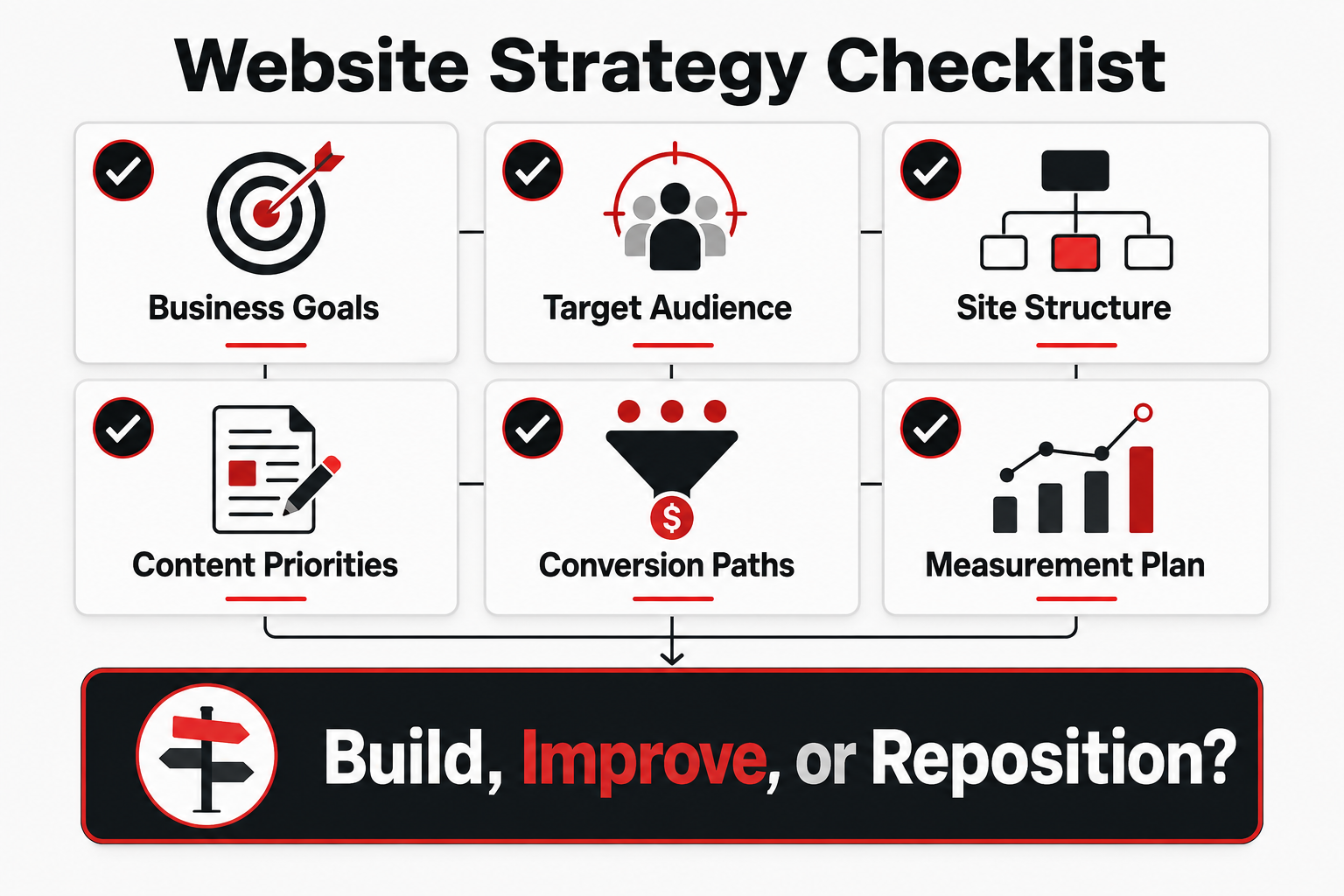
A website strategy often includes six essential components; the list below reflects how that work is tailored to each engagement.
Depending on the engagement, our services may include:
- Clarifying business priorities and website goals
- Identifying priority audiences
- Reviewing service positioning and branding
- Evaluating the current website
- Planning the required page scope
- Organizing services, industries, audiences, or locations
- Recommending navigation
- Mapping visitor and conversion paths
- Identifying content needs and gaps
- Reviewing forms and calls to action that support the sales team
- Defining functional and technical requirements
- Identifying system connections
- Clarifying measurement priorities and analytics
- Recommending website ownership and approval roles
- Creating a practical roadmap for design and development, including keyword research and implementation
The approved direction gives designers, writers, developers, and business leaders a shared understanding of the project.
Masterly Tech can also use the strategy as the foundation for website design, content development, implementation, and optimization.
Plan Before Committing the Full Budget
Website projects become expensive when major decisions are made during production.
Late changes to the page scope, navigation, platform, or content can affect work that has already been approved. They may also create pressure to accept a weaker solution because the budget or launch date cannot move.
Planning reduces this uncertainty and helps teams start planning sooner.
A website strategy session gives leaders an opportunity to define the project before committing the full budget to a build, with the focused planning effort needed to achieve clearer decisions before production begins. It can reveal missing requirements, conflicting expectations, and decisions that need executive approval.
This does not remove every change from the project. It creates a clearer starting point and gives the team a better way to evaluate new requests.
Frequently Asked Questions About Website Strategy
What is a website strategy?
A website strategy defines the site's primary goals, what the website must accomplish, who it serves, what it contains, and how it supports the business.
What is website planning?
Website planning establishes the page scope, navigation, content, features, conversion paths, and ownership requirements before production.
What is a web strategy?
A web strategy connects the website’s audience, content, technology, and user experience with business priorities.
Why should website goals be defined before design?
Clear website goals help teams make better decisions about pages, content, features, calls to action, and measurement.
Can Masterly Tech review an existing site?
Yes. Masterly Tech can review the current site, identify structural and content concerns, and recommend priorities for a redesign.
Can you help plan a completely new website?
Yes. We can define the audience, services, page scope, navigation, content needs, features, and conversion paths for a new build.
Does website strategy include content planning?
It can. The engagement may identify required pages, content gaps, existing materials, and priorities for new website copy.
Can website planning support a rebrand?
Yes. It can connect the new positioning and visual identity with updated services, content, navigation, and visitor paths.
Does Masterly Tech also design and build websites?
Yes. Masterly Tech can use the approved strategy to guide website design, content, development, and implementation.
Request a Website Strategy Session Before Committing Budget to a Redesign or New Build
Masterly Tech can help you define your website goals, audience, services, page scope, content, technology, and conversion paths before design begins, so your session clarifies measurable goals for your online presence, such as how to increase traffic and increase monthly website traffic by 30% within the next quarter.
Visit Masterly Tech or call (888) 209-4055 to request a website strategy and website planning session.