
Crawl Budget: Why Search Engines May Be Spending Time on the Wrong Pages
Your website may have thousands of valuable pages waiting to be discovered or refreshed, while search engines spend time crawling URLs you never intended to become important.
Duplicate pages. Filter combinations. Parameter URLs. Old content. Redirecting URLs. Search-result pages. Multiple versions of nearly identical content.
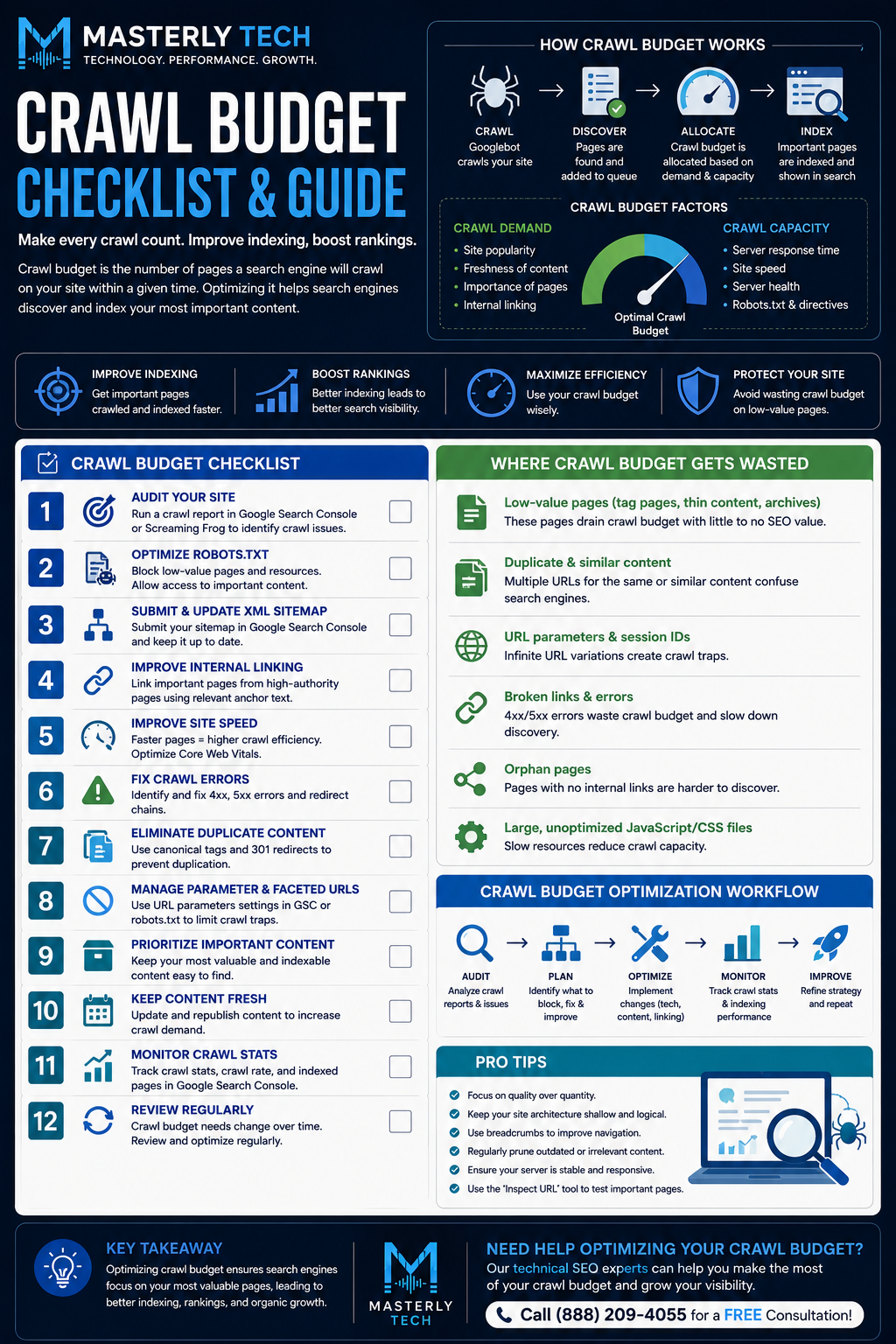
For a large or frequently changing website, those URLs can create a crawl budget problem. Crawl budget is the amount of crawling Googlebot can and wants to perform on a website, shaped by factors that include crawl capacity and crawl demand.
The business problem is not simply that Google is visiting too many URLs. It is that important pages may be competing with unnecessary URLs for search-engine attention, slowing discovery, delaying updates, and weakening organic visibility that supports leads and enquiries.
If you manage a business website and need to understand whether crawl waste is affecting performance, this page explains how Googlebot crawling works, how crawling differs from indexing, when crawl budget matters, where duplicate URLs and faceted navigation create waste, and how Masterly Tech reviews technical SEO issues that interfere with crawl efficiency.
Masterly Tech helps businesses investigate technical SEO problems that can interfere with crawling, indexation, and organic search visibility. The goal is not to chase a technical metric. It is to understand whether the structure of your website is making it harder for search engines to focus on the pages that matter.
Crawl Budget Problems Usually Hide Beneath the Website
A website can look perfectly normal to a visitor while creating a very different experience for a search crawler.
Imagine an ecommerce website with 8,000 useful product and category pages.
Visitors see a clean navigation system.
Behind that navigation, however, filters for size, color, brand, price, availability, sorting, and other attributes may generate many URL combinations.
Search engines may discover far more URLs than the business considers meaningful landing pages.
The visible website has 8,000 important pages.
The crawlable website may appear much larger.
This is one reason crawl issues can be difficult for business owners to recognize. The problem may not be visible from the front end.
It lives in the technical structure search engines encounter.
What Crawl Budget Actually Means
Google describes crawl budget through two main concepts: crawl capacity limit and crawl demand.
Crawl capacity relates to the number of simultaneous connections Googlebot can use and the time between fetches. Google tries to crawl without overwhelming the website's server.
Crawl demand considers factors such as URL popularity, staleness, sitewide events, and Google's estimate of how much inventory needs to be crawled.
Together, these factors influence how much Google wants to crawl and how much a website can handle.
This distinction matters because businesses sometimes treat crawl budget as a fixed number they need to increase.
That is not the most useful business question.
The better question is whether search engines are spending available crawling resources on URLs that deserve attention.
Crawl Efficiency Is About Giving Important Pages a Clearer Path
Crawl efficiency does not mean preventing search engines from exploring the website.
It means reducing unnecessary obstacles and waste so the site's important content is easier to discover and revisit.
A useful way to think about the issue is:
Discover. Prioritize. Consolidate. Index.
These are not instructions for a business owner to implement alone. They are areas a technical SEO review can examine when diagnosing crawl problems.
Discover What Search Engines Are Finding
The first question is not how many pages the company believes it has.
It is how many URLs search engines can discover.
Those numbers can be very different.
Internal links, XML sitemaps, redirects, parameters, filters, old URLs, and other technical elements can expose additional addresses to crawlers.
Understanding that crawlable URL inventory is important when investigating waste.
Prioritize the Pages That Matter
Not every technically accessible URL has equal business value.
A core service page may matter greatly.
A product page may matter.
A useful article may matter.
A parameter-generated copy of an existing page may provide little additional value.
Technical SEO should help search engines understand the site's intended structure and surface the most important pages, rather than forcing them to sort through unnecessary variations; with faceted navigation, extra filter versions can dilute PageRank across too many links.
Duplicate URLs Can Consume Crawling Resources
Duplicate URLs are one of the issues Google specifically identifies in its crawl-budget documentation.
A website can make the same or very similar content available through several addresses.
That does not necessarily mean someone intentionally created duplicate pages.
Technical systems can generate them.
Tracking parameters, sorting options, alternate paths, session information, CMS behavior, and other mechanisms can all contribute to URL duplication.
Some low-value duplicate or parameter patterns can also be managed through the robots.txt file, using robots directives for blocked URLs to reduce unnecessary crawling.
Google states that duplicate content generally wastes crawling resources. It also notes that crawling unnecessary URLs can delay the discovery of new or updated content on larger sites.
For a business, this means a duplication problem can be more than an organizational inconvenience.
It can become part of a larger search-engine efficiency problem.
Faceted Navigation Can Create a Very Large URL Space
Faceted navigation is useful for users.
An online shopper may want to filter products by brand, price, size, color, rating, or availability.
A directory visitor may filter listings by location and category.
The problem is that every possible combination can potentially create another URL.
Google's current documentation warns that faceted navigation can create a very large number of URLs because each combination of filters can generate a different address.
For large sites, this can create what Google describes as an "infinite URL space."
The business may have a controlled inventory of products or content while the underlying website creates a much larger set of crawlable URL combinations.
This is a classic example of why technical SEO problems should be evaluated at the system level rather than page by page.
Googlebot Crawl Activity Can Reveal What the Site Is Communicating
A Googlebot crawl is not simply a search engine visiting the homepage and moving through the menu like a person.
Google discovers URLs from many sources and determines when and how frequently to crawl them. That includes signals that affect crawl rate, and high page load times can reduce the number of crawled pages.
Google Search Console's Crawl Stats report can provide information about Google's crawling history on a website, including crawl requests, download size,
response information, and host status. It also helps diagnose crawl-rate patterns and server-response problems over time using data from google's crawlers and related tools.
For the right type of website, that information can help technical SEO professionals investigate what Googlebot is actually doing. A faster loading website can increase crawl rate significantly, while server errors and slow responses can make Google reduce crawl capacity if servers return errors.
The important distinction is between assumption and evidence.
A business may assume Google is spending most of its time on the company's newest products or most important service pages.
Crawl information may tell a different story.
Crawling and Indexation Are Not the Same Thing
Another important distinction involves indexation.
Crawling means a search engine retrieved a page.
Indexing is a separate process.
Google explicitly states that even when it crawls a page, that does not guarantee the page will be indexed.
This matters because businesses sometimes respond to an indexing problem by trying to force more crawling.
More crawling is not automatically the solution.
If pages are duplicated, low quality, technically problematic, or poorly connected to the larger site structure, increasing crawl activity may not address the real cause.
A professional review should distinguish among discovery problems, crawling problems, indexing issues, and ranking problems.
They are related, but they are not interchangeable.
Crawl Budget Is Not a Crisis for Every Website
Crawl budget deserves context.
Google says most sites do not need to worry about it.
Its detailed crawl-budget guidance is aimed primarily at very large websites, medium or larger sites with rapidly changing content, and sites where a significant portion of URLs remain classified as discovered but not indexed.
For a smaller business website with a manageable number of pages, another technical SEO issue may deserve more attention.
That is why a crawl-budget service should begin with diagnosis rather than assumption.
A company should not pay to solve a crawl-budget problem simply because the phrase sounds important.
The site should first show signs that crawling efficiency may actually be affecting search visibility.
Crawl Waste Can Affect More Than Search Bots
Technical disorder can spread.
Large numbers of unnecessary URLs can make analytics harder to interpret. Duplicate pages can complicate reporting. Poor URL structures can make site management more difficult. Uncontrolled filters can create ongoing problems as the site grows. Redirect chains and dead ends are another form of structural waste: they make maintenance harder, waste crawl budget, and dilute link equity.
Search engines experience one version of that complexity.
Internal teams may experience another.
That is why a strong technical SEO review looks beyond a single crawl metric.
The objective is to understand the architecture creating the problem.
Fixing one URL while leaving the system that generates thousands more does not address the underlying issue.
Masterly Tech Looks at the System Behind the Crawl Problem
Businesses often reach the point of requesting technical SEO help because something does not add up.
Important pages are slow to appear in search.
Large numbers of unexpected URLs are being discovered.
A site migration has created old and new URL patterns.
Filters are generating pages the company never intended to promote.
Google Search Console reports show a growing difference between URLs the business considers important and what search engines are actually processing.
A review may also look for non-indexable pages or non indexable urls consuming attention without adding search value.
These situations require investigation.
Masterly Tech provides SEO and website-development services for businesses that need their digital presence to support visibility and lead generation.
For organizations experiencing broader organic-search problems, Masterly Tech's SEO services provide the relevant internal path for discussing technical and search visibility concerns.
A crawl-budget review should not exist in isolation from the rest of the website. Architecture, development decisions, internal linking, indexation, and organic strategy can all be connected.
Crawl Budget FAQ
What is crawl budget?
Crawl budget describes how much crawling Google can and wants to perform on a website. It is not a default fixed limit, and it can change over time based on how Google evaluates the site. Google explains it through crawl capacity and crawl demand.
Does every website need to optimize its crawl budget?
No. Google says most websites do not need to worry about crawl budget. It becomes more relevant for very large sites, rapidly changing sites, and sites with substantial crawling or indexing concerns.
What is crawl efficiency?
Crawl efficiency refers to making it easier for search engines to focus their crawling on useful, intended URLs instead of repeatedly encountering unnecessary or low-value URL variations, so google crawls spend more time on the most important pages instead of other pages that add little value.
Can duplicate URLs affect crawl budget?
Yes. Google identifies duplicate content and unnecessary URLs as sources of wasted crawling resources, particularly on larger websites. Using canonical tags can point search engines to the preferred canonical URL, but duplicate URLs may still be crawled unless other controls are also used.
How does faceted navigation affect crawling?
Faceted navigation can generate many URL combinations from filters and sorting options. Faceted urls and url parameters can create a separate url for each filter state, even when those pages have little unique content. Google warns that this can create a very large URL space and consume significant computing resources. That often leads to crawl budget issues and indexing problems, so controls may include robots.txt, nofollow, or canonical tags depending on the setup.
What is a Googlebot crawl?
A Googlebot crawl occurs when Google's crawler requests and retrieves URLs from a website as part of Google's process for discovering and refreshing web content. Depending on what it can access on the site, Googlebot may request not only html pages but also resources such as JavaScript files and pdf files.
Does crawling guarantee indexation?
No. Google states that crawling a page does not guarantee indexation. Crawling and indexing are separate parts of the search process.
Can a technical SEO review identify crawl waste?
A technical SEO review can examine issues such as URL discovery, duplicate URLs, faceted navigation, internal linking, blocked URLs, server errors, redirect chains, server responses, indexation patterns, crawl data, and crawler-testing tools to determine whether crawl waste may be a meaningful problem. Reviewers may also inspect how Googlebot is identified in logs or tests through the user agent and, in some tools, the user agent token.
Can increasing crawl budget improve rankings?
A larger crawl budget does not guarantee better rankings. The business value comes from making important content accessible and reducing technical problems that interfere with efficient discovery, crawling, and indexation. For a website with 10,000 pages, crawl budget management matters more, but chasing more crawl budget is not the goal by itself, even if stronger authority and site quality can earn larger sites deeper crawling over time than other sites.
Request a technical SEO review if crawl waste is affecting visibility
If your website is large, changes frequently, or generates far more URLs than your business intends search engines to prioritize, the issue may require more than another content update.
Masterly Tech can help investigate whether crawl budget, duplicate URLs, faceted navigation, indexation patterns, or other technical SEO issues are making it harder for search engines to focus on important pages.
The objective is not to make Googlebot crawl everything more often. It is to determine whether the website is giving search engines a clear, efficient path to the content that matters.
Call Masterly Tech at (888) 209-4055 or visit MasterlyTechGroup.com to request a technical SEO review if crawl waste is affecting visibility.