Internal Linking SEO: Helping Search Engines and Buyers Find the Right Page
Your website may have strong service pages, useful articles, and valuable resources, but those pages can still become difficult to find if they are not connected in a clear way.
A visitor reads an article and reaches the bottom without knowing which service applies to the problem. A valuable service page receives few links from the rest of the website. Several articles discuss the same subject but never connect to each other. Other pages sit alone with no clear path leading to them.
These are problems that internal linking SEO can help address. Internal linking SEO is the strategic use of links between pages on the same domain to help visitors and search engines discover content, understand how pages relate to each other, and pass attention toward the pages that matter most.
Internal links help visitors move between related information.
They also help search engines crawl pages, understand site architecture, and support search engine rankings by connecting important pages, topic clusters, anchor text, and orphan pages into a clearer structure. For businesses, website owners, and SEO professionals, that means a website that is easier to navigate, easier to understand, and better able to guide both search engines and buyers toward the right next step. Google specifically recommends linking important pages from other pages on the same site and using descriptive anchor text that helps people and Google understand where a link leads.
Masterly Tech helps businesses evaluate SEO structure as part of the larger website experience. The goal is not to add links everywhere. It is to create clearer pathways toward the pages that matter.
Strong Pages Can Still Become Buried Inside a Weak Site Structure
A page does not exist in isolation.
Consider a professional services firm with a main service page, 30 supporting articles, several industry pages, and dozens of older resources.
The company may have useful content about one important service, but the pieces were created at different times.
One article links to the homepage.
Another links to a general contact page.
Several do not link anywhere useful.
The primary service page receives almost no contextual links from the supporting content.
To a person browsing the site, the relationship between these web pages may be unclear.
Search engines can face the same structural problem across the entire site, making disconnected site pages harder to discover, understand, and rank.
The business has content authority scattered across individual URLs rather than organized into a connected experience.
Internal Linking SEO Is About Relationships Between Pages
Internal linking SEO is not simply the practice of inserting hyperlinks into articles.
It involves deciding how important pages relate to supporting content and how those relationships should be reflected across the site. The business has content authority scattered across individual URLs, so a clear internal linking strategy helps search engines interpret which pages matter most and how SEO value should move through the site. When pages are poorly connected, important web pages can become harder to interpret across the entire site.
A useful way to think about the structure is:
Find. Understand. Explore. Convert.
Search engines can face the same structural problem. Good links help ensure no page is left hidden or lost by search bots.
Find the Important Page
Search engines first need a path to a page.
Google states that links help it discover a new page to crawl and influence how quickly content can appear in search results. It also recommends making sure the pages on your site that you care about have at least one link from another page on the website so search engine crawlers can reach them as search engines crawl.
That makes internal linking a basic discovery issue.
It involves deciding how key pages relate to supporting content as part of an internal linking strategy, including where incoming internal links should come from. Those relationships help direct SEO value toward the pages that matter most.
If an important page has few meaningful paths leading to it, the website may be communicating less importance than the business intends; more internal links from relevant sections can help clarify that importance.
Understand What the Page Is About
The link itself also carries context.
This is where anchor text matters.
Anchor text is the clickable wording used in a link.
Google recommends descriptive, reasonably concise anchor text that relates to both the page containing the link and the linked page.
For example, a link labeled "learn more" gives little information by itself.
A contextual phrase describing the relevant service or topic helps search engines understand how the source connects to relevant pages and whether the link supports relevant content.
The goal is not to force keywords into every link.
It is to make links understandable.
Site Architecture Should Reflect Business Priorities
A website's site architecture is the larger structure connecting pages, categories, services, resources, and navigation across internal pages.
Internal linking operates inside that structure, and the website's internal linking structure shapes how people and crawlers move through it.
Imagine a business with three primary services.
Each service has supporting educational content, case-related resources, and industry-specific pages.
A clear architecture can help each supporting page connect back to the appropriate main topic, while navigational links guide visitors through the broader hierarchy.
Without that organization, content can become a flat collection of pages.
Everything technically exists, but the relationships are unclear, especially when types of internal links are used inconsistently.
A strong architecture creates hierarchy, and a strong internal linking structure helps distribute context and authority through the site.
The homepage may introduce major services.
Service pages explain specific offerings.
Supporting articles answer related questions.
Industry pages connect the service to particular audiences.
Descriptive anchor text should name the destination page clearly, not just use vague labels.
For example, linking “internal linking audit checklist” gives more context than “learn more.”
Descriptive anchors pointing to relevant content help search engines understand the relationship between the two pages.
These connections can help both buyers and search engines move through the site with greater context, whether they come from menus, sidebar links, or other parts of the internal linking structure.
Topic Clusters Can Organize Related Expertise
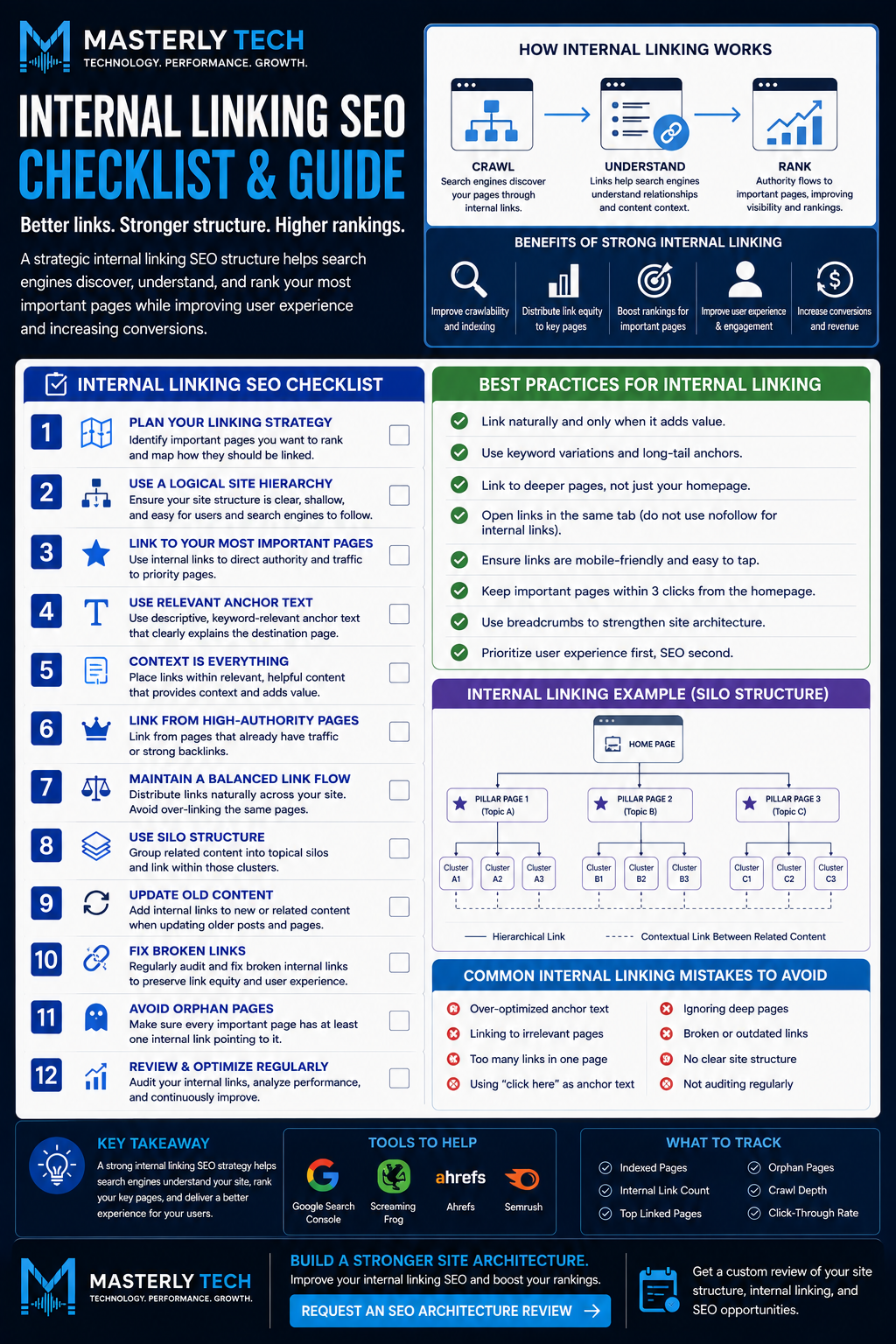
Topic clusters are one way to think about groups of closely related content within a website’s internal linking structure.
A central pillar page may address a major service or subject while supporting cluster pages cover narrower questions connected to it.
For example, a company offering cybersecurity services might have a primary cybersecurity page supported by content about data protection, employee security awareness, threat monitoring, and related subjects.
Those pages should not behave like unrelated islands.
Internal linking operates inside that structure. A strong internal linking structure usually includes different types of internal links, including navigational links and, where relevant, sidebar links.
Relevant contextual internal links can connect supporting information with the broader topic.
This structure can also improve the user experience.
Someone who begins with a narrow informational question can discover the larger service context without having to start a new search.
That is where internal linking begins supporting conversion as well as SEO by helping visitors and search engines move between internal pages with clearer context.
Orphan Pages Can Hide Valuable Content
Orphan pages are pages that have no meaningful internal links pointing to them.
They may exist in a sitemap or be accessible through a direct URL, but normal website navigation does not lead visitors to them.
That can happen for many reasons.
A central page may have been built as a pillar page, but the supporting resources were never connected as cluster pages.
A blog article was published but never added to a related content structure.
A website redesign changed navigation and left behind broken internal links.
A service page was created but supporting pages were never updated, or regular checks missed broken links.
Google recommends that important pages receive a link from at least one other page on the site.
For a business, the issue is also practical.
If the page matters enough to exist, visitors should have a reasonable way to find it.
Contextual internal links help move someone from a narrow question to the broader service context without friction.
An internal linking review can help identify pages that deserve stronger connections and pages that may no longer serve a useful role, while also
improving the user experience by making that path easier to follow.
SEO Internal Linking Should Support Buyers, Not Distract Them
Poor SEO internal linking is easy to recognize.
A paragraph contains links on nearly every other phrase, which raises the question of how many internal links actually help the page.
The same destination appears repeatedly.
Anchor text feels forced.
Links point to pages that are only loosely related to the topic.
The result may technically contain many internal links but provide little value to the reader, and too many links can dilute relevance and make navigation less clear.
Good effective internal linking feels natural because the destination answers the next reasonable question.
For example, a visitor reading about a technical website problem might benefit from a link to a relevant technical SEO service.
Someone reading about local search visibility may benefit from a page explaining the company's local SEO offering.
A person comparing website platforms may need a website-development page rather than another unrelated blog article.
The link should support intent. An internal link audit can also identify broken links on your site, including broken internal links. Regular audits help maintain a healthy internal linking structure. Fixing broken internal links improves crawlability and user experience.
Internal Links Can Create a Better Conversion Path
SEO is not the only reason internal links matter.
They can also help buyers move through the decision process.
Consider this journey:
Search result → Educational article → Relevant service page → Contact opportunity
The article solves part of the visitor's problem.
The internal link helps the visitor understand that professional help is available.
The service page explains the offering.
The visitor then has a clear opportunity to contact the business.
Without the link between the educational page and the service page, the visitor may simply leave after reading.
This does not mean every article should aggressively push a sale.
The transition should make sense.
Internal linking works best when the next page is genuinely useful.
Anchor Text Should Tell People Where They Are Going
Anchor text affects usability.
A visitor deciding whether to click a link should have a reasonable idea of what will happen next.
That is why vague language can weaken the experience.
Compare:
Click here
with:
Explore our technical SEO services
The second link communicates context.
Google's current guidance follows the same principle. Anchor text should be descriptive, concise, and relevant.
There is also no need to make every link use the exact same keyword.
Natural variation can make the site easier to read while still communicating clear meaning.
Internal Linking Problems Often Grow as Websites Expand
Small websites are easier to manage manually.
As a site grows, internal linking can become harder to control.
New articles are added every month.
Services change.
Old URLs remain online.
Industry pages are created.
New locations are added.
Content writers may not know what related pages already exist.
After several years, the site can contain hundreds or thousands of pages built under different strategies.
This is when an SEO architecture review becomes valuable.
The business may not need more content first.
It may need a clearer structure for the content it already owns.
Internal Linking Should Work With Technical SEO
Internal linking problems can overlap with broader technical issues.
A link may point through an unnecessary redirect.
A navigation system may use a format that is difficult for crawlers to process.
Old pages may still receive internal links even though a newer destination exists.
Important pages may be buried several levels deep in the architecture.
As a site grows, internal linking can become harder to control. That is why expanding sites need a solid internal linking strategy. Strong internal and external links also clarify how pages relate within your domain and beyond it.
This is why internal links, technical SEO, content strategy, and site architecture should not be evaluated separately. Done well, they help distribute link equity from high authority pages to sections that need more visibility. They should also consistently resolve to secure destinations rather than outdated http pages.
Google specifically recommends crawlable links using standard HTML anchor elements with valid href attributes. It also notes that links help Google discover pages and understand their relevance. In parallel, external links point from your site to external websites, while external backlinks from other domains can strengthen authority signals.
The technical implementation matters as much as the editorial decision to create the link, and a robust internal linking strategy may deliver more value than simply publishing more content.
Masterly Tech Can Review the Architecture Behind Your SEO
Businesses often ask for more SEO content when the existing content has not yet been organized effectively.
Adding another 30 articles to a weak architecture can make the site larger without making it easier to understand.
Masterly Tech currently provides SEO services that include content writing, on-page SEO, technical SEO, link building, keyword strategy, and website optimization.
That broader SEO perspective is important because internal linking SEO sits between content strategy and website structure. External links point to other websites, while internal links connect pages within your own site.
It requires looking at which pages matter, what topics support them, how users move between those pages, and whether search engines can follow the same paths. That includes identifying key pages and building a strong internal linking strategy around them.
If an older page still links to a redirected URL, the destination should use secure HTTPS rather than an outdated HTTP version.
Businesses that need help with the larger organic search structure can explore Masterly Tech's SEO and digital marketing services.
The goal is not to add the highest possible number of links.
It is to create a website where important pages are easier to discover, understand, and reach. Linking from high-authority pages to lower-visibility pages can redistribute authority. While backlinks from other sites influence authority, internal linking determines how that value moves through the site.
Internal Linking SEO FAQ
What is internal linking SEO?
Internal linking SEO is the strategic use of links between pages on the same website to help users and search engines discover content and understand relationships between pages.
Why are internal links important for SEO?
Internal links connect pages on the same domain and are used as part of a broader internal linking structure to help users and search engines discover content. They help search engines find, index, and understand the importance of all site pages, which can support search engine rankings and make it easier for visitors to navigate to relevant information.
What is anchor text?
Anchor text is the clickable text used in a hyperlink. Google recommends descriptive and concise anchor text that helps people and search engines understand the destination page.
What is site architecture?
Site architecture is the structure that organizes pages and defines how different areas of a website connect.
What are topic clusters?
Topic clusters are groups of related pages organized around a broader central subject or service. In this structure, a pillar page acts as the main hub, while cluster pages cover related subtopics in more detail and link back into that hub. Internal links can help connect those pages, and site architecture also includes how navigational links connect the main areas of a website.
What are orphan pages?
Orphan pages are pages with no meaningful internal links pointing to them. A broader central page should act as a pillar page, with supporting resources linked in as cluster pages so important pages have clear paths from other areas of the website. This is also a good place to check for broken internal links, since dead links can hurt both user experience and crawlability.
Does Google use internal links to find pages?
Yes. Google states that it uses links to discover new pages to crawl and recommends linking important pages from other pages on the same site, so search engine crawlers can reach more pages on your site. An internal link audit can also identify broken links on your site, including broken internal links. Regular audits help maintain a healthy internal linking structure.
Should every article link to a service page?
Not automatically. The destination should be relevant to the reader's intent. Internal links should help visitors continue toward information that naturally supports the subject they are already exploring. Search engine crawlers also use links to find pages on your site, so contextual internal links placed naturally within the main content can help both navigation and discovery. Keep important pages within three clicks of the homepage, since crawl depth over three clicks can reduce page importance.
Can too many internal links be a problem?
Links become less useful when they are excessive, repetitive, irrelevant, or placed without context. Contextual internal links should help visitors continue toward information that naturally supports the subject. If you're wondering how many internal links to use, there is no fixed rule, but too many links on one page can dilute value, confuse search engines, and weaken the user experience. The goal should be clarity and usefulness rather than reaching an arbitrary number. Call-to-action links can guide users to conversion-focused pages when that next step is relevant.
Can Masterly Tech review existing internal links?
Masterly Tech provides SEO, on-page SEO, technical SEO, content, and website optimization services. Contact the team to discuss whether your site's internal linking and architecture, including your website's internal linking structure, should be reviewed as part of a broader SEO strategy. There is no fixed rule for how many internal links a page should have, because too many links can reduce clarity and your internal linking efforts should focus on meaningful, relevant links rather than hitting a target number.
Request an SEO architecture review
If your website contains strong content but important service pages are difficult to find, supporting articles are disconnected, or older pages have become isolated, publishing more content may not solve the problem.
Masterly Tech can review your website's internal linking structure as part of broader SEO work. This can include evaluating existing internal linking efforts alongside site architecture and technical SEO.
Masterly Tech can review how internal linking SEO, topic clusters, anchor text, orphan pages, and opportunities to distribute link equity from high authority pages are affecting the way search engines and buyers move through your website.
The objective is a site where valuable content supports the pages that matter and visitors have a clear path toward the information or service they need next.
Call Masterly Tech at (888) 209-4055 or visit MasterlyTechGroup.com to request an SEO architecture review.