
The Accountant’s Guide to Getting Found First: SEO Strategies That Actually Convert

March 10, 2026

If you are an accountant today, you are not just competing with the firm across town. You are competing with every accounting firm that appears in Google search results when a business owner types “CPA near me” or “tax help for small business.” Most accounting firms assume referrals alone will carry them forward. The reality is that search engines now determine who gets seen first—and who gets ignored.


At Masterly Tech Group, we work with accounting professionals who are exceptional at their craft but invisible online. SEO for accountants is no longer optional. It is the difference between waiting for inquiries and consistently attracting more clients who are actively searching for accounting services.

This guide provides practical, actionable SEO steps that accounting firms must implement immediately. These strategies are designed not just to increase traffic, but to drive high quality leads that convert into loyal clients.


Why SEO Is No Longer Optional for Accounting Firms

The accounting industry has changed dramatically in the last decade. Business owners no longer flip through directories to find a CPA firm. They perform a Google search and compare options within seconds.


Search engine optimization ensures your accounting firm appears in search results when potential clients need your services. Without a strong SEO strategy, even the most reputable firm can be buried beneath competitors who invest in visibility.


SEO for accounting firms is not about chasing trends. It is about building long term success through consistent online visibility and strategic positioning.


Understanding How Search Engines Evaluate Your Accounting Firm

Search engines analyze hundreds of signals to determine where your accounting website appears in search engine results pages. These signals include content quality, site speed, mobile friendliness, backlinks, and user behavior.


When someone conducts a Google search, the algorithm scans millions of pages to deliver relevant content. If your site lacks optimized structure or relevant content, you will struggle to compete in organic search results.


Search engine optimisation works when technical structure and meaningful content align. That is where most accounting firm SEO efforts either succeed or fail.


Starting With a Comprehensive SEO Audit

Before implementing changes, every accounting firm should conduct an SEO audit. A detailed seo audit reveals technical seo issues, duplicate content, broken links, and performance gaps.


An audit evaluates your accounting website from both a technical and strategic perspective. It also highlights missed opportunities for local SEO and keyword optimization.


Masterly Tech Group offers a free SEO audit to help firms identify weaknesses before investing further resources.


Keyword Research That Targets Buyers, Not Browsers

Keyword research is foundational to SEO for accountants. Many firms target broad search terms like “accounting services,” but these terms often attract general traffic rather than high quality leads.

Instead, focus on intent-based search terms such as:

  • CPA services for startups”
  • Tax planning for medical practices”
  • Small business accountant in Houston”


This type of keyword research aligns with real search intent and increases the likelihood of conversion.

Keyword stuffing is a mistake that damages credibility. Instead, natural keyword optimization within quality content improves search rankings sustainably.


On Page SEO That Actually Converts

On page seo involves optimizing the elements directly on your accounting website. This includes meta titles, meta descriptions, headers, and internal links.


Meta titles should clearly state your primary service and location. Meta descriptions should encourage users to click from Google search results.

Internal links connect related pages and help search engines understand your site’s structure. Strong on page seo improves both visibility and user experience.


The Power of Local SEO for Accounting Firms

Local SEO is critical for accountants serving specific regions. Most clients search within their geographic area, especially when seeking a CPA firm.

Optimizing your Google Business Profile is one of the fastest ways to improve local search performance. An optimized Google Business Profile increases visibility in local search and Google search results.


Local seo also includes creating location pages that target specific cities or service areas. This increases your chances of appearing in search results when prospects search nearby.


Technical SEO Foundations You Cannot Ignore

Technical SEO guarantees that search engines can effectively crawl and index your accounting website. Without strong technical foundations, even great content may go unnoticed.

Key elements include:

  • Mobile friendly design for mobile devices
  • Fast load speed and site speed optimization
  • Secure HTTPS structure
  • Clean URL formatting
  • Schema markup implementation


Schema markup helps search engines understand your accounting services and display enhanced search results.


Creating Quality Content That Builds Authority

Content marketing is essential for SEO for accounting firms. Publishing a blog post regularly allows you to target long-tail search terms and answer client questions.


Each blog post should provide relevant content that addresses real financial concerns. For example, writing about “tax strategies for e-commerce businesses” positions your firm as a specialist.


Quality content builds domain authority and strengthens your site’s authority over time.


Link Building That Strengthens Domain Authority

Link building remains one of the strongest ranking signals in SEO. However, not all backlinks are equal.

Not all backlinks from other sites improve credibility. Links from reputable financial publications and business directories increase domain authority and trust.


Strategic link building must be ethical and relevant. Avoid spammy tactics that damage search engine optimisation progress.


Tracking SEO Performance With the Right Tools

SEO work must be measured consistently. Google Analytics and Google Search Console offer useful information about user behavior, keyword performance, and organic searches.


Monitoring seo performance allows you to adjust strategy based on measurable results. Monthly reporting ensures transparency and accountability.

Without performance tracking, seo efforts become guesswork rather than strategic growth.


Conversion Rate Optimization for Accounting Websites

Driving organic traffic is only half the equation. Conversion rate optimization ensures visitors become clients.

Your accounting website should clearly communicate value and trust. Strong calls to action, testimonials, and clear service pages increase lead generation success.


Conversion rate optimization transforms traffic into quality leads and ultimately more clients.


Avoiding Common SEO Mistakes

Many accounting firms damage their seo journey by making preventable errors. Duplicate content across service pages confuses search engines.

Keyword stuffing reduces readability and trust. Slow load speed discourages users and harms rankings.


Ignoring local SEO limits visibility among nearby prospects.


Addressing these issues strengthens both search rankings and credibility.


Why Most Accounting Firms Struggle With SEO

Most accounting firms attempt to manage SEO internally without dedicated seo professionals. While understandable, this often leads to inconsistent implementation.


SEO requires expertise across technical seo, content marketing, link building, and analytics. Without a cohesive seo strategy, results remain limited.

Partnering with an experienced digital marketing agency ensures seo important tasks are handled professionally.


Building Tailored SEO Strategies for Long Term Success

Every accounting firm has unique goals. Tailored seo strategies consider specialization, service area, and target audience.

For example, a CPA firm serving tech startups requires different content ideas than one focused on retirees.


Masterly Tech Group develops tailored seo strategies that align with business objectives and competitive positioning.


SEO for Accountants as a Lead Generation Engine

When implemented correctly, seo for accountants becomes a powerful lead generation engine. Organic leads are often higher quality because they originate from active search intent.


Organic searches driven by relevant content generate trust before the first consultation.


Over time, consistent seo builds a steady pipeline of new clients.


Integrating SEO With Digital Marketing and Social Media

While SEO is foundational, integrating it with digital marketing enhances results. Social media marketing can amplify blog post visibility and attract engagement.


However, SEO remains the backbone of long term online visibility.


Combining search engine optimization with broader digital marketing ensures sustained growth.


Why SEO for Accounting Firms Delivers Sustainable Growth

Unlike paid advertising, SEO delivers ongoing benefits. While Google Ads may generate short-term visibility, strong seo for accounting firms builds lasting authority.


As your site’s authority increases, your ability to attract high quality leads improves.


This creates momentum that supports new business opportunities and long term success.
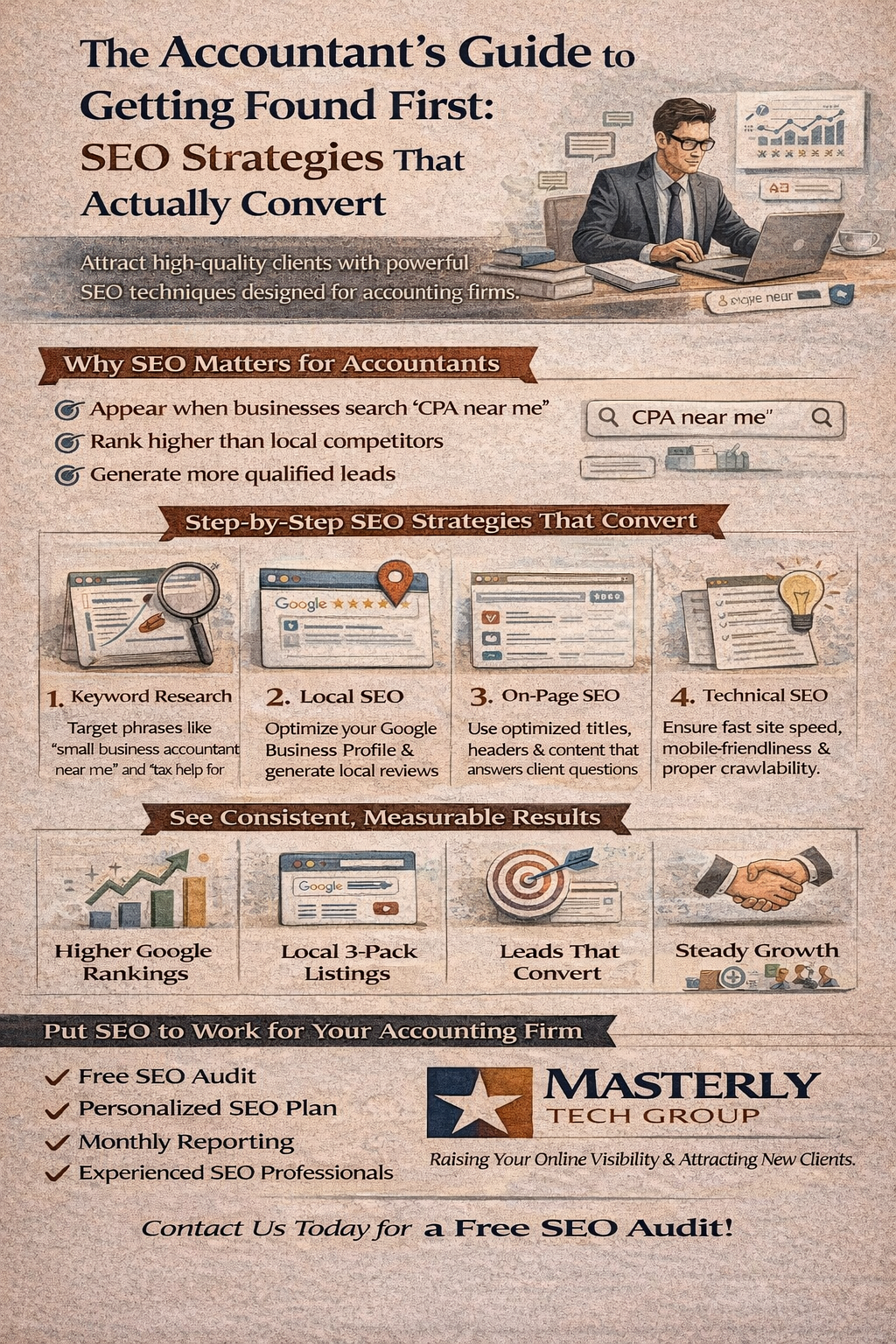
The Accountant’s Guide to Getting Found First: SEO Strategies That Actually Convert.” The design features a professional accountant working on a laptop with charts and analytics in the background. Sections explain why SEO matters for accountants, including appearing in searches like “CPA near me,” ranking higher than competitors, and generating qualified leads. A step-by-step section outlines key strategies: keyword research targeting intent-based phrases, local SEO optimization through Google Business Profile, on-page SEO with optimized titles and content, and technical SEO including fast site speed and mobile friendliness. Another section highlights measurable results such as higher Google rankings, local 3-pack listings, leads that convert, and steady growth. The bottom promotes Masterly Tech Group with offerings like a free SEO audit, personalized SEO plan, monthly reporting, and experienced SEO professionals, ending with a call to contact for a free SEO audit.


Why Professional SEO Services Are the Foundation of Sustainable Growth

Investing in professional SEO services is one of the smartest decisions a growing firm can make. Experienced SEO professionals understand that no two companies are the same, which is why tailored SEO strategies are essential for long-term success. A strong SEO journey begins with understanding your audience, refining content ideas, and aligning your website with a broader digital marketing plan that may also include social media marketing. When SEO is implemented correctly, it does more than improve rankings — it helps boost SEO performance in a way that supports real lead generation and measurable lead generation success. Because SEO is important for visibility in competitive markets, focusing on organic leads instead of relying solely on paid ads allows firms to attract qualified prospects and convert them into new clients. Ultimately, strategic SEO becomes a reliable engine for new business growth that strengthens authority and keeps your company ahead of competitors.


Partner With Masterly Tech Group

If your accounting firm is not appearing in Google search results, it is time to act. Waiting will only allow competitors to strengthen their search rankings.

At Masterly Tech Group, we specialize in SEO for accounting. Our team understands the accounting industry and implements seo strategies that actually convert.


We offer a free consultation to evaluate your accounting firm seo performance and identify immediate improvements. Whether you need technical seo fixes, local seo optimization, or a comprehensive seo strategy, we are here to help.


Contact us at (888) 209-4055 to book a free consultation. Let’s discuss how seo for accountants can help you attract more clients, generate organic leads, and position your firm at the top of search engine results where it belongs.

(888) 209-4055

laptop
By Amber Aniston July 23, 2026
Learn what a small business SEO consultant should deliver - from technical audits and local SEO to content strategy, conversion optimization, and transparent reporting.
laptop and funnel
By Amber Aniston July 23, 2026
Already getting traffic but not enough calls, bookings, or sales? Masterly Tech's website conversion optimization services audit your funnel, forms, mobile UX, and analytics to find where qualified leads are leaking out-then fix them with testing and CRO.
DEVICES WITH MASTERLY TECH LOGO
By Amber Aniston July 22, 2026
Learn how modern legal website design goes beyond looks to drive rankings, trust, and qualified inquiries. See the essentials of architecture, intake, mobile UX, authority, compliance, and SEO.
By Angelie Te July 21, 2026
Most authors treat their website like a digital business card - a place to park a bio and a headshot. That approach leaves money, readers, and opportunities on the table. Author website design is the process of building a strategic site that works as a marketing engine before launch and an authority platform long after publication day. Whether you're a debut author getting ready for a first book launch, a mid-list author managing a series, or an executive or expert using a book to win speaking and media opportunities, the right site can support book sales, email growth, credibility, and long-term discoverability. This guide walks through how to define your website goals, choose the right platform and hosting, map the site, and build the pages that matter most - including the homepage, book pages, About page, speaking and media pages, and launch funnels. It also covers conversion-focused design, branding, images, mobile responsiveness, site speed, SEO, DIY versus professional design, and the ongoing maintenance that keeps an author site effective over time. 1. Define the real job of your author website (before you touch design) Before you open a design tool or pick a color palette, get clear on what the site must accomplish. An effective author website should serve as the central hub of your digital presence - not a static brochure you publish once and forget. Every author website needs to do five things: Sell more books (directly or through retailer links) Grow an email list of engaged readers Book speaking gigs and professional appearances Attract media coverage and podcast invitations Position the author as a long-term authority in their space The weight you give each goal depends on who you are. A debut nonfiction author preparing a 2026 launch might invest heavily in email capture and pre-order campaigns. A mid-list romance author with a book series will focus on backlist discovery and community. A high-profile executive or expert may prioritize speaking inquiries and media credibility as much as direct book sales. Goals also shift with timing. Before launch, the emphasis is on building anticipation - collecting email addresses, sharing teasers, and driving pre-orders. After launch, priorities move to conversions, collecting reviews, and producing more posts that fuel search engine optimization over time. Every design choice - colors, layout, images, navigation labels - must serve one or more of these goals. This article comes from Masterly Tech Group's perspective: we build author website design projects as strategic launch funnels and long-term platforms, not quick template jobs. 2. Choose your platform, web host, and domain like a pro Three decisions form the technical foundation of your author site: your domain, your web host, and your content management system. Getting these right early saves expensive rework later. Domain name. When choosing among domain names, pick one based on your author name, not a book title. Books come and go; your name is your career. Good examples: janedoe.com, janedoeauthor.com, janedoebooks.com, and the extension usually has little effect on rankings unless you are targeting a specific country. Avoid using book titles for your domain name because you will likely publish more books. If your author name is already taken, try variations like yournameauthor.com or yournamewriter.com. Using .com domains is preferred for better traffic and reader trust. Web host. A reputable web host with SSL, daily backups, fast support, and strong uptime (99.9%) is non-negotiable in 2026. Misconfigured hosting or slow load times are among the top causes of bounce and failed conversions. Look for a hosting plan that includes a global CDN and automatic security updates. CMS platform. A basic site on a drag-and-drop platform like Squarespace or Wix can work for authors who need a simple catalog fast - typically $200–500 per year all in. The tradeoff is limited control over search engine optimization, speed tuning, and launch funnel complexity. A WordPress site offers deeper customization, plugin-powered e-commerce, and content scaling capacity, typically running $500–2,000 per year with quality hosting and themes. Masterly Tech Group typically builds on WordPress for book launch website projects and long-term content strategies, but we integrate with other systems when an author already has them in place. The right platform depends on budget, technical comfort, expected website traffic, and how many books you plan to add over time. 3. Plan your site map: essential pages every author website needs Think of your site map as a blueprint. Maintain a simple site structure to improve user experience - not a sprawling directory of every idea you have ever had. Essential core pages: Homepage About Books (or Works) Contact Email Signup / Landing Page Media / Press Important additional pages: Speaking Resources or Blog (for more posts and evergreen content) FAQ for readers and event organizers Dedicated Book Launch Page Every author website should have a clear About page, include a Books overview page for all published works, and provide a contact page that is essential for reader engagement. Every author website should include a dedicated page for each book - not just a single list. A clear navigation menu helps users find information quickly. Make navigation effortless by limiting the main menu to essential pages. Use simple, descriptive labels: "Books" instead of "My Literary Creations," "Media" instead of "Where I've Been Featured." This clarity benefits search engines, usability, and conversion tracking. Map out user journeys before you build: Curious reader: Homepage → Books → Individual book page → Buy link Journalist on deadline: Homepage → Media page → Press kit → Contact Event planner: About → Speaking page → Inquiry form When the site map reflects how people actually move through your pages, conversions follow. 4. Design a homepage that sells your book and your authority The homepage is the most strategic page on your author website. Your homepage should convey your identity within 3 to 7 seconds - who you are, what you write, and why it matters. Structure it in distinct, scannable sections with ample white space and clear calls to action. Hero section. Lead with a large cover image of your latest book or a strong author portrait, a one-sentence positioning statement, and one primary CTA. Your homepage should feature a clear call to action such as "Buy Now," "Get the Book," or "Pre-Order Today." Avoid cluttered layouts that can overwhelm visitors in this critical first impression zone. Book blurb. Below the hero, include a short, benefit-driven brief description of your flagship or latest book. Link directly to the detailed book page and to retailer buy links. Include links to purchase books on every page of your site, starting here. Social proof. Showcase credibility signals above or near the fold: bestseller badges, "As Seen In" media logos (New York Times, major podcasts), or notable endorsements with real names and dates. Social proof removes hesitation and gives new visitors a reason to keep scrolling. Email signup. Add a concise email capture block on the homepage with a specific, reader-focused incentive - "Download the first chapter free" beats "Join my newsletter" every time.  Secondary navigation. Include visible links to other pages like Speaking, Media, or Events so the homepage doubles as a hub for all professional opportunities.
By Angelie Te July 20, 2026
Your website works around the clock, even when your team doesn't. For growing businesses that depend on their site for leads, orders, and client trust, a professional website maintenance plan is what keeps that engine running. Here's what it should cover and why it matters. Website Maintenance Services: Answering What You Need, Up Front If you're evaluating website maintenance services for the first time-or replacing a provider who disappeared-this is the short answer to what a serious plan includes. Every professional maintenance plan should cover these core elements: Software updates - CMS core, themes, and plugin updates applied on a regular basis to prevent vulnerabilities. Security monitoring - firewalls, malware scanning, and login protection to keep your site secure. Regular backups - automated and stored offsite so you can recover quickly from any failure. Uptime monitoring - 24/7 checks on your site and critical endpoints like checkout or contact forms. Site speed optimization - performance checks that help maintain website speed and functionality. Content updates - keeping service descriptions, pricing, team pages, and legal notices current for users. Form and conversion testing - verifying that quote requests, checkout flows, and lead forms actually work. Website maintenance includes software updates and security monitoring as baseline expectations. Regular backups are part of website maintenance services at every tier. Content updates are often included in maintenance packages because outdated information costs you credibility and customers. These services matter most for businesses that rely on their website for leads, ecommerce orders, account access, or bookings-B2B firms, professional services, and online stores. Maintenance is an ongoing service with a monthly or quarterly cadence. It is not a one-time repair or redesign. This article is written from the perspective of a specialist maintenance company focused on long-term support and risk reduction. Ready to see where your site stands? Request a website maintenance assessment to get a risk review, performance snapshot, and prioritized recommendations. What Website Maintenance Really Is (and What It Isn't) Many businesses still confuse website maintenance services with random fixes or occasional redesigns. In 2025 and 2026, that misunderstanding is one of the most common reasons sites break at the worst possible time. Ongoing website maintenance and website support services are systematic, proactive, and scheduled-not reactive. Here's what maintenance is not: A one-time web design or rebuild project A "set it and forget it" launch where nobody touches the site again Purely reactive emergency fixes when something visibly breaks A professional website maintenance plan focuses on stability, security updates, performance, analytics health, and alignment with your business goals. It does not mean unlimited work or free support without boundaries. A maintained professional website supports the marketing and sales systems your team depends on-contact forms, chat tools, quote requests, product catalog accuracy, and lead flows tied to CRM tools. When those systems break silently, you lose revenue without realizing it. Ongoing maintenance prevents website issues before they affect business operations. Neglected sites accumulate risk fast. Outdated plugins, untested forms, expired SSL certificates, and broken analytics create fragile, unpredictable behavior. Shopify's own maintenance guidance warns that without frequent updates and monitoring, security vulnerabilities and SEO decline happen quietly. Website maintenance ensures your site remains functional and up-to-date, and content updates keep website information current for users who are evaluating whether to trust you. Risks of Neglecting Business Website Maintenance This section isn't a list of vague warnings. These are scenarios that play out regularly for businesses that skip business website maintenance. Revenue and lead loss: A contact form stops sending email notifications after a plugin update-nobody notices for three weeks, and dozens of potential customers never hear back. Checkout errors caused by a payment gateway change lead to abandoned carts during peak sales. Quote requests get misrouted after a CRM integration update, and your sales team never sees them. Brand and reputation damage: A hacked homepage replaced with spam content signals to every visitor that your business can't be trusted. An expired SSL certificate triggers browser "Not Secure" warnings that drive new clients away. Outdated information-2023 office hours or 2022 pricing still showing in 2026-makes the company look stagnant. SEO and paid campaign performance: A slow website frustrates visitors and increases bounce rates, directly hurting search engine rankings. Search engines penalize sluggish, unreliable sites. Deleted landing pages used in Google Ads campaigns return 404 errors, wasting ad spend. Broken tracking pixels mean your marketing team can't optimize campaigns. Security and compliance risk: WordPress plugin vulnerabilities widely reported between 2023 and 2025 were exploited at scale. Regular software updates help prevent hacks, malware, and data breaches. Outdated websites are more vulnerable to security threats, and missing patches can violate GDPR or PCI-DSS obligations, putting customer data at risk. According to the Uptime Institute's 2026 outage report , 57% of organizations experiencing a major outage reported costs exceeding $100,000, and 20% lost over $1 million. Website maintenance is crucial for small businesses to avoid costly issues like these. One anonymized example: an ecommerce company's checkout broke for 36 hours during Black Friday 2025 because nobody had tested it after a platform update. The emergency recovery cost dwarfed what a year of proactive maintenance would have run. Core Components of Professional Website Maintenance Services Think of this as the checklist for evaluating any serious maintenance company. Common website maintenance tasks include security updates and performance optimization, but the details matter.  Software updates: CMS core, theme, and plugin/module updates for platforms like WordPress, Shopify, or Magento. Updates should be applied in a staging environment first, tested, then deployed to production with rollback options ready. Regular updates improve website security and performance across the board. Security monitoring and security updates: Firewall rules, scheduled malware scans, login protection, CAPTCHA, and 2FA recommendations. Providers should monitor security advisories for critical vulnerabilities as they're announced-not weeks later. Backups and recovery: Daily or hourly backups depending on site criticality. Routine backups ensure quick restoration in case of server failure. Offsite storage, documented restore procedures, and periodic recovery tests are non-negotiable. Website maintenance services typically include backups and security monitoring as standard. Site speed and performance optimization: Regular Core Web Vitals checks (LCP, CLS, INP), image compression, caching, database cleanups, and CDN considerations. Regular updates improve website security and performance simultaneously. Uptime monitoring and incident response: 24/7 monitoring tools with SMS and email alerts. Defined escalation paths and response SLAs during business-critical hours. Monitoring reduces downtime by catching potential issues early. Functionality and conversion-path checks: Monthly or quarterly testing of key forms, checkout flows, logins, and user journeys. Fixing broken links and resolving browser- or device-specific technical issues. Content updates and brand accuracy: Text and image edits, adding new landing pages, updating PDFs, FAQs, and team pages. Ensuring pricing, product specs, service areas, and opening hours are current for 2024–2026. E-commerce sites require specialized maintenance to ensure functionality across payment, shipping, and catalog systems.
By Angelie Te July 20, 2026
For law firms in practice areas like personal injury, family law, criminal defense, employment, and business litigation, SEO services for law firms should be judged by one standard: do they produce signed matters with real revenue potential? Not impressions. Not keyword counts. Not traffic graphs that look impressive in a slide deck but never translate to retained clients. Masterly Tech Group measures law firm SEO by intake quality, cost per signed case, and case value mix. That focus exists because the economics demand it. Legal keywords can exceed $670 per click in high-value niches, and relying solely on Google Ads for lead generation burns through budgets without building anything lasting. The gap between vanity metrics and firm metrics is where most law firm SEO company relationships fall apart. A report showing 10,000 monthly visitors means nothing if those visitors are law students, job seekers, or people looking for free legal forms. What matters is the number of qualified inquiries, how many convert to consultations, the cost per signed case, and whether intake staff are spending time on prospects who actually need attorney SEO services. This article is a practical evaluation framework. Use it to vet any law firm SEO agency, audit your current provider, or build an internal scorecard. Every section addresses a specific dimension of what makes legal SEO effective - from keyword research to measurement to vendor selection. Why Law Firms Need SEO: Economics, Competition, and Client Behavior The data is unambiguous: 86% of Americans search Google to find a lawyer. That single stat reshapes how firms should allocate marketing budgets. Organic search often drives 60–70% of non-branded traffic for mature law firm websites, and SEO can drive up to 66% of call conversions in the legal industry. Most clients now search for legal representation online before making any calls. SEO builds long-term authority and consistent traffic compared to pay-per-click advertising. A personal injury attorney in Chicago who invests in search engine optimization accumulates ranking equity that compounds over 12–24 months. A firm relying on Google Ads starts from zero the moment the budget is paused. One documented case study showed a PI firm generating $2.1 million in case value from digital leads in its first year of integrated SEO and content marketing. Consider the cost difference: SEO can lower client acquisition costs compared to paid ads, sometimes dramatically. A firm spending $42,000 monthly on ads reduced cost per case from roughly $8,400 to $1,200 after shifting investment toward organic search. SEO allows law firms to attract qualified leads without ongoing ad spend at that scale.  Doing nothing is its own strategy - one that guarantees shrinking visibility. Only about 0.63% of users click to the second page of Google, so every position lost to a competitor's expanding content library is a prospective client who never sees your firm. In highly competitive legal markets like Los Angeles, Dallas, and Atlanta, leading firms invest six figures annually in law firm marketing and content. A criminal defense lawyer in a mid-size metro competes differently than an estate planning attorney in Des Moines, but both need organic presence to grow.
Law firm marketing service for attorney websites
July 11, 2026
Need a law firm marketing service? Masterly Tech helps law firms improve online visibility, attract qualified legal leads, and grow with strategic SEO. Call today.
Dental SEO strategy for growing patient appointments.
July 11, 2026
Need a dental SEO company? Masterly Tech helps dentists attract qualified patients, improve online visibility, and grow their practice. Request an SEO review.
Google Ads campaign dashboard for real estate marketing and realtor lead generation.
July 9, 2026
Maximize results with Google Ads managed by a Google Ads expert. Get strategic AdWords campaigns from one of the top Google Ads experts for business growth.
Dental marketing strategy with a dentist reviewing online SEO and patient growth analytics.
July 9, 2026
Learn how to market your dental practice with proven strategies to attract new patients, grow your dental practice, and increase every new patient opportunity.