Technical SEO Checklist What Businesses Should Review Before Publishing More Content
Publishing more content will not solve every SEO problem.
Your company can invest in new service pages, location pages, articles, and landing pages while technical problems make it harder for search engines to discover, understand, or index that content. A page might be live but blocked from indexing. Several URLs may compete as duplicate versions. Important pages may be difficult to reach through internal links. Mobile visitors may encounter problems that are not obvious on a desktop computer.
That is why businesses should consider a technical SEO checklist before responding to weak organic performance by simply publishing more.
Google's current technical requirements state that, at a minimum, Googlebot must not be blocked, a page must work with an HTTP 200 success status,
and the page must contain indexable content to be eligible for indexing. Even meeting those requirements does not guarantee indexing.
Masterly Tech provides technical SEO as part of its current SEO services, with a focus on website performance, user experience, and search engine performance.
A Technical SEO Checklist Can Reveal Problems Content Cannot Fix
Imagine that your business has published fifty useful pages.
Your writers did their work. The pages answer real customer questions. Your services are explained clearly.
But some important URLs are difficult for search engines to discover. Other pages point to unexpected canonical URLs. Your XML sitemap contains URLs you no longer want represented as preferred pages. Internal links do not provide clear paths to several valuable pages.
Writing another twenty articles does not resolve those problems.
The issue is not necessarily the amount of content.
It may be the technical foundation supporting it.
A professional technical SEO checklist helps businesses identify these problems before they continue investing heavily in content that may not be positioned to perform as intended.
Technical SEO Starts With Crawlability
Search engines need to discover and access pages before those pages have an opportunity to appear in search results.
Google explains that robots.txt is a txt file that can control which pages or files its crawlers may request, with directives set by user agent. Google also uses crawlable links to discover other pages on a website.
For businesses, this creates an important review point.
Are important pages accessible to search engines?
Crawl barriers can prevent search engines from reaching key content and affect how search engines find pages efficiently, especially on large sites.
Are internal links implemented in a way Google can crawl?
Have technical settings unintentionally restricted content that should be available?
A crawlability problem can remain unnoticed because human visitors may still be able to use parts of the website normally.
That is why professional technical review goes beyond looking at the website in a browser.
Indexability Determines Whether Pages Are Eligible for Search
Crawling and indexing are related, but they are not the same.
A search engine may be able to access a URL without ultimately indexing it.
Indexability should therefore be reviewed before a business assumes that every published page has the same opportunity to appear in search.
Technical settings can influence whether a page is intended for indexing. Google's documentation identifies robots meta tags and the X-Robots-Tag as an HTTP header that can control indexing behavior. Critical content and metadata should also render in the HTML source so pages are actually indexable.
The practical business question is straightforward:
Are the pages you want searchers to find technically eligible to be indexed?
A professional review can help identify mismatches between the website's business priorities and its technical directives.
Canonical Tags Help Clarify Preferred URLs
Websites can create duplicate content by making the same or very similar content available through multiple URLs.
This is where canonical tags and broader canonicalization signals become relevant.
Canonicalization helps search engines determine the representative URL among duplicate pages, especially when different URLs carry the same content. Google notes that even when a site specifies a preferred version, Google may select another URL based on its own assessment.
For businesses, canonical issues can arise after redesigns, migrations, URL changes, testing, filtering, or other site modifications.
When content exists on other sites or appears at separate URLs, canonical tags and redirects help clarify which page should be treated as primary.
The important question is whether the signals are consistent.
If a business wants one URL treated as the primary version but other technical signals suggest something different, the site may require investigation.
Moved or consolidated pages should use permanent redirects, including permanent 301 redirects, rather than temporary 302s.
This is not something more blog posts will fix.
Your XML Sitemap Should Reflect the URLs That Matter
An XML sitemap helps search engines discover URLs and understand which pages a website considers important.
It should include the website's pages that are intended for indexing and search visibility.
Google recommends including URLs that you want to see in search results and notes that sitemap submission is a hint rather than a guarantee that URLs will be crawled or indexed.
That distinction matters.
Having an XML sitemap does not automatically mean the sitemap is correct.
A business should be concerned if its sitemap contains obsolete URLs, unwanted duplicates, or pages inconsistent with the site's intended canonical structure.
The sitemap should support the site's technical strategy rather than using tools that automatically generate a file nobody reviews.
Page Speed Should Be Reviewed as Part of the User Experience
A technically functional website can still create a frustrating experience if visitors regularly wait for important content.
Page speed is therefore another part of the technical picture.
The causes of performance problems vary. Images, scripts, third-party tools, hosting conditions, page construction, and other technical factors can contribute.
Masterly Tech's current technical SEO services specifically identify website speed and performance as areas its team addresses, and its industry SEO services describe site speed optimization as part of technical SEO.
For a business, the goal should not be chasing a number without context.
The larger concern is whether technical performance is interfering with visitors and the site's ability to support search visibility and conversions.
Structured Data Needs Correct Implementation
Structured data or schema markup can help Google Search understand page content and make eligible pages more visible in search engine results.
But simply adding markup does not guarantee enhanced search visibility.
Schema markup is added as in-page markup on the relevant page, with JSON-LD the preferred format Google supports alongside Microdata and RDFa.
Google states that structured data must follow the requirements for the relevant feature and that adding structured data does not guarantee a rich result.
When implemented correctly, structured data can improve click-through rates and improve search visibility.
This makes structured data an implementation issue, not a shortcut to rankings.
A technical review should consider whether relevant structured data is appropriate, implemented correctly, and consistent with the visible content on the page.
Businesses should be cautious about adding large amounts of markup simply because an SEO plugin or tool makes it easy.
The markup needs a legitimate purpose and should describe the visible content in the same language search engines understand, not just add code for a single page test.
Mobile SEO Should Reflect How the Site Actually Works on Phones
A website that looks excellent on a large desktop screen can behave very differently on a phone.
Mobile devices account for 54.37% of web traffic, which is why mobile search engine optimization matters for mobile users.
Navigation may become difficult. Text may be uncomfortable to read. Interactive elements may become harder to use. Forms can become frustrating. Content may shift or display incorrectly.
Mobile SEO therefore involves more than shrinking the desktop design: mobile friendliness depends on responsive design, and responsive web design adapts content and other elements to the user's device across mobile devices.
Google's crawling and indexing documentation specifically includes mobile-site considerations, and its supported meta-tag documentation explains the role of the viewport tag in indicating mobile-friendly rendering. Google uses mobile-friendliness as a ranking factor and relies on mobile-first indexing, so the mobile version has more influence on search rankings and mobile search results than the desktop experience does for desktop users.
Masterly Tech also identifies mobile responsiveness as part of its current technical SEO and website services.
For businesses, mobile review should consider both technical accessibility and the actual customer experience. Mobile pages should preserve mobile friendly content, relevant content, and metadata, and avoid full screen pop ups or pop ups that cover a significant portion of the screen, since intrusive interstitials negatively impact user experience.
Internal Links Help Search Engines and Visitors Find Important Pages
Internal links connect the information on your website.
They can help a visitor move from an educational article to a relevant service. They can connect related services. They can provide paths from major navigation areas to deeper content.
They also help search engines discover pages. A clear site structure helps users navigate important content and helps search engines find it more efficiently.
Google states that links are used both to discover new pages for crawling and as a signal when determining page relevance. It recommends crawlable HTML links with an href attribute.
This makes internal linking part of the technical foundation as well as the content strategy.
If an important page is isolated from the rest of the website, publishing additional unrelated content may do little to solve that structural weakness. Keep internal linking shallow so important pages are ideally reachable within three clicks from the homepage.
What Businesses Should Expect From a Technical SEO Review
A useful review should connect technical findings and other technical elements to business priorities.
That means looking beyond a list of warnings generated by software.
An automated tool may report hundreds of items. They are not necessarily equally important.
A business needs to understand which problems affect important pages, which issues create conflicts, and where technical work should be prioritized before additional content investment.
A practical review may consider areas such as:
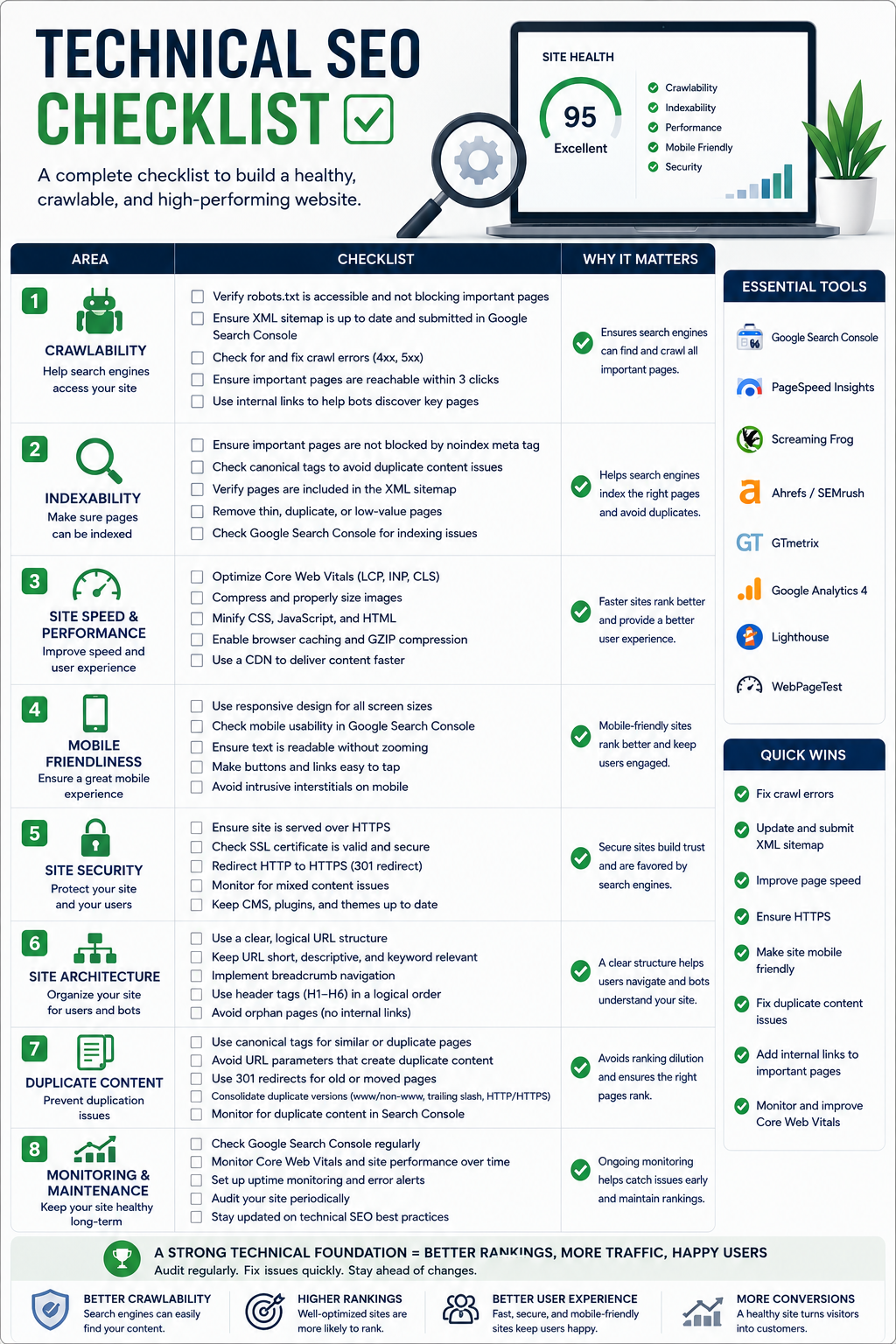
- Search-engine access and crawlability
- Indexability of important pages
- Canonical signals and duplicate URLs, including redirect chains and redirect loops a review may surface
- XML sitemap alignment
- Page performance
- Structured data implementation
- Mobile behavior
- Internal linking and page discovery
Technical findings should be prioritized based on which issues are most likely to affect search engine rankings and overall search engine optimization.
This is a framework for evaluating the site, not a recommendation that business owners troubleshoot every issue themselves.
The value comes from identifying what requires professional attention.
Why Technical Problems Can Become Business Problems
Technical SEO sounds like a search-engine concern.
Its effects can reach customers.
Slow pages can frustrate visitors. Poor mobile experiences can make contacting a business harder. Broken site architecture and broken links can interrupt navigation, hide valuable information, and make discovery harder. Check for broken links and fix internal 404 errors while maintaining noindex tags where necessary. Technical errors can keep important content from receiving the search visibility a business expected when it invested in creating that content.
Those experiences also affect the brand. Unresolved technical issues can reduce user trust when the site feels unreliable.
A company may have excellent services and strong expertise, but its website still needs to communicate that professionalism.
Technical quality helps support that experience behind the scenes.
More Content Should Follow a Stronger Technical Foundation
Content and technical SEO should support each other.
Businesses still need useful service pages, authoritative articles, clear messaging, and relevant information.
Google's Search Essentials continues to recommend helpful, reliable, people-first content while also establishing technical requirements for search eligibility.
The mistake is assuming content quantity can compensate for unresolved technical problems.
If the foundation has significant issues, the better investment may be identifying and correcting those problems before accelerating publishing.
That is especially important for businesses planning large SEO campaigns, new service sections, location content, or significant website expansion.
Professional Technical SEO From Masterly Tech
You do not need to become a technical SEO specialist to recognize that something may be wrong with your website.
Masterly Tech currently offers technical SEO within its broader SEO services. The company states that its technical SEO specialists work on website speed, user experience, search-engine performance, and secure setup such as using the https version as the main URL, which supports rankings and user security because HTTPS has been a Google ranking signal since 2014. Its broader services include on-page SEO, local SEO, keyword research, content writing, website design, and website optimization.
That combination allows technical issues to be considered within the larger website and search strategy rather than treated as isolated warnings.
Businesses can review Masterly Tech's current SEO and Technical SEO services for more information about its search engine optimization seo capabilities.
The exact issues, priorities, and corrective work required will depend on the website and should be determined after professional review. Choosing a preferred version of the domain and redirecting HTTP traffic to it helps support trust and consistent visibility across Google and other search engines.
Technical SEO Should Support Search Visibility and User Experience
A professional technical review can use Google Search Console and PageSpeed Insights to identify issues that may affect search performance and an improved user experience. Performance reviews may include metrics such as Cumulative Layout Shift, while mobile testing can help determine how important pages behave across each device type. Websites may use responsive design, dynamic serving, or other technical configurations, but the goal is to provide users and search engines with a reliable experience. When possible within the site's architecture, maintaining a single URL for content across devices can also simplify how users access and share a page. These technical details can become complex quickly, which is why businesses may benefit from having Masterly Tech identify and address issues rather than trying to diagnose them internally.
Frequently Asked Questions About a Technical SEO Checklist
What is a technical SEO checklist?
A technical SEO checklist is a framework for reviewing technical conditions on a website and its web pages, including technical elements that can affect how search engines access, understand, and index the site. It can cover crawlability, indexability, canonicalization, sitemaps, performance, structured data, mobile behavior, and internal links.
What is technical SEO?
Technical SEO focuses on the technical foundation that supports search-engine crawling, indexing, website performance, and related search visibility.
What is indexability?
Indexability refers to whether a page is technically eligible to be included in a search engine's index. Eligibility does not guarantee that Google will index the page.
Why should canonical tags be reviewed?
Canonical tags help communicate a preferred URL when duplicate or very similar pages exist. Conflicting or incorrect canonical signals can require technical investigation.
Does an XML sitemap guarantee Google will index a page?
No. Google explicitly states that submitting a sitemap is a hint and does not guarantee crawling or indexing, and that applies to every one page listed in it.
Does structured data guarantee rich results?
No. Google states that adding structured data does not guarantee that a page will appear as a rich result.
Should businesses check mobile SEO before publishing more content?
Yes. Mobile SEO and mobile usability should be considered part of the site's technical foundation, particularly when new content is being added at scale.
Can Masterly Tech review technical SEO issues?
Masterly Tech currently lists technical SEO as one of its core SEO services, along with website optimization and other search marketing services.
Request a Masterly Tech Technical SEO Review if the Checklist Identifies Unresolved Issues
A technical SEO checklist can reveal an important truth: your business may not need another fifty articles yet.
It may first need unresolved problems involving indexability, canonical tags, the XML sitemap, page speed, structured data, mobile SEO, crawlability, or internal links identified and addressed.
Masterly Tech provides technical SEO, website optimization, on-page SEO, content, local SEO, and related digital marketing services for businesses that want professional support rather than trying to diagnose complex website issues internally.
Call Masterly Tech at (888) 209-4055 or visit MasterlyTechGroup.com to request a technical SEO review if your checklist identifies unresolved issues.