
Speed to Lead: Why Response Time Decides Which Leads Convert
Speed to lead is how quickly a business responds after a person becomes a new lead: a form is filled, a phone call is missed, a chat is started, or an email arrives asking for contact. Lead response time refers to that first human or automated reply, measured from the moment the lead is created to the moment someone from the sales team actually reaches out. The two phrases are often used together. Speed to lead is the idea. Lead response time is the measure.
This article explains how to calculate lead response time, how to set a practical target, and how to tighten follow up so qualified leads do not wait. It does not repeat unverified industry benchmarks or a single conversion multiplier. Widely shared figures about the first five minutes or the first hour are often old or taken from secondary summaries. Use your own data.
The work usually involves your sales reps, your intake process, and the tools that route every lead to the person who should call. That is why speed to lead sits next to sales automation, CRM implementation, and marketing automation consulting. Those pages cover the systems. This page covers the response-time habit those systems should support.

What Speed to Lead and Lead Response Time Mean
In sales, a lead is a person or company that has shown interest, or that you are trying to start a conversation with. "Lead time" in operations (how long it takes to produce or deliver work) is a different idea. So is a three-week lead time on a supplier order. Speed to lead is not that.
Lead response time is usually counted in minutes or hours, not weeks. You determine the start time from the lead source: the form timestamp, the call time, the chat open, or the inbound email. You determine the end time when a person, or a clearly labeled system acting for a person, makes contact: a phone call, a text, an email, or a live chat reply. A notification that only sits in a queue is not a response.
Lead type matters. A person who just submitted a form is often urgent. A cold list you bought is not the same kind of lead. Some companies buy leads and then treat them as equally hot; that usually inflates the pipeline without improving conversion rates. Qualify the lead, but do not use qualification as a reason to wait hours before the first attempt.
How to Calculate Lead Response Time
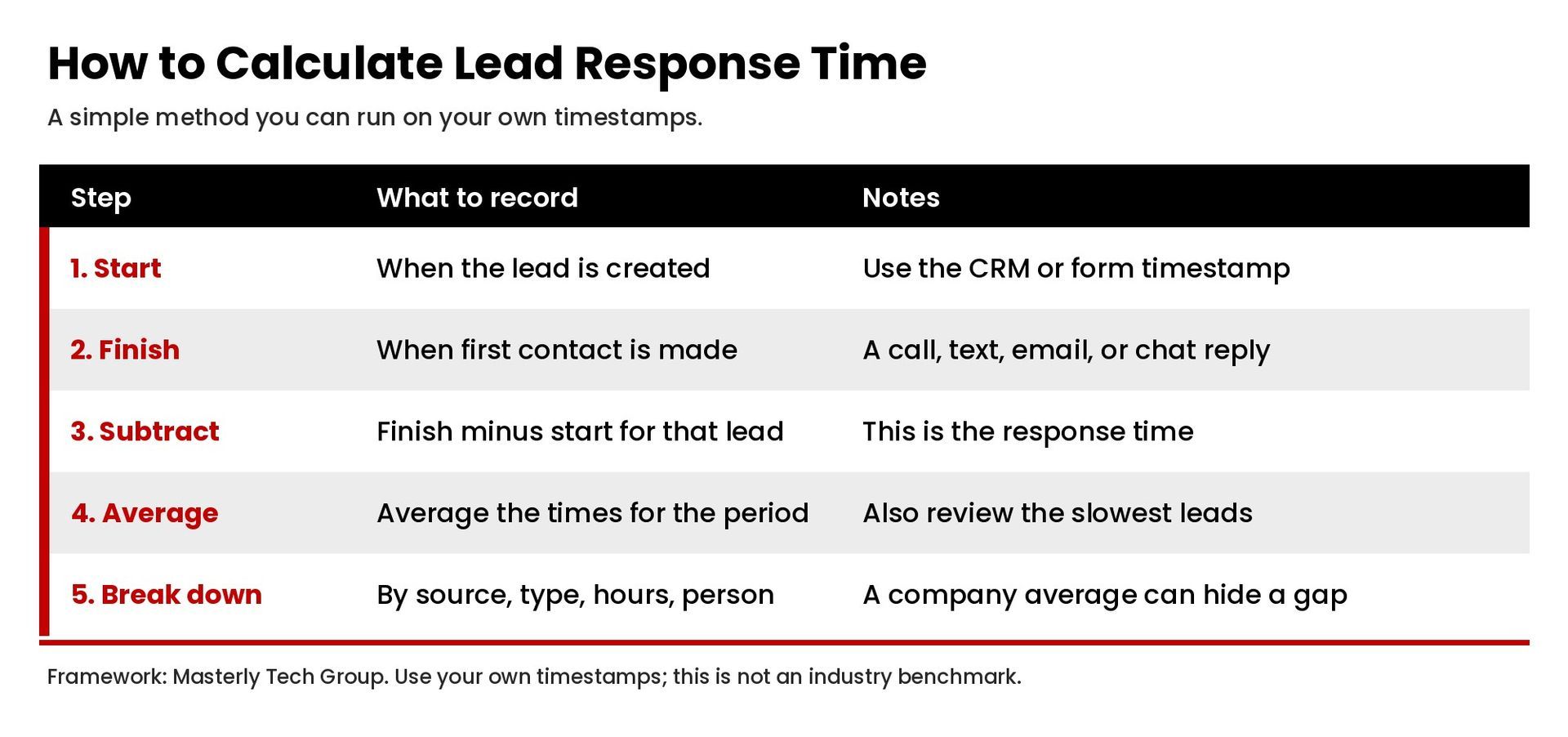
To calculate lead response time, pick a consistent definition and use it for every lead in the period you are reviewing.
- Record the timestamp when the lead is created or when the form is filled.
- Record the timestamp of the first genuine outreach (call, text, email, or chat).
- Subtract start from finish. That is the response time for that lead.
- Average the results for the period. That average response time, sometimes called average time to first contact, is the number the team should review.
You can also look at the median, the share of leads reached within five minutes, and the share reached in the first hour. Break the data by lead source, lead type, office hours, and the person who owns the lead. A company-wide average can hide a slow source or a single backlog.
Track the same fields in your CRM so employees and managers see the same numbers. If timestamps are missing, you cannot measure the process, and you cannot improve it.
Some vendors sell this as "speed to lead automation." Automation can route the lead, notify the assigned rep, and send a first acknowledgment. It cannot replace a real conversation when the person expects to talk to someone. Use tools to shorten the wait, not to hide an empty roster.
Why Response Time Matters
People who ask for contact often contact more than one business in the same sitting. If your sales reps are slow, the person may already be in a conversation with someone else. That is the practical importance of speed to lead. It is not a claim that faster always produces more deals in a fixed ratio. Conversion rates depend on the offer, the market, and whether the lead was qualified. Response time is one factor you can see and change.
A useful way to look at your own data is to compare lead response time with later outcomes: booked conversations, qualified opportunities, and closed revenue. If a source has a long average time and a weak close rate, that is a process issue worth fixing. If a source is fast and still does not convert, the problem may be the offer, the lead quality, or how reps qualify the call.
Do not borrow a published "21 times more likely" style figure unless you can read the primary study yourself and it still applies to your industry. Many articles repeat those numbers without that context. This article leaves them out on purpose.
How Quickly Should You Respond?
There is no official rule. Some teams use a five minute rule: try to return a new inbound lead within five minutes during business hours. Others aim for the first hour. The right target depends on your hours, your staffing, and the lead type. A form submitted at 2 p.m. on a Tuesday is different from one submitted at 11 p.m. on a Saturday.
Set a target you can keep, then staff to it. A five-minute goal with no one on the phone will not help. After hours, decide whether an on-call rep, a scheduled callback first thing the next morning, or an honest automated message is the practice you will actually follow. People usually prefer a clear wait to a promise no one keeps.
For paid or high-intent sources, treat the lead as urgent and assign the right rep quickly. For colder outreach, a same-day or next-day follow up may be enough, as long as the team is consistent. Write the standard down so sales reps are not guessing.
How to Tighten Follow Up
Speed is a process, not a personality trait. These steps help most service businesses, including law firms, studios, and professional firms:
- Route every lead automatically to an assigned rep or a round-robin queue. Do not leave new records sitting in a general inbox.
- Notify that person on a channel they will actually answer: phone alert, text, or a desk notification, not only an email they will read later.
- Create a short first-contact script so the first call or message can happen immediately. The goal is to start a conversation and, if needed, set a time to qualify the work, not to close the deal on the first ring.
- If the first call is missed, follow up again on a set schedule the same day. One attempt is not a process.
- Give managers a daily view of open leads and lead response time by rep, so a backup person can join in when someone is already on a call.
- Review slow lead sources. If a form is filled but the record arrives 20 minutes late because of a integration delay, fix the tool path.
After-hours coverage, backup coverage for lunch, and a clear handoff when the owner of the lead is out all matter as much as the first-hour policy. Companies that only measure weekday middays will not see the hours that break the average.
An Example of the Calculation
Here is a simple example, using illustrative times, not a benchmark. A form is filled at 10:02 a.m. The CRM creates the lead at 10:02. A person from the sales team places a phone call at 10:11. The lead response time for that lead is nine minutes. If ten similar leads that day have times of 4, 7, 9, 12, 15, 18, 20, 22, 25, and 40 minutes, the average time is 17.2 minutes. The average response time is useful, but the two slowest leads also deserve a look, because they pull the average up and may point to a lunch gap or a missed alert.
Managers should run this kind of example with their own timestamps every week. The focus should be the difference between sources and hours, not a single company-wide average that hides the problem. If one lead source is consistently slow, companies often find the form is filled correctly but the record arrives late, or the sales reps who own that source are already on the phone. The difference between a four-minute lead and a 40-minute lead is usually process, not effort.
What Managers Should Review
The sales team needs a short weekly view: lead response time by lead source, by lead type, by hours, and by person. Include the number of new leads, the share contacted in five minutes, the share contacted in the first hour, and the later conversion rates for those same leads. Do not treat conversion rates as the only grade; a slow team can still close a deal if the offer is strong, and a fast team can still lose a deal if the lead was not qualified.
Ask whether sales reps have time to respond. If the same two reps take every lead, they cannot answer the phone, finish a conversation, and also handle the next lead without a queue. Companies with more than a few employees should decide who covers overflow and who takes after-hours contact. The rest of the staff should know how to pass a lead, not leave it in a personal inbox.
Track open leads at the end of each day. A lead that is still untouched after business hours should have a next step on the calendar. Expect sales reps to log every attempt, including no-answers, so the follow up sequence is visible. Practice the first call until the opening is short and calm. Urgency belongs in the routing, not in a pressured pitch. When reps sound rushed, buyers notice, and the conversation is harder to finish.
Companies in different parts of the same industry will not have the same hours or the same mix of phone and form leads. That is why borrowed benchmarks are a weak guide. Use your data, in context, and compare this month to last month for the same lead sources. If the average response time improves and more conversations are booked, the process is working. If the time improves and nothing else moves, look at how reps qualify the lead and how they close, not only at speed.
The pipeline should show, for every lead, who owns the next follow up and when it is due. A deal does not start when the form is filled; it starts when someone makes contact and the other person is willing to continue. Companies that want more deals usually need both a faster first response and a cleaner later follow up. One without the other is a partial fix. Sales reps who win work tend to respond, then follow up again, then qualify, then close. The first step is still the one this article is about: do not let the new lead go cold.
Buyers and other interested people expect a reply while their request is still on their mind. Business owners should treat that expectation as part of the offer. A business that answers quickly, on the phone or in writing, is easier to trust than a business that waits until the next afternoon. That does not mean every lead will become a deal. It means fewer leads are lost only because no one called.
Employees who are not officially on the sales team still affect the process. A front-desk person who can answer a new-lead alert, or a coordinator who can schedule the first conversation, can keep lead response time down when sales reps are already in meetings. Give those employees a simple path and the same logging standard. Cold leads, leftover from an old list, should not crowd out a new inbound lead. Keep the two queues separate so the urgent work stays visible.
What This Is Not
A three-week lead time on a project is not speed to lead. "Led time" is not the usual phrase; the sales phrase is lead response time.
This article is also not a review of any one vendor. Some tools are marketed to real estate investors who want to find motivated sellers, buy leads, or calculate a maximum allowable offer, and some of those vendors advertise that you can cancel anytime. Those product claims are outside the scope here. The same response-time ideas still apply if you work with buyers or sellers in any industry: respond while the person is still interested, measure the wait, and put a human on the follow up.
Industry benchmarks can be a starting conversation, but your own timestamps are the data that should determine your standard. Success, in this context, is a process the team can run every day, not a slogan.
Frequently Asked Questions
What is the five minute rule for leads?
It is a working standard some teams use: try to make first contact within five minutes of a new inbound lead during business hours. It is a discipline, not a law, and this article does not treat it as a proven industry statistic.
How quickly should you respond to a lead?
As quickly as you can staff reliably. Many teams aim for minutes on high-intent inbound leads and a same-day follow up as a fallback. Write the standard, then measure whether you meet it.
How do you calculate speed to lead, or lead response time?
Subtract the lead-created timestamp from the first genuine outreach timestamp, then average those times for the period. Break the results by source, type, hours, and rep.
What does speed to lead automation do?
It can route the lead, alert the assigned rep, and send a first acknowledgment so the person is not left in silence. A person still has to take the conversation.
How much is speed to lead?
There is no price for the idea. Software that helps with routing and alerts has its own fees, which vary by vendor. Judge a tool by whether it shortens real response time, not by the label on the package.
Shorten the Wait
Speed to lead only improves when someone is available to respond and the process gets the new lead to that person without delay. Measure lead response time, set a target your sales team can keep, and fix the routing and follow up around it. Respond to the lead you have today, then follow up on the ones you missed, and review the response data with the people who make the calls. Companies that treat lead response as a weekly habit, not a one-time project, give sales reps a fair chance to win the next conversation. The difference shows up in the log: fewer untouched leads, a shorter wait, and a clearer next contact. If a lead arrives, someone should respond. That is the whole idea, applied with enough process that it happens on ordinary days, not only when the office is quiet.
Handle inbound leads quickly enough that the person is still available. That is the practical urgency, and it should stay in focus when the sales team is busy. Lead response time refers to the first outreach, but later lead response still matters: a second and third follow up can save a qualified lead that missed the first call. Add those later attempts to the same lead response time report, or keep a separate follow-up clock, so managers can track both. Companies that want a fuller picture should also track how often reps respond to a second attempt, how they qualify the lead, and how often a deal is created after that contact.
Sales reps need time on the phone and a clear list. More reps does not always fix lead response time if the routing is unclear. Give the right rep a fair load, then let other reps take overflow. Companies, including small businesses and larger companies in the same industry, should write this down. A business that responds in minutes and a business that waits until the next day are not running the same process, even if they use the same form. Buyers notice the difference. Employees who take the first call should know how to qualify, how to schedule, and when to pass the lead. Keep another example in your weekly review: pick five leads, read the timestamps, and walk through the response with the reps who made contact. The importance of that habit is simple. It keeps lead response time visible, keeps the follow up honest, and gives the company a way to improve without guessing. Other companies can copy the method: measure lead response time, review lead response by source, and ask reps to respond to every new qualified lead the same day at a minimum. A second follow up, and a third, should be part of the standard, not a favor. If the business can respond during posted hours, it should. If it cannot, say when the person can expect contact. Lead response time, lead response, and overall response time are related views of the same work. Track them together. Close the loop on each deal attempt, qualify with care, and keep the focus on the next lead as well as the current one. Sales reps, and the other reps who help them, will use a process they can see. Companies that keep that process in view usually have a shorter wait and a cleaner log, even when the day is full. Put lead response time on the weekly agenda. Compare lead response time this month with last month. If lead response time is rising, find the hours or the source that caused it. If lead response time is falling, look at whether qualified leads and later follow up improved too. The importance of that review is that lead response time stays a managed number. Companies can then decide who should respond, how they qualify, and how they respond when the first attempt fails. Other companies in your market will not share their private data; your own lead response, and the way your people respond, is the record you can actually use. Companies should respond once, respond again if needed, and qualify the next step in the same conversation when they can. If you want help connecting that habit to your CRM or automation, contact Masterly Tech Group or call (888) 209-4055 to talk through your setup.