Landing Page Optimization: Fixing the Friction That Stops Qualified Visitors From Converting
Your advertising is bringing the right people to your website, but too many leave without calling, completing the form, requesting a consultation, or taking the next step.
The problem may not be the traffic.
It may be what happens after the click.
Landing page optimization focuses on the experience between a visitor arriving and completing the action your business wants that person to take. A page can look professional and still create friction through unclear messaging, a weak call to action, a confusing form, poor message match, slow performance, or missing proof.
For a business paying to attract qualified visitors, those problems matter. You have already earned the click. The landing page needs to continue the conversation.
Masterly Tech provides website optimization, digital advertising, website design, and conversion tracking and analytics services. Rather than treating the landing page as an isolated design project, the goal is to consider how the page supports the visitor, the campaign, and the business outcome.
Landing Page Optimization Starts With the Moment After the Click
Consider a prospective customer searching for a specific professional service.
The person sees an ad that speaks directly to the problem and clicks.
Then the landing page opens.
The headline is broad. The service mentioned in the ad is difficult to find. The page introduces several unrelated offers. The visitor has to scroll through large blocks of content before finding a way to contact the business.
The advertisement may have done its job perfectly.
The landing page did not continue the experience.
This is where landing page optimization becomes important.
Google's current advertising guidance says people expect the page they reach after clicking an ad to be relevant to what the ad promised. Google recommends matching landing pages closely with ads and keywords and making the intended action easy to complete.
For a business, the lesson is simple. Getting the right person to the page is only part of the process.
Message Match Keeps the Visitor's Journey Consistent
Message match is the connection between what persuaded someone to click and what that person sees after arriving.
Suppose your ad focuses on a particular service.
The visitor clicks because that service addresses an immediate need. If the landing page opens with a general company message and forces the person to search for the service, the experience changes unexpectedly.
A stronger connection keeps the promise clear.
The language does not need to be identical word for word. The visitor should simply recognize that the page is relevant to what brought them there.
Google currently recommends keeping messaging consistent from an ad to its landing page and ensuring the page follows through on the offer or call to action presented in the ad.
That consistency can also protect the brand experience.
A prospect should not feel as though one company wrote the advertisement and another built the page.
Landing Page Conversion Depends on Clarity
A landing page has limited time to communicate its purpose.
The visitor should be able to understand what the business offers, why it is relevant, and what to do next without working through unnecessary distractions.
That makes clarity central to landing page conversion.
Consider two pages advertising the same service.
The first has several competing offers, multiple navigation paths, a vague headline, and several buttons asking visitors to do different things.
The second clearly identifies the service and problem, provides relevant information, supports its claims appropriately, and leads toward one logical next step.
The second page gives the visitor fewer decisions to make.
That does not mean every landing page should be short or stripped of useful information. Some services require more explanation before a prospect is comfortable taking action.
The right amount of content depends on what a qualified visitor needs to make an informed decision.
Your Call to Action Should Make the Next Step Clear
A call to action tells the visitor what can happen next.
That might be requesting a consultation, calling the business, submitting an inquiry, scheduling an appointment, or completing another action relevant to the offer.
Problems develop when the CTA is difficult to find or does not fit the visitor's expectations.
For example, an ad may invite someone to request a consultation, while the landing page prominently promotes newsletter registration instead.
Those actions represent different levels of intent.
Google recommends that landing pages mirror the call to action used in advertising and make it easy for visitors to perform the intended action.
The CTA should support the reason the person came to the page.
Form Optimization Should Reduce Unnecessary Friction
The prospect is interested.
The service appears relevant.
Then the visitor reaches the form.
A poorly designed form can create friction at the last moment.
Form optimization is not simply about making every form as short as possible. A business may need enough information to understand whether an inquiry is relevant and route it appropriately. Depending on the business, the conversion goal may be to complete a purchase or submit a lead form, so the questions should match that outcome.
The question is whether every requested field serves a purpose.
A complex professional service may reasonably need more context than a straightforward appointment request. The form should reflect the actual business process.
Mobile usability matters too.
Google's current guidance recommends minimizing the steps needed for mobile visitors to complete forms or transactions and making it easy for users to take action.
A form that works comfortably on a desktop computer may feel very different on a phone.
Social Proof Can Reduce Uncertainty
Qualified visitors may still hesitate.
They may understand the service but know very little about the company providing it.
Appropriate social proof can help provide context and credibility.
Depending on the business and what it can accurately substantiate, this might include genuine reviews, testimonials, relevant experience, professional credentials, case studies, or other trustworthy evidence. In practice, 45% of people won't purchase without reviews, which is why credible review proof can matter.
The proof should support the decision rather than distract from it.
Google's current landing-page guidance recommends providing useful, original information about the product or service and identifies genuine customer reviews as one example of information that may be useful to visitors.
For businesses, accuracy is essential.
A landing page should never invent testimonials, results, clients, awards, or statistics simply because those elements might make the page appear more persuasive.
Trust is more valuable than decoration.
Page Speed Can Create Friction Before the Message Is Seen
A carefully written landing page cannot persuade someone who struggles to load it.
That makes page speed part of the conversion experience.
Large images, unnecessary scripts, complex page elements, third-party tools, tracking tags, and other technical issues can contribute to slower performance.
The effect becomes especially important for visitors using mobile devices.
Google currently identifies landing-page speed as an important consideration for mobile advertising and recommends checking landing-page performance regularly. It also provides landing-page reporting within Google Ads to help advertisers evaluate the pages receiving campaign traffic.
The important point for business owners is not that every page must chase one perfect speed score.
The page needs to provide a usable experience on the web for the people the company is paying or working to attract.
Mobile Visitors Should Not Get a Second-Class Landing Page
A page can look excellent on a large office monitor and become difficult to use on a phone.
Text may be too small. Forms may become awkward. Buttons may be difficult to select. Important information may be pushed far down the page.
That can create unnecessary friction for qualified prospects.
Google recommends keeping mobile landing pages quick, making businesses easy to contact, and using simple navigation. It also advises advertisers to ensure that the mobile landing page matches the ad and gives visitors a clear path toward the intended action.
For a business, mobile optimization should therefore be part of the landing-page review rather than an afterthought.
The visitor's device should not determine whether the offer makes sense.
Conversion Tracking Helps Show What Happens After the Visit
A business cannot evaluate a landing page using appearance alone.
It needs appropriate measurement.
Testing should be systematic: start with research, form a hypothesis, make a change, test, measure, and learn.
Conversion tracking can provide insights into how visitors respond after interacting with a campaign or page, depending on the tracking systems and configuration in place.
Masterly Tech currently lists conversion tracking and analytics among its digital advertising services and states that it uses analytics to monitor campaign performance.
The specific conversion should reflect the main goal of the page or campaign.
A professional services firm may care about qualified consultation requests. Another company may prioritize phone calls, purchases, appointments, or other actions.
Tracking should support the decision the business needs to make.
It should not create a dashboard full of numbers with no connection to the company's goals.
A High Conversion Number Does Not Always Mean Better Leads
Conversion rate needs context.
Suppose a landing page receives 100 inquiries after a change.
That looks better than receiving 50.
But what if most of the additional inquiries have no connection to the services the company provides?
More conversions do not automatically mean better business outcomes.
This is why landing-page work should consider qualified conversion rather than simply trying to maximize every form submission.
The message, offer, CTA, form, and targeting all contribute to who decides to contact the company.
A page that attracts everyone may not be serving the business as well as a page that speaks clearly to the target audience, not just attract as many contacts as possible.
Landing Page Problems Can Affect Brand Perception
Landing-page friction is not only a performance problem.
It can become a brand problem.
A prospective client clicks a polished advertisement and reaches a page that loads slowly, looks unrelated, contains unclear information, or asks for an unreasonable amount of information.
That experience becomes part of the person's impression of the company.
For premium services in particular, the digital experience should support the professionalism the company wants to communicate.
The advertisement, landing page, contact process, and eventual conversation should feel connected.
A strong landing page does not need to pressure the visitor.
It needs to make the decision process easier.
Landing Page Optimization Should Focus on the Specific Page
Landing pages exist within a larger website, but they often have a specific purpose.
That distinction is important.
A full website optimization project may involve navigation, technical SEO, content architecture, site-wide speed, accessibility, and many other issues.
Landing page optimization is narrower.
The focus is the page receiving a specific group of visitors and whether that page supports the intended action.
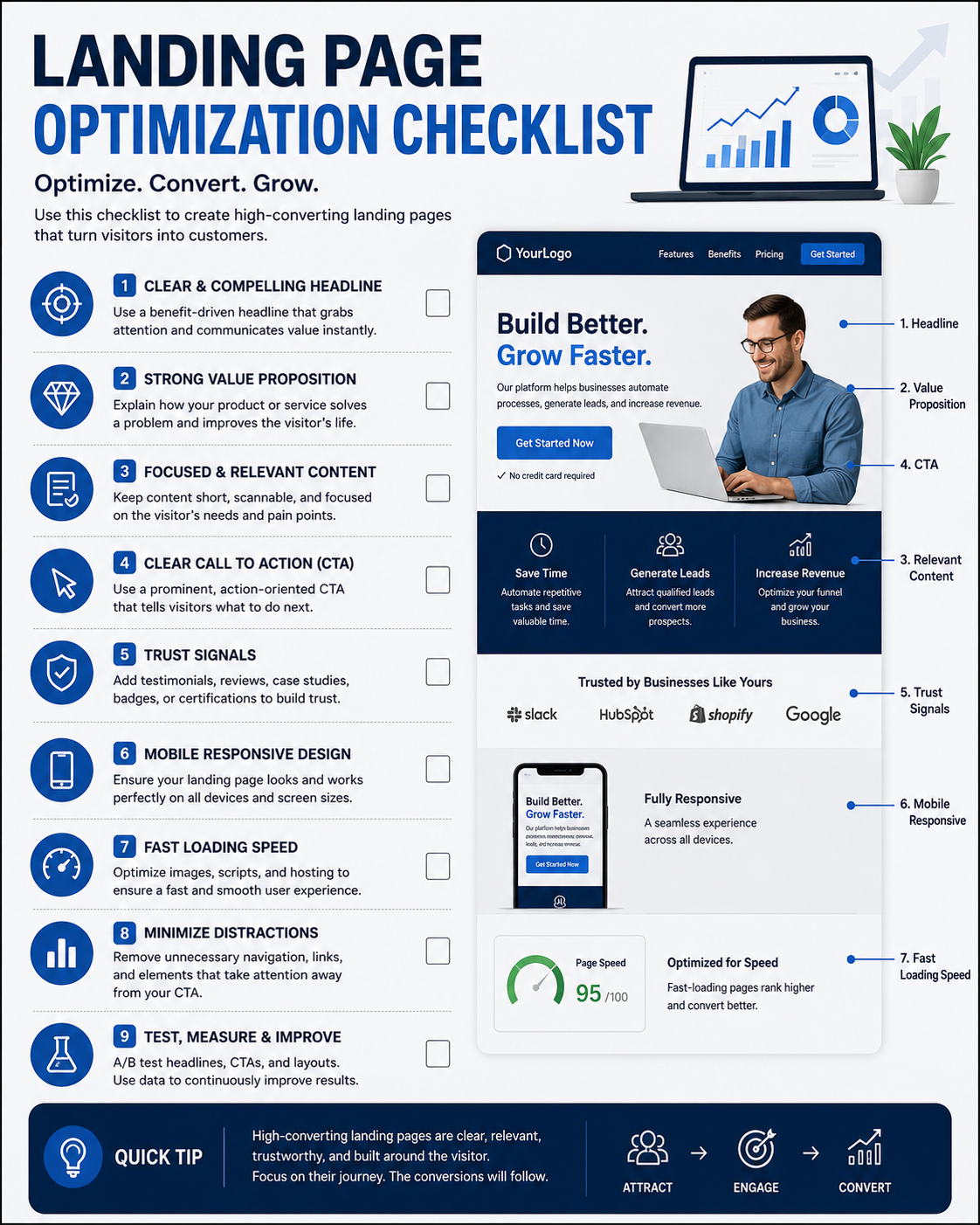
That can include reviewing:
- message match between the traffic source and page;
- offer and service clarity;
- CTA placement and the words used in the CTA;
- form experience;
- appropriate social proof;
- mobile usability;
- page speed; and
- conversion measurement.
These elements should be evaluated together because changing one part can affect another.
The objective is not to apply generic rules.
It is to examine where qualified visitors may be experiencing friction.
Masterly Tech Connects Landing Pages With the Larger Marketing System
A landing page does not create its own visitors; it depends on the wider mix of marketing materials and traffic sources that bring people there.
People may arrive through Google Ads, search engines, social campaigns, email, or another marketing source.
That makes the surrounding system important, because the direction from the ad or source should stay consistent when the visitor arrives.
Masterly Tech currently provides website optimization, custom website services, SEO, Google Ads and PPC management, and conversion tracking and analytics. Its published industry services also describe creating optimized landing pages that align with Google Ads and social advertising.
This broader perspective matters because a page should align with the broader ad strategy rather than be optimized in isolation from the traffic reaching it.
If the advertisement promises one thing while the landing page communicates another, changing the button color will not solve the core problem.
If qualified prospects want to contact the company but the mobile form creates friction, adding more traffic may simply send more people into the same problem.
The purpose of professional optimization is to identify the obstacles that matter and help encourage people to act by removing the friction that matters and connecting the page more clearly with the intended business action.
Connect the Landing Page to the Rest of the Customer Journey
A landing page does not exist on its own. Marketers and organizations may send visitors to it from a blog post, email campaigns, paid media, an app, a community, or another promotion, making message consistency critical to the visitor's response. Someone who clicks after reading an article may show different behavior from a person ready to jump from an ad into a contact form, so the key is understanding the intent behind each visit rather than suggesting that one page structure works for everyone.
Masterly Tech can help businesses explore how each traffic source may play a role in the conversion journey, whether the company is selling a service, a course, or another offer. That can include reviewing available answers from performance data, considering appropriate experiments, and helping the business manage the page around a clear idea of what qualified visitors need.
In a digital world where prospects may watch content, research companies, compare options, or move between devices before contacting a business, the goal is to adopt a landing-page strategy that supports the right audience, including women and other relevant customer groups, without making unsupported assumptions about them. The page should also connect appropriately with the company's advertising account and broader marketing system so the business can evaluate performance instead of relying on guesswork.
Keep the Landing Page Aligned With the Campaign
A strong ad strategy should not end when a prospective customer clicks. The web page that follows needs to continue the same message, offer, and professional experience presented in the advertisement and related marketing materials. When those elements feel disconnected, qualified visitors may hesitate because they are no longer certain they reached the right place.
Masterly Tech can review the relationship between campaign messaging and landing-page content to identify friction that may interfere with conversion. The goal is a consistent experience that moves from the original marketing message to a clear next step without forcing the visitor to search for the information that brought them to the page.
Frequently Asked Questions About Landing Page Optimization
What is landing page optimization?
Landing page optimization is the process of improving a specific web page so qualified visitors can more clearly understand the offer, support the campaign or offer’s goal, and complete the intended action.
What affects landing page conversion?
Landing page conversion can be influenced by factors including message clarity, relevance, the offer, call to action, forms, mobile usability, social proof, page speed, and the quality of traffic reaching the page, all of which shape conversion rates.
What is message match?
Message match is the alignment between what a visitor saw before clicking and what appears on the landing page. The page should clearly follow through on the message, offer, or intention set before the click.
Why is the call to action important?
A call to action gives the visitor a clear next step. It should be clear and direct, fit the visitor's intent, and match the offer presented on the page.
What is form optimization?
Form optimization examines whether a form collects the information the business needs without creating unnecessary friction for qualified prospects.
Does page speed affect a landing page?
Yes. Slow performance can make a landing page harder to use, particularly for mobile visitors. Google recommends improving landing-page speed and monitoring landing-page performance.
Should a landing page include social proof?
Relevant and truthful social proof can influence how visitors evaluate a company. Accurate reviews, testimonials, credentials, results, and other claims help build consumer trust and should be supportable.
What is conversion tracking?
Conversion tracking measures defined actions related to marketing activity. The specific actions tracked should reflect the goals of the business and be configured appropriately.
Can Masterly Tech optimize landing pages?
Masterly Tech currently provides website optimization, website design, Google Ads and PPC services, and conversion tracking and analytics. Its published services also describe optimized landing pages aligned with digital advertising campaigns.
Request a Landing Page Review Focused on Qualified Conversion and Measurable Next Steps
Your business has already done the work required to attract the visitor.
Do not let unnecessary landing-page friction interrupt the next step.
Masterly Tech can review how your page's message, offer, call to action, form experience, proof, page speed, mobile experience, and measurement work together to transform the page from a source of friction into a clearer conversion path. The focus of landing page optimization should not simply be generating more button clicks or form submissions. It should be helping qualified visitors engage and move toward meaningful actions your business can measure.
If your campaigns are producing traffic but your landing pages are not producing enough qualified opportunities, the page deserves a closer look.
Call Masterly Tech at (888) 209-4055 or visit https://www.masterlytechgroup.com/ to request a landing page review focused on qualified conversion and measurable next steps.