Local SEO Audit: What to Review Before Spending More on Local Search
A local SEO audit is a comprehensive review of a business’s website and local search presence that uncovers the issues already limiting visibility, accuracy, rankings, and the local customer journey before more money goes into SEO, content, ads, or website updates.
A local business may have location pages, but they may not clearly match the areas the business actually serves. The Google Business Profile may contain incomplete information. Important business details may appear differently across directories. Reviews may be growing, but the company may not have a clear process for monitoring them. Internal links may fail to support important local pages. Technical SEO issues or missing structured data may also make it harder for search engines to understand and rank the site locally.
When these pieces do not align, publishing more content or spending more on advertising may add activity without solving the underlying issue. For local business owners and marketers trying to improve local search visibility, an audit shows where performance is being held back across Business Profile accuracy, location page quality, citation consistency, reviews, internal linking, technical SEO, structured data, and the overall path a local customer takes from search to contact.
Google states that local results are primarily influenced by relevance, distance, and prominence, and that complete, accurate Business Profile information can help Google better understand and match a business to relevant local searches.
Masterly Tech helps businesses evaluate the website, local search presence, and supporting digital structure that influence how potential customers find and engage with a company online.
A Local SEO Audit Should Start With Business Reality
The first step in evaluating local visibility is understanding the business itself.
Where does the company actually operate?
Which locations have real staff or customer-facing operations?
Which services are offered in each market?
Which locations matter most commercially?
Which searches should lead someone to a specific location or service page?
Those questions should shape the local search audit.
A business with one physical office needs a different structure from a company with several offices. A service-area business may require another approach. A company with locations across several cities needs to make sure each important market is represented accurately without creating unnecessary or duplicate pages.
The audit should begin with the operation, not a generic checklist.
Google Business Profile Alignment Matters
For many local businesses, the Google Business Profile is one of the most visible parts of local search.
Google explains that keeping Business Profile information complete and accurate can improve the likelihood that a business appears for relevant local searches. Google also recommends maintaining key information such as address, hours, business category, and other business details.
That means a local SEO audit should review whether the profile accurately reflects the business.
Business Information Should Match Reality
Important information may include:
- Business name
- Address, where applicable
- Phone number
- Business hours
- Primary and secondary categories
- Website link
- Services or other relevant profile details, including a complete business description that uses relevant keywords naturally
- high quality photos as part of a complete profile review
The goal is consistency and accuracy. Even minor variations in NAP can harm local rankings.
Google also notes that business categories help describe what a company does and can influence local ranking.
An audit should therefore look beyond whether a profile simply exists. Some Google Business Profile audits use 102+ automated checks to assess completeness and consistency.
It should ask whether the profile gives Google and potential customers a clear picture of the business.
Local Rankings Depend on More Than the Business Profile
A Google Business Profile is important, but it does not operate in isolation.
Google states that local results are mainly based on relevance, distance, and prominence. It also notes that prominence can be influenced by factors such as links and reviews.
That means local rankings can reflect signals from across the broader web presence.
The company's website matters.
Its location information matters.
Reviews matter.
Links matter.
Public business information found elsewhere can matter.
Google explains that Business Profile information may be compiled from owner-provided details, publicly available web content, licensed third-party data, and user contributions.
A strong audit therefore looks for alignment across these sources rather than focusing on one profile in isolation. It should also include competitor analysis that evaluates the strategies of top local competitors affecting local search rankings.
Location Pages Should Serve Real Search Intent
Location pages are often important for businesses serving more than one geographic market.
But simply creating a page for every city name does not automatically create a useful local SEO strategy.
A strong location page should help a potential customer understand whether the business serves that location and what is available there.
It should also match user intent by answering what that visitor actually needs to know before taking the next step.
The page should have a clear purpose.
For example, a business with several offices may need separate pages because each location has a distinct address, hours, team, or service availability.
A service company may instead need pages that explain meaningful service coverage in important markets.
The audit should ask whether each location page provides real value rather than existing only to repeat keywords.
Avoid Thin Location Pages
A weak location page may change only the city name while repeating the same content used everywhere else, which can also lead to duplicate content issues.
That can create a poor user experience.
A stronger page reflects real differences when those differences exist, such as:
- Specific services available in that area
- Local contact information
- Location-specific calls to action
- Relevant service-area information
- Useful directions or geographic context
- Links to related services
Unique local details and related internal links also help build topical authority.
For businesses planning a website redesign, local search requirements should be considered before the new site structure is finalized.
Masterly Tech currently offers website design and development services built around usability, SEO, and business goals.
Local Citations Should Support Consistent Business Information
Local citations generally refer to online mentions of a business's identifying information across local business listings, relevant directories, platforms, and other websites.
The concern is not simply having as many citations as possible.
The more important issue is whether business information is accurate and consistent enough to avoid confusion.
Google states that it can use information gathered from websites, users, third parties, and other public sources when building Business Profile and local search information.
An audit should therefore look for significant mismatches such as:
Run the business name through the top 50 local directories to check citation accuracy.
An old address.
An outdated phone number.
A former business name.
Incorrect hours.
Duplicate business listings.
A closed location that still appears active.
If you cannot edit a directory directly, submit change requests.
These inconsistencies can also confuse customers, which makes citation accuracy a brand issue as well as a search issue.
Reviews Should Be Evaluated as Part of Local Search
Reviews influence how potential customers evaluate a local business before they ever visit the website, and review management plays a significant role in local SEO, not just reputation.
Google also states that more reviews and positive ratings can help local ranking, and it encourages businesses to respond to reviews. 71% of consumers use Google for local business reviews.
A local SEO audit should therefore review the broader review environment.
That may include:
- Whether customers are leaving reviews
- Whether reviews appear on the correct profiles
- Whether the business responds appropriately
- Whether outdated or duplicate listings are splitting reviews
- Whether rating trends indicate a broader customer-experience issue
Responding to negative reviews and positive reviews within 24-48 hours is a recommended part of review management.
Google displays review scores, total review counts, and individual reviews in Search and Maps.
That makes reviews both a visibility factor and a reputation factor.
The audit should not treat them as a separate marketing channel.
They are part of how the business appears in local search, and requesting reviews immediately after service completion is often the most effective time to generate more customers and strengthen local search visibility.
Internal Links Can Strengthen Important Local Pages
Location pages should not sit disconnected from the rest of the website.
Internal links help visitors and search engines understand how pages relate to each other. Use descriptive anchor text to connect relevant content across service and location pages.
For example, a main service page may link to relevant location pages.
A location page may link to the specific services available there.
The main navigation or location directory may help users move between markets.
An audit should identify important local pages that have few meaningful internal links.
This is especially important when the business has a large website and several geographic markets.
A local page that is difficult to reach from the rest of the website may also be harder for users to discover.
Technical Problems Can Limit Local Visibility
Local SEO still depends on a technically functional website.
An excellent location page cannot perform well if it cannot be crawled or indexed properly.
A local SEO checklist should therefore include a basic technical website audit.
A typical website audit can include over 310 SEO checkpoints, even when a local audit focuses only on issues affecting key local pages.
Important issues may include:
- Pages blocked from indexing
- Incorrect canonical tags
- Broken links within the internal linking structure
- Redirect problems
- Duplicate URLs
- Missing or incorrect sitemap entries
- Poor mobile usability on mobile devices
- Render-blocking resources that slow loading
- Slow or unstable page experiences that hurt Core Web Vitals
- Important location pages that Google has not indexed
Mobile optimization is critical for local SEO rankings and crucial for local search rankings.
On-page SEO analysis should also inspect title tags, meta descriptions, and local schema markup.
Masterly Tech's current technical SEO content emphasizes that pages must be discoverable and accessible before they have a meaningful opportunity to compete in search.
The goal of a local audit is not to become a full technical SEO audit.
It is to identify technical problems that directly affect important local pages.
Local Business Structured Data Can Support Clearer Location Information
For eligible businesses, structured data can provide additional machine-readable information about a local business.
Google's Search Central documentation identifies LocalBusiness structured data as a way to provide information such as a physical location and opening hours on relevant business information pages.
Structured data should accurately represent what is already visible on the page.
It is not a substitute for clear location content, correct contact information, or a complete Business Profile.
During an audit, it may be appropriate to review whether location-related markup is present, accurate, and consistent with the visible website.
A Local Search Audit Should Review the Customer Journey
Local SEO is not successful just because a listing appears.
The visitor still needs to take the next step.
Imagine someone searches for a nearby service provider.
They find the company.
They click through to the website.
Then they encounter an outdated phone number, confusing navigation, or a location page with no clear contact option.
The search visibility worked.
The customer journey did not.
This is where local SEO and Website Design begin to overlap.
A well-designed local website should make it easy for someone to understand:
Where the business operates.
What it offers.
How to contact the right location.
What action to take next.
Masterly Tech's current website design services emphasize user-friendly, SEO-aware website structures designed around business objectives.
A Practical Local SEO Audit Framework
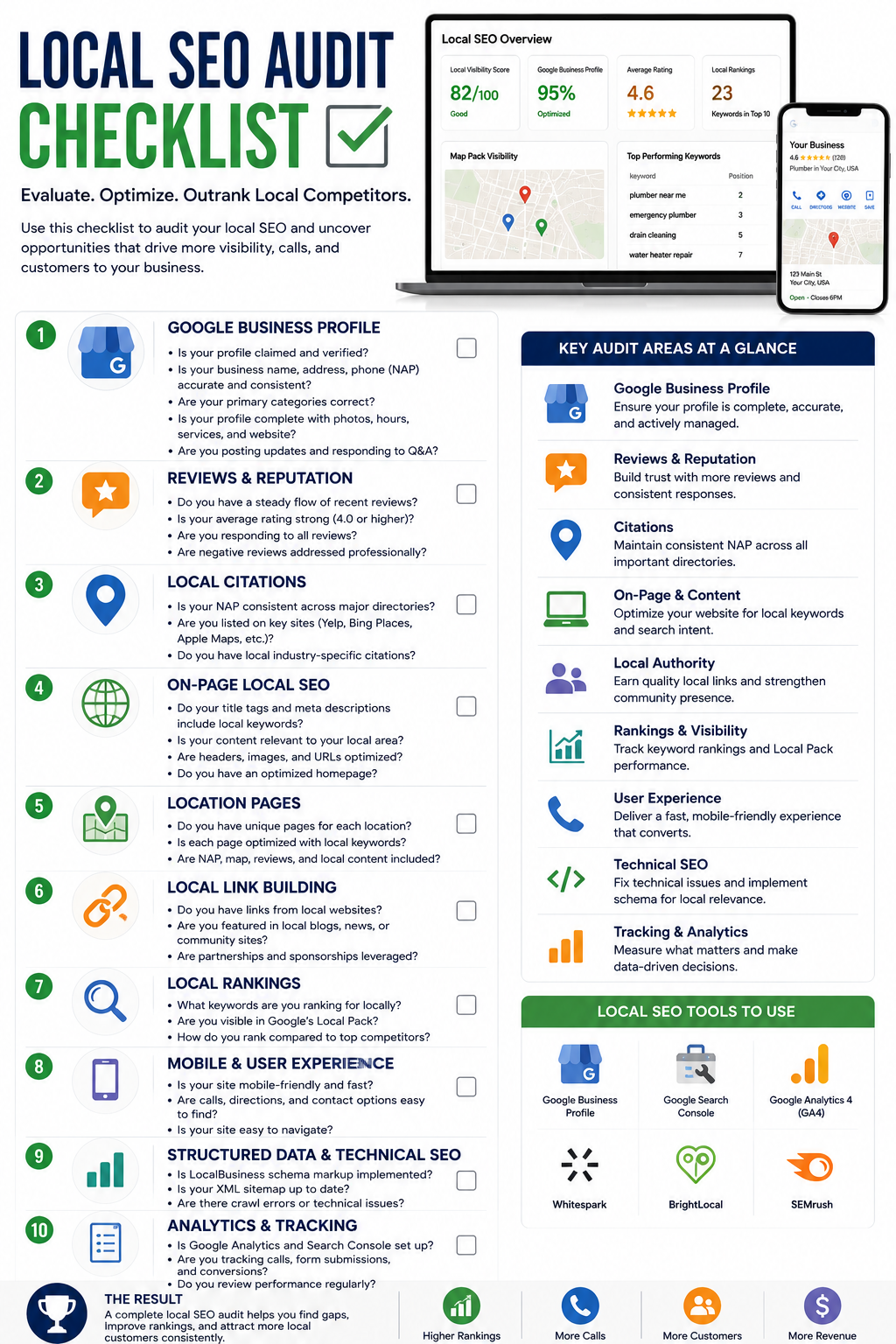
A useful comprehensive local SEO audit can be organized around six areas.
1. Google Business Profile
Review whether the profile is complete, accurate, verified, categorized correctly, and aligned with the business; this review can also function as a gbp audit focused on completeness, categories, reviews, photos, and other profile signals.
2. Website Location Structure
Evaluate whether important location pages exist, provide useful content, and match actual operating locations or meaningful service areas.
3. Local Citations
Review important external business listings for outdated or conflicting information, and handle building citations by correcting and standardizing details across relevant directories.
4. Reviews and Reputation
Evaluate review presence, profile distribution, response activity, and obvious reputation issues.
5. Internal and Technical Website Signals
Check whether important local pages are accessible, linked appropriately, crawlable, and indexable, and flag optimization gaps in crawlability, indexing, and on-page signals that can hold those pages back.
6. Local Conversion Paths
Review whether visitors who arrive through local search can easily call, contact, schedule, visit, or complete the next important action.
This framework keeps the local SEO audit focused on the entire local search experience rather than one ranking factor.
Do Not Spend More Before Fixing the Foundation
A business may believe it needs more content because rankings are weak.
That may be true.
But more content will not fix an incorrect Business Profile.
More advertising will not fix a broken location page.
More citations will not fix an inconsistent address.
More reviews will not fix an unclear website experience.
A local search audit helps determine what is actually limiting performance and builds a strong foundation before more budget is spent.
That gives the business a better basis for deciding whether the next investment should involve content, website improvements, profile work, technical corrections, reputation management, advertising, or another priority.
Why Local SEO Audits Matter Before a Website Redesign
Website redesigns can create opportunities to improve local visibility.
They can also remove useful local signals if location strategy is ignored.
Important local URLs may change.
Internal links may disappear.
Location pages may be consolidated incorrectly.
Contact information may be reorganized.
Calls to action may move.
A redesign should therefore consider local search requirements before development is complete.
For businesses that need a new website or major site improvement, Masterly Tech provides Website Design and Development focused on user experience, SEO, and business goals.
Recommended internal link: Link the phrase Website Design and Development above to Masterly Tech's primary website design service page. This supports the user's stated commercial intent while avoiding another page targeting the same local SEO audit keyword.
Masterly Tech Helps Connect Local Search With the Website
Masterly Tech works across website design, SEO, local SEO, technical SEO, and digital marketing, with a focus on local search and online visibility. Its current public site specifically lists Google Business Profile optimization as part of its local SEO offering and provides website design and optimization services alongside it.
That broader view matters. Complete local SEO means connecting the Business Profile, website, citations, reviews, and technical signals.
A local search problem may begin in the Business Profile and end on the website.
A location page may rank but fail to convert.
A redesigned website may look better but lose important local structure.
A technical issue may prevent a strong page from being indexed.
Professional review helps connect these issues instead of treating each one separately.
The exact audit, implementation, and website-design scope should be confirmed for each engagement.
Frequently Asked Questions About a Local SEO Audit
What is a local SEO audit?
A local SEO audit is a review of the website and local search presence to identify issues that may affect visibility, accuracy, rankings, and local customer journeys. A complete local SEO audit looks at both the site and the broader local presence, and it should usually be repeated every 6 to 12 months.
What does a local search audit review?
A local search audit may review Google Business Profile information, location pages, local citations, reviews, internal links, technical issues, and local conversion paths. On the website side, it may also check how pages align with your target keywords and use Google Search Console data to spot indexing issues, search visibility trends, and missed traffic opportunities.
Why is Google Business Profile important for local SEO?
Google uses Business Profile information to help match businesses with relevant local searches. Complete and accurate information can support stronger local visibility.
What factors influence local rankings?
Google says local results are mainly based on relevance, distance, and prominence. Those factors influence both local pack visibility and broader local search results. Reviews, links, and complete business information can also contribute to local visibility.
Are location pages important for local SEO?
Location pages can help when they represent real locations or meaningful service areas and give visitors useful, specific information about the business in that market.
What are local citations?
Local citations are online mentions or listings of business information. Important listings should accurately reflect current business details.
Do reviews affect local rankings?
Google states that more reviews and positive ratings can help a business's local ranking, while reviews also influence how customers evaluate the business.
Is a local SEO checklist enough to improve rankings?
A local SEO checklist can help identify common areas to review, and many businesses start there, but the most useful audit should reflect the actual business, locations, website, and customer journey. A proper local seo audit tool gives broader insight across profiles, listings, and website signals than a simple checklist, while an audit tool helps diagnose issues in a more structured way. Manual review can also be time consuming for local business owners.
Should local SEO be reviewed before a website redesign?
Yes. Local search requirements should be considered before redesigning important URLs, navigation, location pages, contact information, and conversion paths.
Request a Local SEO Review From Masterly Tech Group
If your business is spending more on local content, advertising, or website improvements but still struggling with local rankings, the first step may be understanding what is already limiting local search visibility in the search results.
A professional local SEO audit can help uncover problems with your Google Business Profile, location pages, local citations, reviews, internal linking, technical website setup, and local customer journey, including issues that show up in google maps and Google Search.
Masterly Tech can help connect those findings to the website and broader digital strategy so the next investment is based on what the business actually needs.
It also helps identify issues that can have a negative impact on local presence and overall online visibility.
Call Masterly Tech at (888) 209-4055 or visit masterlytechgroup.com to request a local SEO review from Masterly Tech Group.