
SEO Reporting: What Business Owners Should Measure Beyond Rankings
Your dental SEO report says your practice moved up for several keywords.
That sounds encouraging. But did more prospective patients find your practice? Did they reach your implant, cosmetic dentistry, emergency dental, or other important service pages? Did they take meaningful actions after arriving?
If your SEO reporting cannot help answer those questions, rankings alone are not giving you enough information to make informed marketing decisions.
Dental practices need reporting that puts search activity into business context. That means looking beyond a list of keyword positions and examining organic visibility, traffic, important landing pages, conversions, and the search trends that can influence where your marketing attention goes next.
Masterly Tech provides SEO and digital marketing services for businesses that want search strategy connected to measurable business objectives. Instead of leaving practice owners with disconnected numbers, reporting should help them understand what is happening and what deserves attention.
A Dental SEO Report Should Answer Business Questions
A practice owner should not need to become an SEO analyst to understand a monthly report.
An SEO report should help answer questions such as:
- Are prospective patients finding our website through organic search?
- Which dental services are gaining search visibility?
- Which pages are receiving organic traffic?
- Are important keywords gaining or losing visibility?
- Are visitors taking meaningful actions after reaching the website?
- Which pages or search trends deserve attention next?
Those questions put the data into context.
Consider two dental practices.
Practice A receives a spreadsheet showing that 40 keywords moved up and 18 moved down.
Practice B receives reporting that explains which important service pages gained visibility, where organic clicks changed, which relevant searches are moving, and whether website visitors are taking defined actions.
Both practices received data.
Only one received information that can more easily support a business decision.
SEO Reporting Should Measure More Than Dental Keyword Rankings
Rankings matter because they provide information about search visibility.
They should not stand alone.
Google itself cautions against placing too much emphasis on average position. Its current Search Console guidance recommends watching position changes but generally focusing more on trends in impressions and clicks than on position alone.
That distinction is important for dental practices.
A practice could improve for several low-value searches without seeing a meaningful change in qualified website activity. Another practice might see modest keyword movement while an important service page gains more impressions and clicks from relevant searches.
The second change may deserve far more attention.
Good reporting helps distinguish between movement that looks impressive in a spreadsheet and movement that matters to the practice.
Organic Traffic Reporting With Google Analytics Should Show Where Potential Patients Arrive
Total organic traffic provides part of the picture.
The next question is where those visitors went.
Google Analytics can track organic traffic and user behavior at the page level, helping a dental practice see where potential patients arrive and what they do on those pages.
Organic traffic reporting should help a dental practice understand which sections of its website are attracting people through unpaid search.
Imagine organic traffic rises during a quarter.
The increase could be coming from a dental implant service page that supports an important area of the practice. It could come from several educational articles. Or most of the increase could come from one page that has little connection to the practice's current growth priorities.
The total may look the same on an executive summary.
The business meaning is different.
That is why page-level reporting matters.
Landing Page Performance Connects Search Visibility With Dental Services
For a dental practice, some website pages have a particularly important job.
They introduce potential patients to the services the practice provides.
A person searching for information about dental implants should ideally reach a page relevant to that need. Someone looking for an emergency dentist has a different intent. A prospective patient researching cosmetic treatment may require different information again.
Landing page performance helps the practice understand what happens at the page level, including which are the popular pages attracting the most search interest for key services.
Google Search Console currently allows performance information to be grouped by page. Search Console reports metrics including impressions, clicks, CTR, and average position, which can help identify pages experiencing meaningful changes in Google Search and support content strategy decisions for important dental services.
For dental SEO reporting, that creates useful questions:
Is an important service page receiving more search exposure?
Are clicks increasing along with impressions?
Did a page lose visibility?
Which search queries are connected to that page?
The numbers become more valuable when they are tied to specific services and pages, and to the intended audience for each service page.
Keyword Movement Needs Context
A list of ranking changes can look precise while still leaving the practice owner with unanswered questions.
Keyword movement needs context.
Suppose a dental practice moves from position 62 to 37 for one term and from position 9 to 5 for another.
Both rankings improved.
They do not necessarily have the same significance.
The relevance of the search matters, and so does its search volume. So does the page appearing for it, the number of impressions, whether people click, and how closely the search connects to the practice's services.
Google Search Console provides query-level information that can show the searches bringing visibility and traffic to a website. It also lets users examine which pages Google showed for a particular query, and keyword research helps interpret which searches are worth tracking closely.
This helps reporting move beyond "we gained five positions."
The better question is whether the practice is becoming more visible in the searches that support its goals, with keyword tracking focused on following those terms over time.
Search Console Helps Explain What Happens Before Someone Visits
Search Console provides a valuable view of how a website performs in Google Search.
Its Performance report currently includes:
- Impressions: how often the site or page appeared in eligible Google Search results;
- Clicks: how often someone clicked from Google to the website;
- CTR: clicks divided by impressions; and
- Average position: the average position of the topmost result from the site or page under the applicable reporting view.
The data can also be grouped using dimensions such as queries and pages.
For a dental practice, these measurements can help explain what happens before a potential patient reaches the website.
A service page might receive more impressions but not a similar increase in clicks.
Another page may experience a sudden decline.
A group of relevant non-branded searches may begin gaining visibility.
Those movements deserve interpretation, not just screenshots. In some cases, technical issues can affect what appears in Search Console by hindering search engine indexing, so a visibility change should be diagnosed before it is treated as a ranking shift alone.
Search Console Data Has Technical SEO Limits
Reporting should also respect the limits of the underlying data.
For example, Google says some Search Console queries are omitted to protect user privacy, while its newest Performance data can sometimes be preliminary and subject to change.
A professional report should not pretend the data tells us more than it actually does.
That is especially important when a dental practice is making marketing decisions based on the results.
Conversions Help Connect Traffic With Patient Intent
Getting someone to the website is important.
What happens next matters too.
For a dental practice, meaningful conversions may include actions defined by the practice and its measurement setup, such as a consultation request, appointment request, contact form submission, booked appointments, treatment inquiries, or another trackable action tied to sales.
Conversion information can add important context to SEO performance when reliable tracking is in place.
Imagine one service page receives 5,000 visits while another receives 800.
Traffic alone makes the first page look more important.
But if the second page consistently attracts people who take meaningful actions related to a high-priority dental service, brings in better traffic quality, and leads to higher conversion rates, leadership may view its role differently.
This is why traffic should not automatically be treated as the final measure of success.
The practice needs to understand whether the right people are reaching the right pages and whether those visits support business goals, including follow-up through channels like email marketing.
An Executive Dashboard Should Make Dental SEO Key Performance Indicators Easier to Understand
A dental practice owner and an SEO specialist do not need the same level of detail.
The SEO team may need query data, individual URL trends, technical information, and detailed comparisons.
Leadership needs the larger picture.
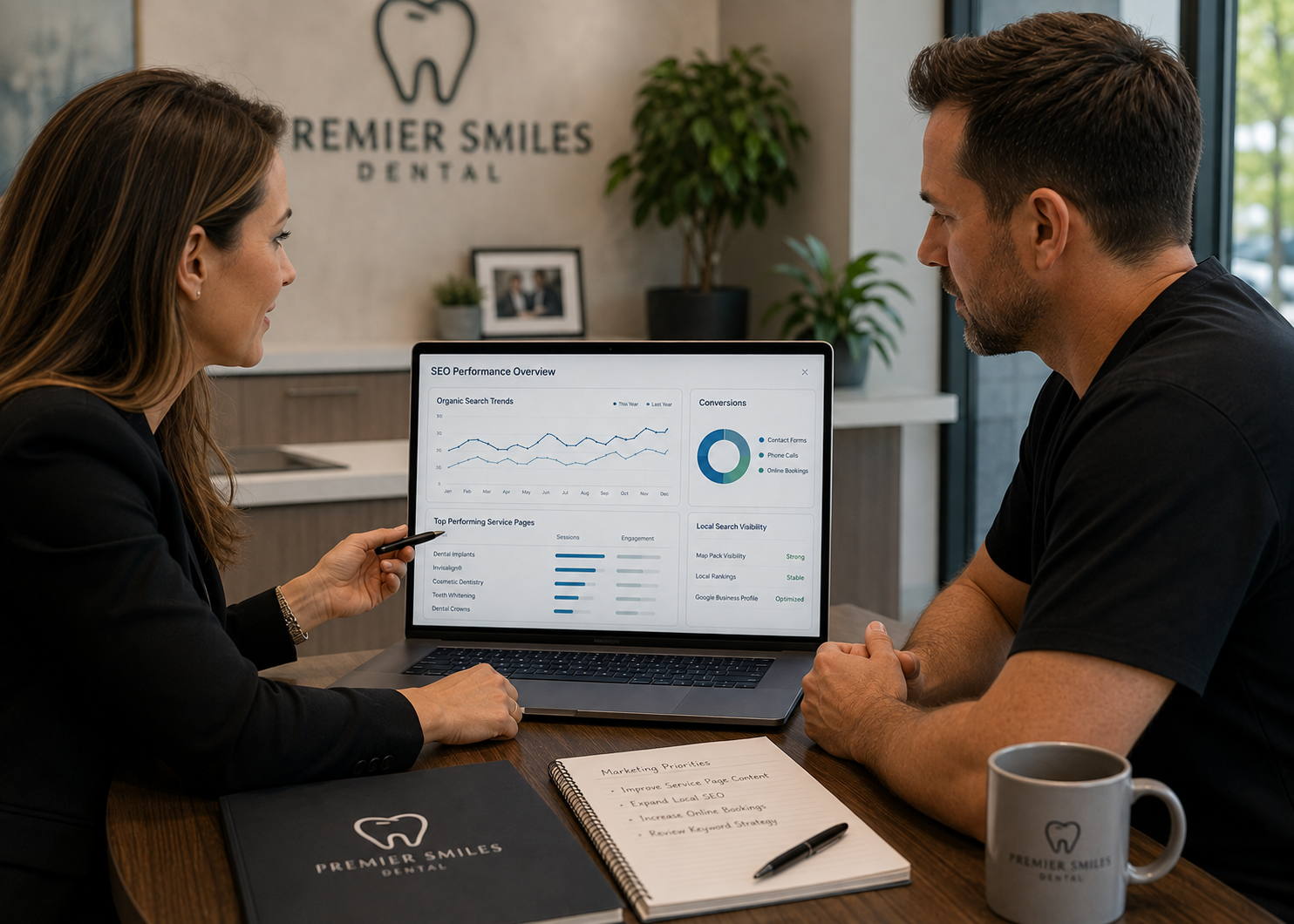
A well-designed executive dashboard or one of your custom dashboards can bring key performance indicators together so owners can quickly understand what is happening.
That may include SEO data pulled from multiple data sources into a single source view of organic visibility trends, important landing pages, organic traffic, meaningful keyword changes, and conversions when reliable tracking is available.
The goal is not to hide detail.
It is to organize it.
The right tools should allow customizable automated reporting with real-time analytics so leadership can access a clear overview without manual compilation.
A practice owner should be able to see the important story without searching through dozens of charts.
Dental SEO Reporting Should Explain What Changed
Numbers without interpretation can create more questions than answers.
Imagine an important dental service page loses 25 percent of its organic traffic.
The percentage tells leadership what happened.
It does not explain where the change occurred.
Did impressions fall? Did clicks decline while visibility remained stable? Did relevant queries lose position? Did another page begin appearing for searches that previously led to this one?
These questions help turn an SEO report into a decision-making tool.
A useful reporting conversation should help leadership understand three things:
What changed?
Why does that change matter to the practice?
What deserves attention next?
This approach keeps reporting focused on business decisions rather than filling pages with metrics simply because the data is available.
Reporting Can Also Reveal Dental SEO Opportunities
Not every meaningful change is a problem.
Reporting can uncover opportunities by turning trend data into SEO insights and valuable insights about where visibility is growing.
A service page may begin receiving more impressions for relevant searches even though clicks have not grown at the same rate, including shifts tied to AI Overviews and AI search.
Another page might begin appearing for non-branded searches that suggest new patient demand.
An educational article could start attracting people researching a treatment the practice provides.
Google's current Search Console documentation specifically supports identifying pages and queries with significant changes and evaluating page effectiveness using search performance data.
Those insights can help the dental practice decide where additional attention may be worthwhile and optimize pages based on what the data reveals.
Reporting Protects the Value of Your Dental Marketing Investment
Dental SEO is not simply a collection of rankings.
Your practice invests in service pages, website content, technical improvements, local visibility, backlinks, and other digital marketing work because you want the website to support the business.
Reporting should help show how those pieces are moving. Backlink reporting should track link quality trends, new referring domains, and how the backlink profile is evolving over time to support SEO authority.
Without that visibility, leadership may continue investing in areas that are losing momentum while overlooking pages or searches that are creating opportunities.
Clear reporting also creates accountability.
The purpose is not to make every number look positive.
The purpose is to give the practice an accurate picture of performance so leadership can make better-informed decisions.
Masterly Tech Provides Done-for-You SEO Support
Dental practice owners have patients, employees, operations, finances, and clinical responsibilities demanding their attention.
Their team should not have to spend their time interpreting raw search data; they should analyze data and generate reporting for leadership.
Masterly Tech provides SEO as part of its digital marketing services, including content, on-page SEO, technical SEO, and other search-focused work. Its published approach emphasizes customized digital marketing solutions tied to business objectives, with analytics and reporting resources that support SEO teams and the broader marketing team.
For dental practices, reporting should connect that work with the information leadership actually needs.
Which important pages are moving?
Are relevant searches creating more visibility?
Where is organic traffic going?
Are website visitors taking meaningful actions?
How is the practice performing against competitors as rankings shift and visibility is gained or lost?
Where should the practice focus next?
That is the role of business-focused SEO reporting.
Frequently Asked Questions About SEO Reporting for Dental Practices
What is SEO reporting?
SEO reporting organizes SEO data into reporting so a dental practice can understand changes in visibility, organic traffic, important landing pages, keyword movement, and other relevant business outcomes in plain language, giving leadership a practical idea of what is changing and why it matters.
What should a dental SEO report include?
An SEO report for a dental practice should include consistent key metrics tied to the practice's goals. Using a consistent reporting format and cadence also makes trend tracking more reliable over time. That may include organic search visibility, clicks, impressions, important service pages, relevant keyword movement, and conversions when reliable tracking is available.
Are dental keyword rankings enough to measure SEO?
No. Rankings provide useful information, but they do not show whether people saw the practice in search, clicked the website, reached important service pages, or took meaningful actions. Another important metric is whether ranking gains lead to meaningful business results, not just better positions.
What does Google Search Console show?
Search Console provides Google Search performance information including clicks, impressions, CTR, and average position. It also allows data to be analyzed by dimensions including queries and pages.
What is organic traffic reporting?
Organic traffic reporting examines website activity coming from the search engine and helps businesses analyze traffic patterns by page. Traffic volume matters, but the report should also look at quality and context.
Why should dental practices track landing page performance?
Important dental service pages connect search demand with the treatments and services a practice provides. Page-level reporting can help show whether those pages are gaining or losing search visibility and traffic, and whether on-site factors like internal links are helping important service pages get found and supported across the website.
Should a dental SEO report include conversions?
Conversions can add valuable business context when reliable tracking is configured. The appropriate conversions depend on the practice's goals and measurement setup. They also help show the benefits of SEO more clearly for the business.
What is an executive SEO dashboard?
An executive dashboard is essential for organizing important SEO measurements into a concise view for practice owners and decision-makers, surfacing the metrics leaders need without overwhelming them with raw data. It should make meaningful trends easier to understand and support smarter decisions.
Discuss an SEO Reporting System That Connects Search Activity to Business Outcomes
Your dental practice does not need a monthly ranking report that leaves you wondering whether SEO is helping the business.
You need reporting that provides context and actionable visibility without unnecessary cost.
Masterly Tech can help connect SEO reporting with search activity, key metrics, important service pages, organic visibility, traffic, and measurable business outcomes that matter to your practice.
Instead of asking you to interpret Search Console reports and ranking spreadsheets on your own, the goal is to provide a clearer picture of what is changing so leadership can make smarter decisions about where to focus time and resources next.
Call Masterly Tech at (888) 209-4055 or visit https://www.masterlytechgroup.com/ to discuss an SEO reporting system that connects search activity to business outcomes.